
Table of Contents
- JOOLA Pro V vs Pro IV: the short answer
- What actually changed in the Pro V
- JOOLA Pro V vs Pro IV specs side by side
- JOOLA Pro V vs Pro IV on court: how they actually play
- Who should upgrade to the Pro V
- Who should keep the Pro IV
- What the JOOLA Pro V vs Pro IV price gap actually buys
- Matching your shape across generations
- Settle the JOOLA Pro V vs Pro IV question on court
- FAQs
If you already own a Pro IV, the honest answer to the JOOLA Pro V vs Pro IV question is: probably not yet. The Pro V is a real engineering change, not a repaint, but it's a refinement of the same platform rather than a replacement for it. JOOLA kept the honeycomb core, kept the carbon face, and redesigned the throat. Whether that's worth roughly fifty dollars more depends entirely on one thing — whether your current paddle is producing shots you didn't ask for.
Below is what actually changed, what didn't, and a straight read on which players should switch and which should keep playing the paddle they already trust.
JOOLA Pro V vs Pro IV: the short answer
Upgrade to the Pro V if your Pro IV occasionally launches a ball long on a drive or counter you thought you'd controlled, and you have enough swing speed to generate your own power.
Stay on the Pro IV if you rely on easy, immediate pop, you're happy with your current launch behavior, or you're a developing player who benefits from the paddle doing more of the work.
- Same: Honeycomb Propulsion core, Hyper-Foam edge wall, textured carbon fiber face, thermoformed build, 16.5" × 7.5" Perseus footprint, 5.5" handle
- Different: KineticFrame throat geometry, added internal carbon reinforcement, launch consistency, price
- Unchanged that some hoped would change: no full-foam core, no new grit technology
What actually changed in the Pro V
KineticFrame is the whole story
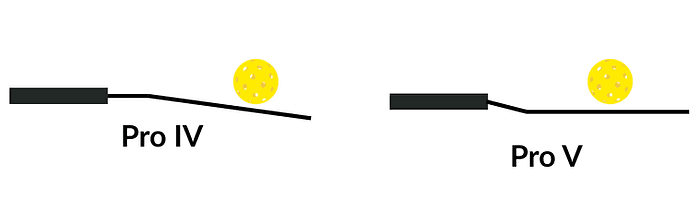
JOOLA's headline change is a patent-pending throat structure called the KineticFrame. Previous JOOLA paddles, including the Pro IV, flexed at the neck in what the company describes as a diving-board pattern — the head tips relative to the handle on contact, then springs back. The KineticFrame uses a different flex-point architecture designed to move the paddle head more parallel to its original position instead of pivoting it.
JOOLA Simone Jardin Perseus Pro V Breeze Blue 16mm Pickleball Paddle
$299.95
JOOLA Simone Jardim Perseus Pro V — Breeze Blue • 16mm The trusted Perseus shape, now in Simone Jardim’s Breeze Blue signature edition. Rounded top corners keep the sweet spot centered, while the elongated profile gives you extra reach—so you… read more

JOOLA's R&D team has said the idea came from kick-point engineering in golf shafts and hockey sticks, where when the shaft loads and unloads matters as much as how much it bends. The practical goal is a more consistent launch angle: the face stays truer through impact, so the same swing produces a more repeatable exit trajectory.
JOOLA Ben Johns Perseus Pro V Blaze Red 14mm Pickleball Paddle
$299.95
Also Available Perseus Pro V — 16mmMore dwell time, softer feel, and extra plow-through on drives. Better for all-court and reset-heavy play. View 16mm → JOOLA Ben Johns Perseus Pro V (Blaze Red) — 14mm Pickleball Paddle This is the… read more

What JOOLA deliberately did not change
This is the part most upgrade guides skip. Through 2026, much of the paddle market has moved toward full-foam cores. JOOLA didn't. The Pro V retains the same polypropylene Honeycomb Propulsion core and Hyper-Foam edge wall as the Pro IV, and it keeps the same peel-ply textured carbon fiber surface rather than adopting one of the longer-lasting grit textures other brands have introduced.
That's a defensible position — plenty of strong players still prefer polymer feedback to foam — but it means any JOOLA Pro V vs Pro IV decision is being made entirely on flex behavior, not on materials. If what you actually wanted was foam feel or grit that outlasts a season, the honest recommendation is to look outside the JOOLA lineup. Our guides to the best foam core pickleball paddles and the best durable grit pickleball paddles cover that ground.
One quiet durability change
JOOLA added a carbon fiber layer between the outer foam and the polymer core near the top of the paddle, aimed at improving compression strength in an
That's a defensible position — plenty of strong players still prefer polymer feedback to foam — but it means any JOOLA Pro V vs Pro IV decision is being made entirely on flex behavior, not on materials. If what you actually wanted was foam feel or grit that outlasts a season, the honest recommendation is to look outside the JOOLA lineup. Our guides to the best foam core pickleball paddles and the best durable grit pickleball paddles cover that ground.
area that has historically been a failure point on thermoformed paddles. It's a sensible fix. It is also too new to have long-term field evidence behind it, so treat it as a design improvement rather than a guarantee — core crushing has been declared solved before.JOOLA Pro V vs Pro IV specs side by side
Using the Ben Johns Perseus in both generations, since that's the most common upgrade path:
| Spec | Perseus Pro IV | Perseus Pro V |
|---|---|---|
| Core | Honeycomb Propulsion | Honeycomb Propulsion |
| Throat tech | TechFlex Power | KineticFrame |
| Face | Textured carbon fiber | Textured carbon fiber |
| Edge wall | Hyper-Foam | Hyper-Foam |
| Dimensions | 16.5" × 7.5" | 16.5" × 7.5" |
| Handle length | 5.5" | 5.5" |
| Weight (14 / 16mm) | 7.9 oz / 8.1 oz | 7.9 oz / 8.1 oz |
| Grip circumference | 4.125" (14mm), 4.25" (16mm) | 4.25" (Ben Johns), 4.125" (Simone Jardim) |
| Approvals | USAP, UPA-A | USAP, UPA-A |
Read that table again and notice how much is identical. Put plainly, the JOOLA Pro V vs Pro IV gap is not a new paddle versus an old one — it is the same chassis with one structural revision. That's the strongest argument both for and against upgrading, depending on which side of the launch-consistency problem you're on.
JOOLA Pro V vs Pro IV on court: how they actually play
The most consistent finding across independent reviews is this: the Pro V gives up easy power to gain predictability.
The Pro IV pops. Ball leaves quickly, counters happen almost by reflex, and you don't have to swing hard to hit hard. The tradeoff is the occasional shot that leaves faster than you intended — the drive you meant to land three feet inside the baseline that sails instead.
The Pro V asks for more deliberate activation. You have to swing to unlock the offense. In exchange, drives, drops and counters behave more uniformly across the face, and the surprise flyer shows up less often. Players who describe the Pro IV as "hot" tend to prefer the Pro V immediately. Players who describe the Pro IV as "effortless" tend to feel like the Pro V took something away.
Neither reaction is wrong. They're describing the same change from opposite sides, which is why most JOOLA Pro V vs Pro IV arguments never resolve — the two camps are answering different questions.
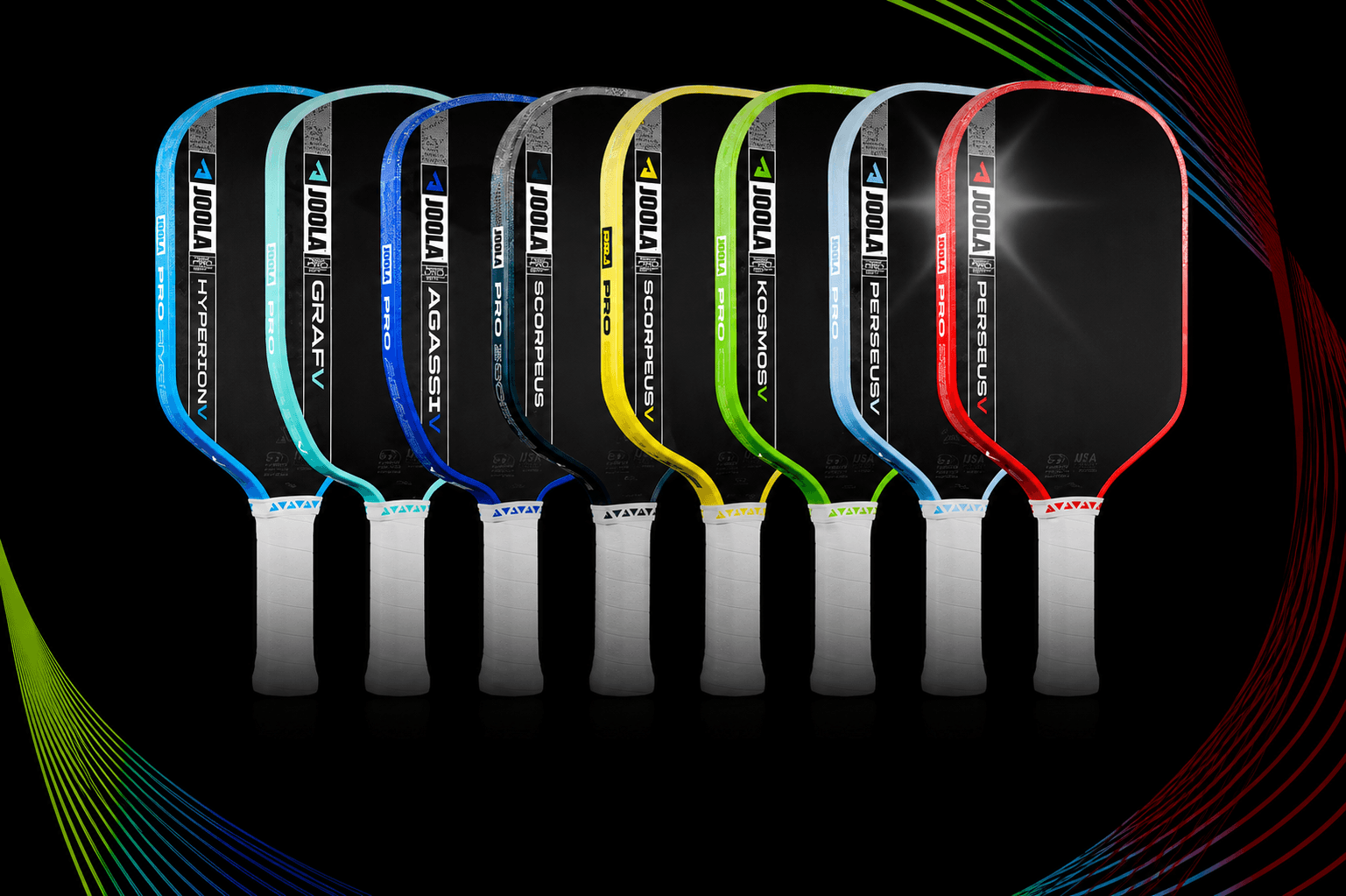
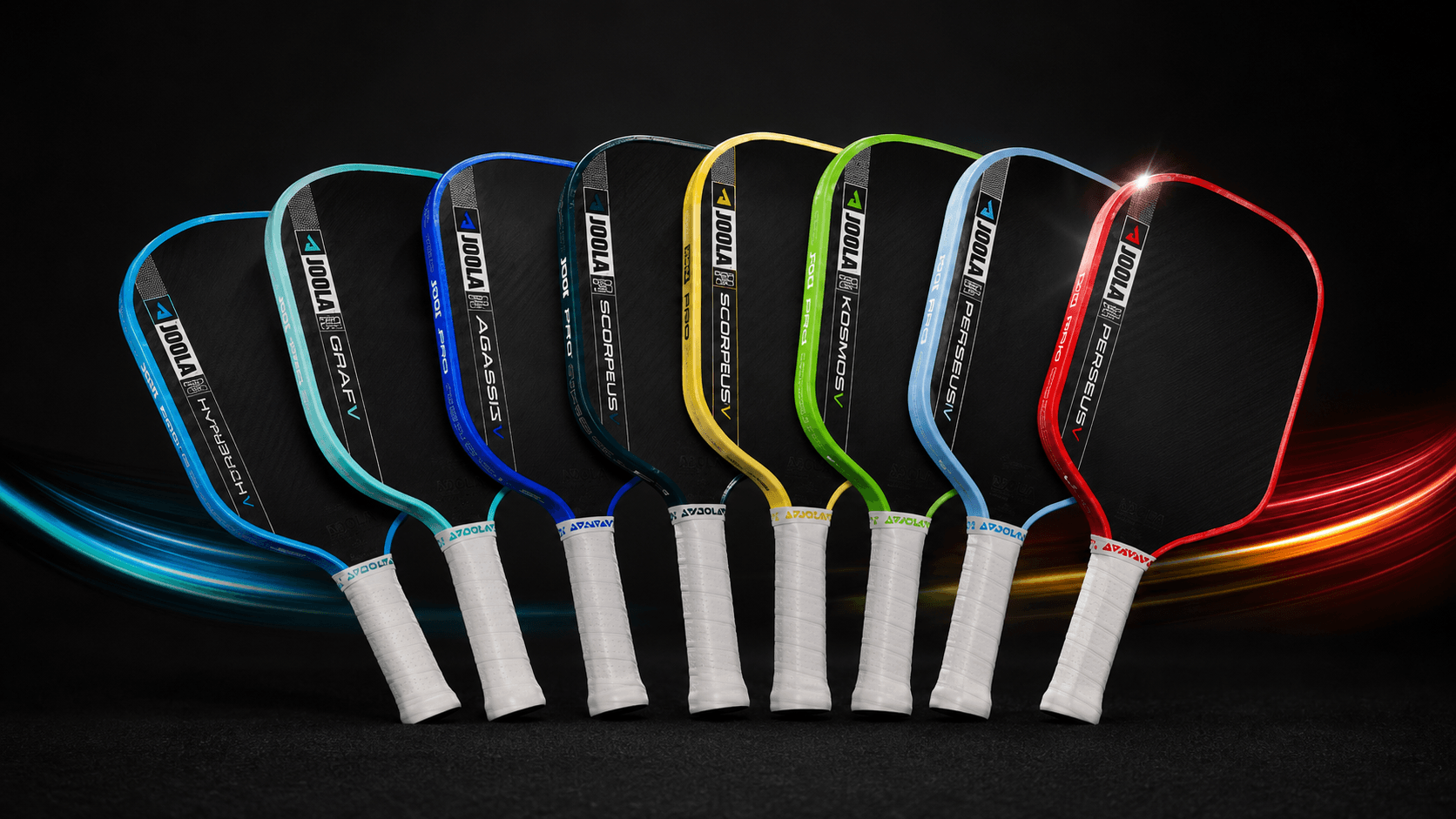
The Perseus Pro V 16mm in Blaze Red is Ben Johns' own configuration and the most direct upgrade for anyone currently on a Perseus Pro IV 16mm. Same elongated reach, same handle, same weight class — the difference you'll feel is in how the ball comes off, not how the paddle swings. It's the right pick if you're an aggressive baseline player who generates your own pace and wants tighter margins on drives. It is the wrong pick if you were hoping for more free power than your Pro IV already gives you.
If your complaint about the Perseus shape has always been the sweet spot, the Scorpeus Pro V is the wider, more forgiving frame in the same generation. Collin Johns built his defensive game around it. You trade some reach for stability on off-center contact, which pairs well with the Pro V's more predictable launch if resets and blocks are the part of your game you're trying to protect.
Who should upgrade to the Pro V
- You hit out more than you'd like. This is the single clearest signal. The Pro V exists to solve it.
- You have real swing speed. Tennis converts and 4.0+ players who accelerate through the ball will find the offense without hunting for it.
- You play a lot of singles or aggressive drive-heavy doubles where a consistent launch window matters more than free pop.
- Your Pro IV is nearing the end of its life anyway. If you're replacing rather than upgrading, buy the current generation.
Who should keep the Pro IV
- Nothing is wrong with your paddle. "Newer" is not a performance problem. If your Pro IV isn't producing errors you can trace to the paddle, that fifty dollars buys nothing.
- You're still developing swing speed. Under roughly 3.5, the Pro IV's easier power is genuinely useful. The Pro V will feel like it went quiet.
- You wanted foam or better grit. The Pro V is neither. Look elsewhere.
- You're price-sensitive. Pro IV pricing has settled well below launch, and several shapes are now the better value buy in our JOOLA pickleball paddles range.
Worth being direct here: the Perseus Pro IV 16mm is still an excellent paddle and now sits meaningfully below Pro V pricing. For an intermediate player buying their first premium elongated paddle — as opposed to a Pro IV owner weighing a switch — this is frequently the smarter purchase. The launch inconsistency that motivated the Pro V redesign is a problem that mostly shows up at higher swing speeds.
What the JOOLA Pro V vs Pro IV price gap actually buys
As of publication, the Pro V lineup sits at $299.95 and most Pro IV shapes run between roughly $170 and $250 depending on model and colorway. Prices and availability move, so check the current listing before you commit.
So you're paying somewhere around a fifty-to-hundred-dollar premium for one structural revision. Framed that way it sounds thin, and for a lot of players it is. But there's a third option most upgrade guides don't mention, because most sites publishing them don't sell used paddles.
A Certified Pre-Owned Pro V typically lands below the price of a new Pro IV. Every paddle in our Certified Pre-Owned collection is cleaned, inspected for cracks and delamination, and assigned a condition grade before it's listed. If you're curious about the KineticFrame but not convinced it's worth full retail, that's the low-risk way to settle the JOOLA Pro V vs Pro IV question for yourself. Stock is one-of-one and rotates constantly.
JOOLA Ben Johns Perseus Pro IV 16mm Pickleball Paddle
$149.95
Also Available Perseus Pro IV — 14mmSnappier feel, more pop on counters, and a lighter swing. Better for fast hands and aggressive net play. View 14mm → The JOOLA Ben Johns Perseus Pro IV 16mm Pickleball Paddle takes performance to… read more

Matching your shape across generations
If you do upgrade, stay in your shape family. The Pro V changes how the paddle loads and releases; changing shape at the same time makes it impossible to tell which variable caused what.
| If you play | Upgrade to | Why |
|---|---|---|
| Perseus Pro IV | Perseus Pro V | Elongated reach, most direct comparison |
| Scorpeus Pro IV | Scorpeus Pro V | Widebody, largest sweet spot |
| Agassi Pro IV | Agassi Pro V | Elongated, tennis-convert friendly |
| Hyperion / Magnus Pro IV | Kosmos Pro V | Hybrid split between reach and control |
Also check your grip circumference before ordering. In the Pro V line, the Ben Johns and Simone Jardim Perseus models differ mainly by handle thickness — 4.25" versus 4.125" — and that's the kind of detail that makes a new paddle feel wrong for reasons you can't name. Our paddle fitting tool walks through it, and for a deeper look at the full range there's our JOOLA Pro V paddle guide.
Settle the JOOLA Pro V vs Pro IV question on court
This is a comparison where reading has limits. The difference lives in how the ball leaves the face, and no article can put that in your hand. Hit ten drives with each and you'll know within a session which one your game wants.
We keep both generations available to demo at our Long Island locations, and you can bring your current Pro IV to compare directly against a Pro V rather than guessing from memory. If you'd rather narrow it down first, the Spinwave paddle fitting tool will get you to two or three candidates in a few minutes.
FAQs
Is the JOOLA Pro V more powerful than the Pro IV?
Not in the way most players mean. The Pro IV produces easier, more immediate power at lower swing speeds. The Pro V can generate comparable pace, but you have to swing for it. If raw effortless pop is the metric, the Pro IV wins.
Is the JOOLA Pro V worth $300?
It depends on whether launch consistency is a problem you actually have. For a player who regularly hits long on drives and counters, the KineticFrame addresses a real fault and the price is justifiable. For a player who is happy with their Pro IV, it isn't.
Does the JOOLA Pro V have a foam core?
No. JOOLA kept the polypropylene Honeycomb Propulsion core and Hyper-Foam edge wall from the Pro IV rather than moving to a full-foam construction. This was a deliberate choice: JOOLA has said it believes polymer delivers better feedback for its players.
Is the JOOLA Pro V more durable than the Pro IV?
JOOLA added internal carbon reinforcement near the top of the paddle to improve compression strength in a known weak area. That is a real design change, but the paddle is too new for meaningful long-term durability data. Judge it on play, not on durability promises.
Are both the JOOLA Pro V and Pro IV tournament legal?
Both lines carry USAP and UPA-A approval. Approvals can change, so verify your specific model against the USA Pickleball approved equipment database before a sanctioned event.
Should I buy a used JOOLA Pro V instead of a new Pro IV?
It is a legitimate option and often the better one. A Certified Pre-Owned Pro V in Mint or Excellent condition frequently costs less than a new Pro IV, which lets you try the current generation without paying current-generation retail. The tradeoff is that used inventory is single-unit and unpredictable.
Will I notice the difference between the Pro V and Pro IV right away?
Most players notice something in the first session, but not necessarily as an improvement. The Pro V often reads as quieter at first because it isn't handing out free pop. Give it a few sessions of drives and counters before deciding, which is exactly what the demo program is for.
What is the KineticFrame on the JOOLA Pro V?
The KineticFrame is a patent-pending throat structure that replaces the TechFlex Power throat used on the Pro IV. Previous JOOLA paddles flexed at the neck in a diving-board pattern, tipping the head relative to the handle on contact. The KineticFrame uses a different flex-point architecture that moves the paddle head more parallel to its original position, so the face stays truer through impact and the same swing produces a more repeatable launch angle.