
Table of Contents
- Quick Verdict
- How We Evaluate Paddles
- What Changed From the Original Coral
- Six Zero Coral Pro Specs
- The Double Diamond Tough Surface, Explained
- Spin Durability in Context
- How the Coral Pro Plays
- Which Shape Should You Buy?
- The Certification Problem
- Customizing and Weighting the Coral Pro
- Coral Pro vs Our Other Q3 Top Picks
- Coral Pro vs Coral: Is the Upgrade Worth It?
- Who Should Buy It
- Who Should Skip It
- Related Spinwave Links
- The Complaints Worth Taking Seriously
- Final Verdict
- FAQs
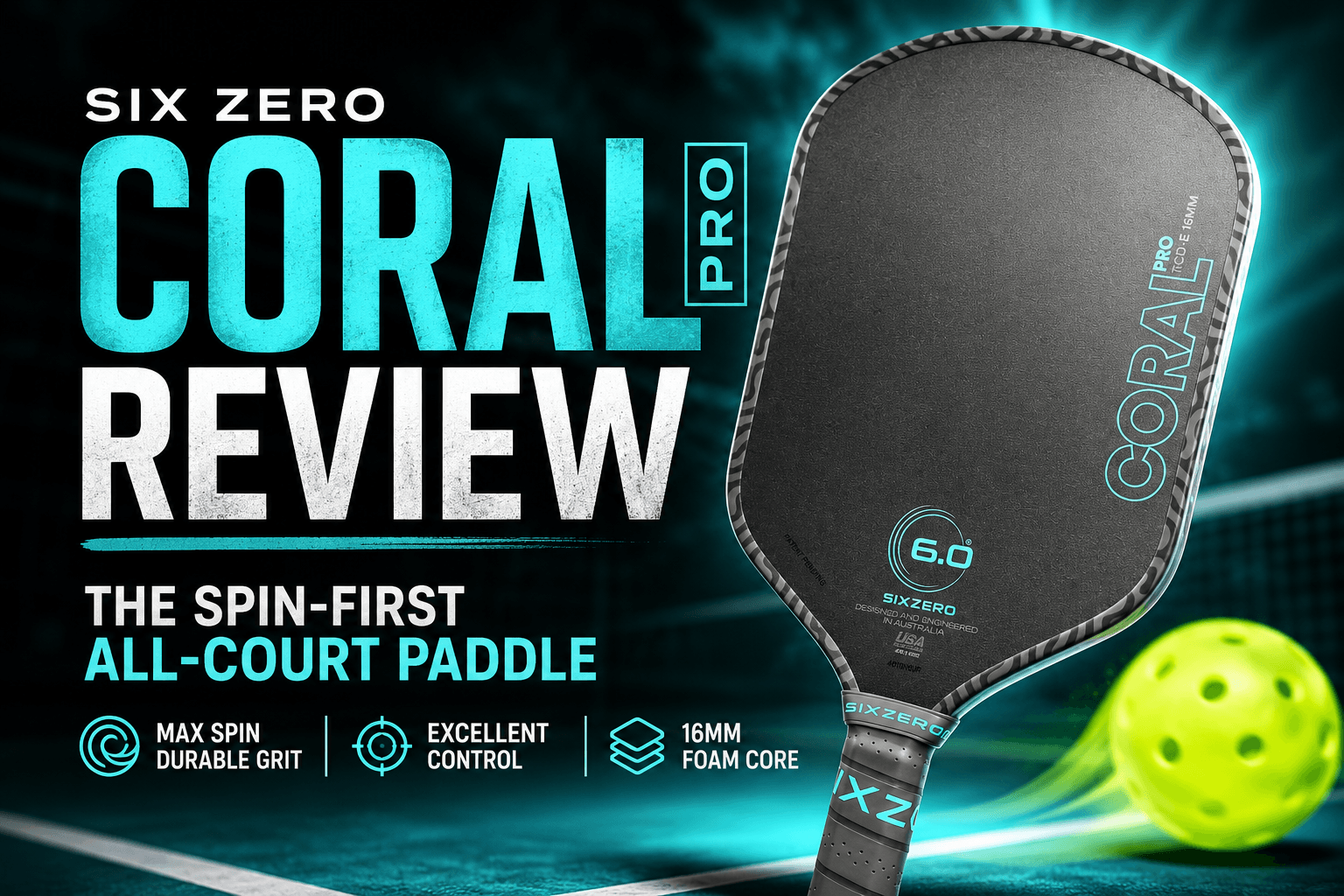
This Six Zero Coral Pro review covers a $220, 16mm all-court paddle built around a single idea: a rougher carbon face that keeps its bite long after a normal raw carbon surface has gone slick. Everything else about the paddle is inherited. The face is the upgrade.
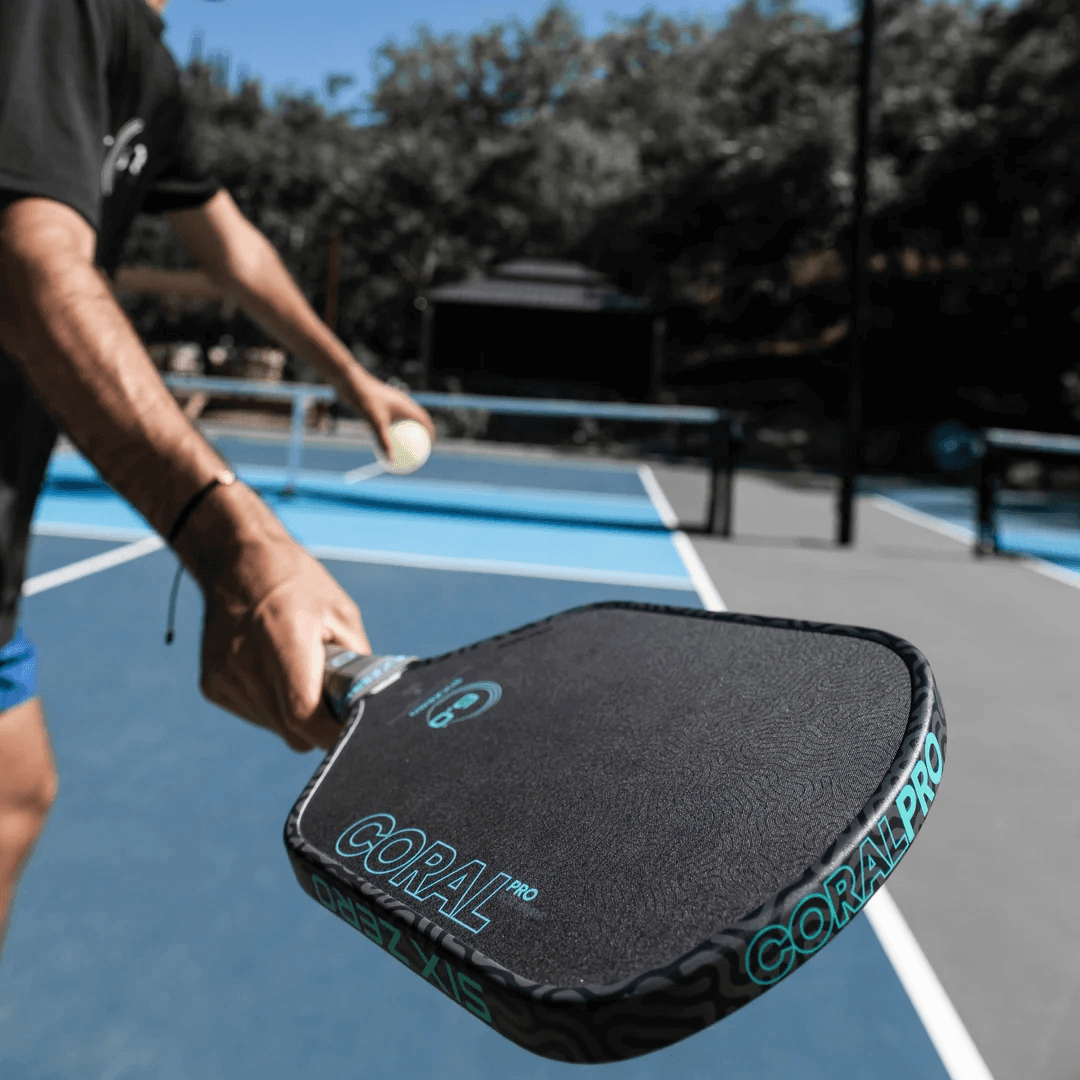
It won Best All-Court in our Q3 2026 paddle rankings, and the short version is this: it is a spin-first paddle with real touch, not a power bat. If your game runs through rolls, dipping drives and heavy serves, it is an easy recommendation. If you want free power off the bounce, there are better options and we will name them.
Quick Verdict
Buy it if: you shape the ball for a living, you are tired of replacing paddles when the grit fades, and you want a paddle that stays composed on resets while still letting you attack.
The rest of this Six Zero Coral Pro review breaks down each of those points.
Skip it if: you need the paddle to generate pace for you, you prefer a plush and muted feel, or you play USA Pickleball sanctioned tournaments. That last one is not a minor footnote — see the certification section below.
Shape to pick if you are unsure: the Hybrid. It is the most balanced of the three and the one Six Zero themselves point new buyers toward.
How We Evaluate Paddles
Most paddle coverage restates the manufacturer's press release. This Six Zero Coral Pro review is built on the same criteria we apply across our rankings: verified swing weight and twist weight rather than static weight alone, measured spin output rather than marketing adjectives, how long the face texture survives real play, certification status for the events you actually enter, and price-to-performance against what else is on the shelf at that number.
The last criterion matters more than any single spec. A paddle that sells well once is interesting. A paddle players buy again when the first one wears out is the one worth writing about, and durable-grit paddles like this one are specifically designed to change that second number.
What Changed From the Original Coral
Every Six Zero Coral Pro review has to start here, because the upgrade is narrower than the name suggests. The original Coral spent a year as one of the easiest paddles in the sport to recommend. It was balanced, forgiving, held its spin better than most raw carbon, and did not have an obvious weakness. What it started to lack was a top-tier spin number, as brands like Honolulu and 11SIX24 pushed durable grit technology forward.
The Coral Pro is Six Zero's answer, and it is a narrow one. The Tectonic Core Suspension System is unchanged. The Pro Pulsion foam core is unchanged. The three shapes are unchanged. What changed is the face: the Double Diamond Tough surface packs roughly twice the diamond infusion into the texture layer, producing about 2.5 times the texture and, per Six Zero, up to eight times the durability of standard raw carbon fiber.
Six Zero's own testing puts spin output around 2,481 RPM, roughly a ten percent jump over the original Coral. Independent reviewers have consistently placed it in elite-spin territory alongside paddles costing well north of $300.
The knock-on effect worth knowing before you buy: the Coral Pro plays firmer than the original. Not harsh, but noticeably stiffer at contact. If you bought the original Coral specifically because it was plush, this is a different paddle wearing the same name.
Six Zero Coral Pro Specs
Here are the verified numbers behind this Six Zero Coral Pro review, laid out by shape. All three share the same 16mm Tectonic Core, the same Pro Pulsion foam, and the same 300K Japanese Toray carbon face with Double Diamond Tough texture. Only the geometry changes — and it changes more than the marketing suggests.
| Spec | Hybrid | Widebody | Elongated |
|---|---|---|---|
| Length | 16.3" | Shortest of the three | 16.5" |
| Width | 7.5 – 7.7" | Widest of the three | 7.3 – 7.5" |
| Swing Weight | 114 | Lowest | 117 |
| Twist Weight | 6.70 | 7.10 | 5.90 |
| Handle Length | 5.5" | 5.5" | 5.75" |
| Weight | 8.0 – 8.3 oz | 8.0 – 8.3 oz | 8.0 – 8.3 oz |
| Core | 16mm Tectonic Core Suspension System with Pro Pulsion Foam | ||
| Face | 300K Japanese Toray Carbon, Double Diamond Tough™ | ||
| Certification | UPA-A approved. Not on the USA Pickleball approved list. | ||
| Price | $220 | ||
The twist weight spread is the number to look at. A 7.10 on the Widebody against a 5.90 on the Elongated is a genuinely large gap in stability on off-center contact. These are not cosmetic shape variants.
The Double Diamond Tough Surface, Explained
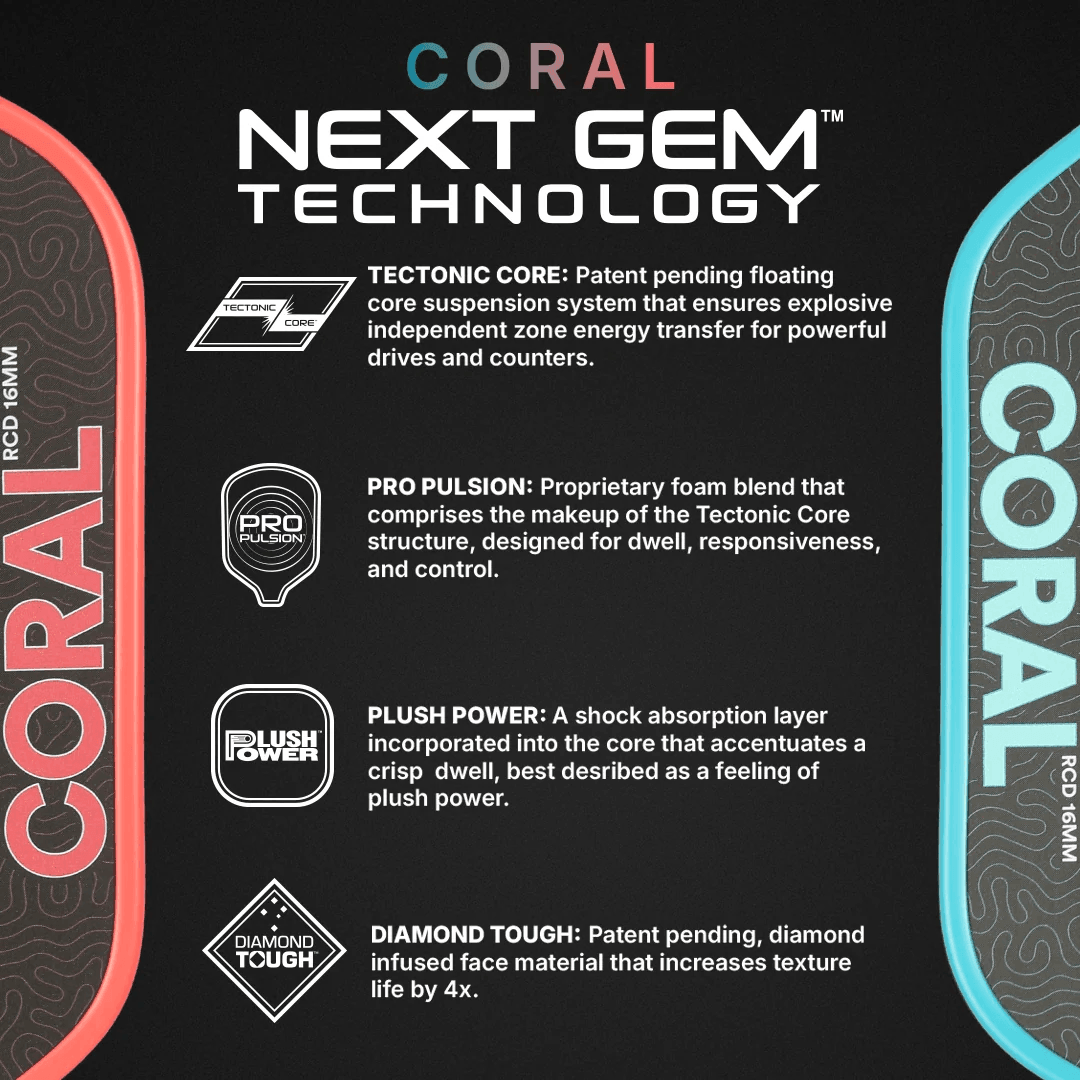
Most of what people call spin is two things working together: how much the face grabs the ball, and how long the ball stays on the face. Texture handles the first. Dwell time handles the second. The Coral Pro pushes hard on texture while the Tectonic Core and Pro Pulsion foam handle dwell, which is why it produces heavy shape without feeling like a trampoline.
The part that matters for your wallet is longevity. A sprayed or coated texture wears smooth relatively quickly, and your spin drops with it — which is how most paddles actually die. Diamond-infused and mechanically interlocked surfaces hold their bite considerably longer. That is the entire argument for spending $220 here instead of $150 somewhere else, and it is the same argument behind Honolulu's Blue Grit and 11SIX24's HexGrit.
Any Six Zero Coral Pro review that treats the spin number in isolation is missing the point. Day-one spin is easy to buy. Month-eight spin is not.
Spin Durability in Context
Durable grit went from a marketing term to a real spec category this year, and the Coral Pro is competing in a crowded field. Honolulu's Crystal Blue Endurance mechanically locks crystal media into the surface. 11SIX24's HexGrit embeds silicon carbide, one of the hardest substances available outside of actual diamond. Six Zero's Double Diamond Tough doubles the diamond infusion in an already diamond-textured carbon face.
All three approaches solve the same problem from different directions, and the honest position for this Six Zero Coral Pro review is that the long-term separation between them is still being established. Independent accelerated-wear testing has shown durable surfaces losing roughly half the spin that traditional raw carbon loses over the same number of impacts. That is a meaningful gap, but it is not the same as a face that never wears.
What you are actually buying is a longer useful life, not a permanent one. For a player who replaces a paddle every eight to ten months because the spin went flat, that shift is worth more than the twenty dollars separating this from the original Coral.
How the Coral Pro Plays
Spin
This is the part of the Six Zero Coral Pro review where the spin claim either holds up or it does not, and it holds up. Serves dip, roll volleys grip and drop, and dinks can be shaped low and short rather than floated. The practical difference over the original Coral shows up most on shots where you are trying to do something specific with the ball rather than just get it back — topspin serves that land deep and jump, and third-shot drives that clear the net and still land in.
Control and Touch
The Tectonic Core suspension keeps soft shots predictable, which is the reason this paddle is our all-court pick rather than a pure spin pick. Resets do not fly. Drops behave. The caveat is the firmer contact feel — you get more feedback than the original Coral gave you, and if you are coming off something genuinely plush, expect a session or two of recalibration on touch shots.
Power
Modest, and that is deliberate. The Coral Pro sits in the upper-middle of the power range, not the elite tier. It rewards players who generate their own pace and shape the ball, and it will frustrate anyone hoping the paddle does the work. If you want a paddle in this price range that hits genuinely hard, look at the power paddle category instead.
Which Shape Should You Buy?
The most useful part of any Six Zero Coral Pro review is the shape decision, because the three versions play meaningfully differently.
- Hybrid (114 SW / 6.70 TW) — the default. Balanced reach, balanced forgiveness, quick enough at the kitchen. If you do not have a strong shape preference, take this one and stop researching.
- Widebody (7.10 TW) — the most forgiving paddle in the line and the fastest in hand. Best for net-first doubles players, players still developing consistent contact, and anyone who loses more points to mishits than to being out of reach.
- Elongated (117 SW / 5.90 TW) — the most demanding. You get reach and baseline leverage, and you pay for it with the smallest margin for error on the face. Best for tennis converts and singles players with clean mechanics.
One honest note: at a 5.90 twist weight, the Elongated is meaningfully less stable than the other two. If you mishit even occasionally, that number will show up in your results before the extra reach does.
The Certification Problem
Read this before you buy. The Coral Pro is UPA-A approved. It is not on the USA Pickleball approved list. If your events are USAP sanctioned, this paddle is not eligible, and no amount of spin performance changes that. For rec play, leagues, club ladders and PPA-governed events, it is cleared and it is not an issue.
This is the single most common reason someone returns a Coral Pro, and it is entirely avoidable. Check which body sanctions your events before you order. If you need a paddle that clears everything, the AIREO Cyclone 2.0 carries both approvals plus PBCoR .43 certification.
Customizing and Weighting the Coral Pro
All three shapes arrive in the 8.0 to 8.3 ounce range, which leaves room to tune. This is worth covering in a Six Zero Coral Pro review because the shape you buy determines what customization actually helps.
On the Elongated, the 5.90 twist weight is the weakness. Lead or tungsten tape at the 3 and 9 o'clock positions raises twist weight directly and buys back stability on off-center contact. Start with two to three grams per side before adding more.
On the Hybrid, weight at 3 and 9 adds stability without much swing weight penalty. Weight at the throat adds plow-through on drives while keeping hand speed. Most players leave the Hybrid alone, which is part of why it is the default pick.
On the Widebody, adding weight is usually a mistake. The 7.10 twist weight is already the most stable in the line, and the whole reason to buy this shape is hand speed. Weighting it down undoes the purchase.
One caution across all three: added weight changes how the Pro Pulsion core releases the ball. Add in small increments and play a full session between changes rather than building a setup in one sitting.
Coral Pro vs Our Other Q3 Top Picks
The Coral Pro does not exist in a vacuum, and at $220 it sits in the most competitive price band in the sport. Here is how this Six Zero Coral Pro review places it against the other paddles that won categories in our Q3 rankings.
| Paddle | Price | Where it beats the Coral Pro | Where the Coral Pro wins |
|---|---|---|---|
| Honolulu J2CR Crystal Blue | $195 | Cheaper, higher twist weight at 7.0, quicker through the stroke | Broader shape choice and a more composed soft game |
| 11SIX24 Vapor Power 2 | $209.99 | Lighter swing weight and cheaper | More forgiving platform and better touch on resets |
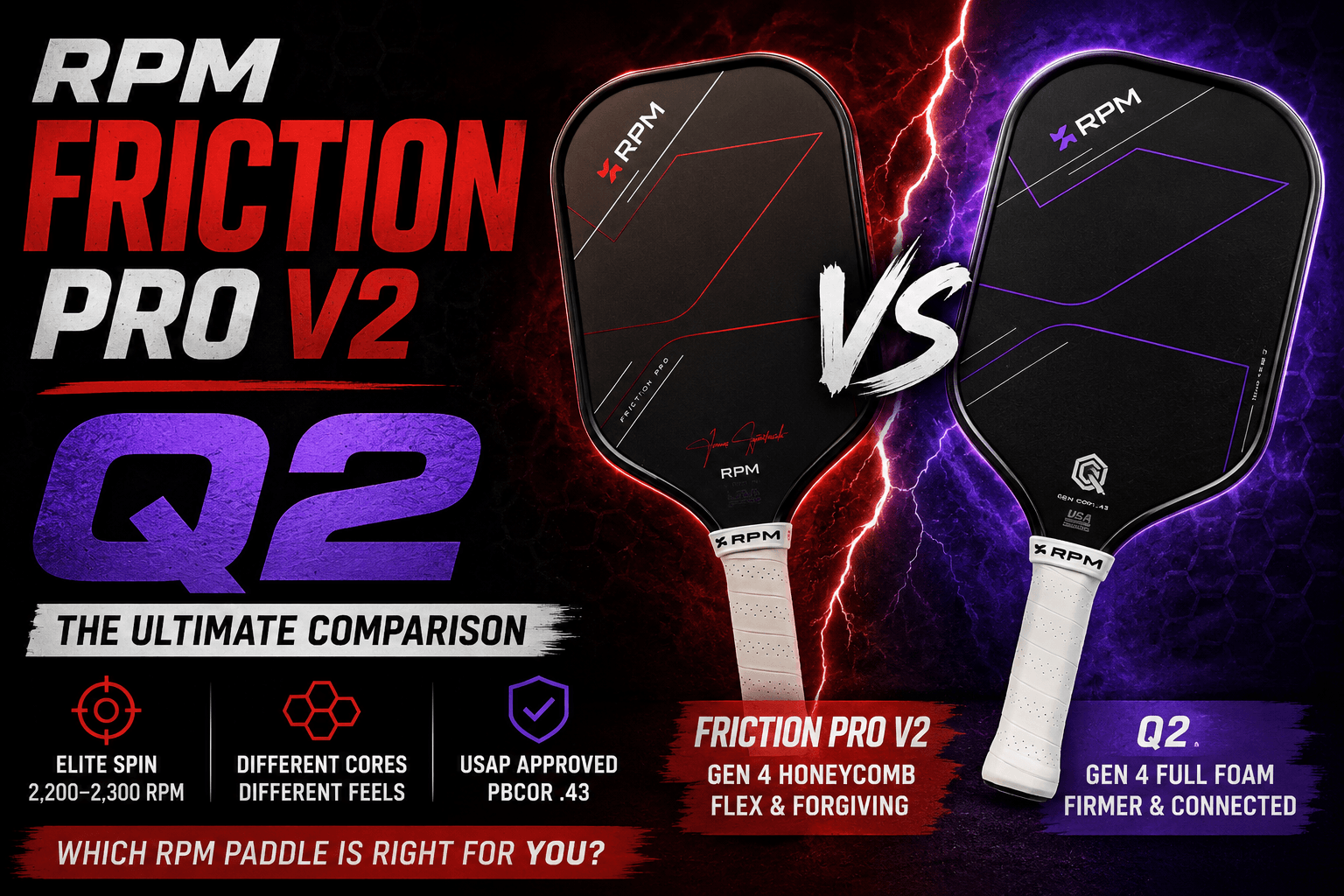
| RPM Q2 Widebody | $249.99 | Noticeably more raw power and pop | Cheaper, and far more controlled in the short game |
The pattern is consistent. The Coral Pro is rarely the most powerful or the cheapest option in a given comparison, but it is the one that gives up the least in the soft game. That is the whole case for it as an all-court paddle rather than a specialist.
Worth noting: the J2CR and the Vapor Power 2 both carry the same certification caveat, so switching to either does not solve the USAP problem. The AIREO Cyclone 2.0 at $199 is the pick if approval across every sanctioning body is non-negotiable.
Coral Pro vs Coral: Is the Upgrade Worth It?
The original Coral sits at $200 and the Coral Pro at $220. Twenty dollars is not the real decision — feel is.
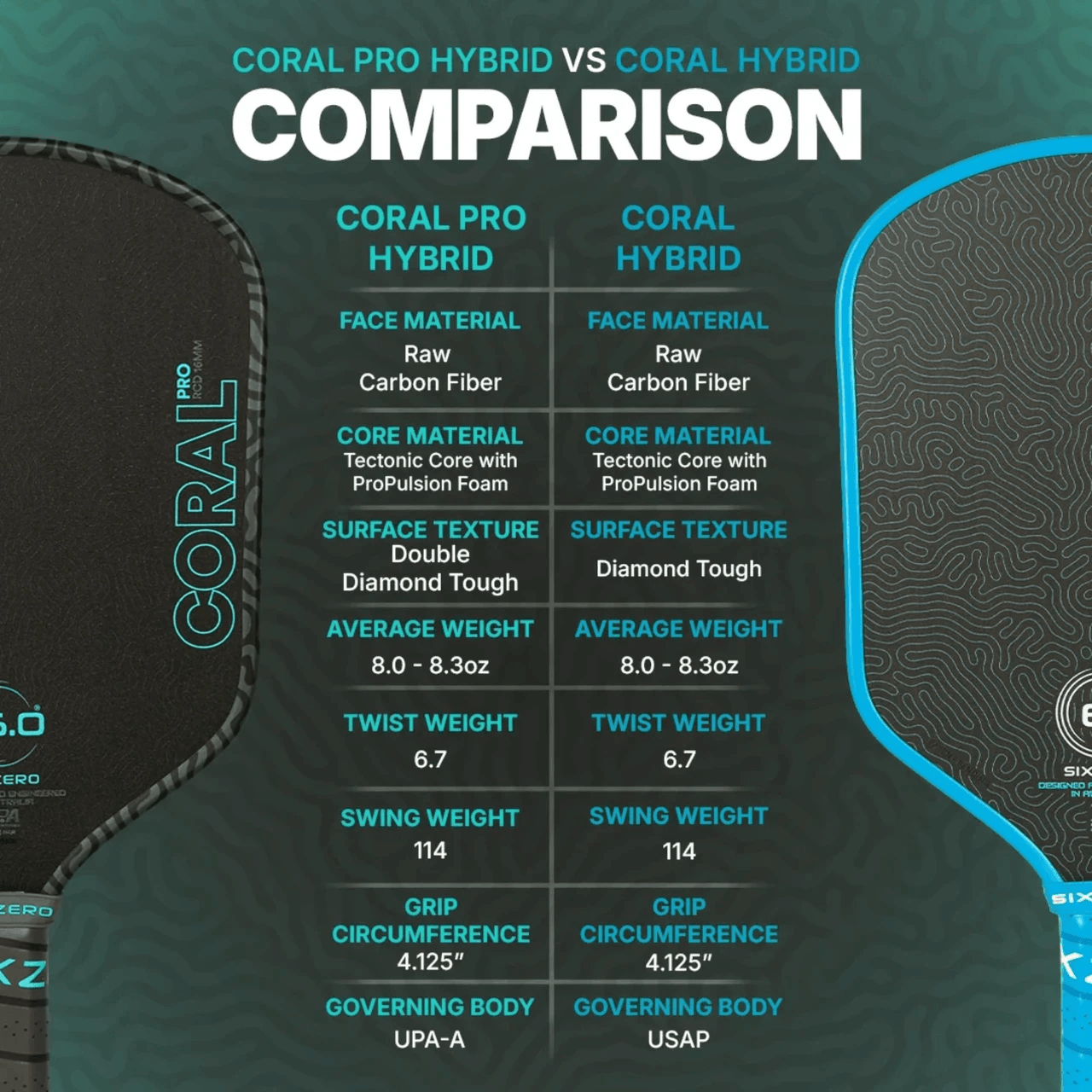
Take the Coral Pro if spin is how you win points, if you want the texture to last, and if you are comfortable with a firmer, more connected response.
Take the original Coral if you loved the plush, cushioned feel, if you play USAP sanctioned events, or if you are more of a placement-and-consistency player than a shape-the-ball player. It is still an excellent paddle and it did not get worse when the Pro launched.
Who Should Buy It
The takeaway from this Six Zero Coral Pro review, sorted by player type:
- Intermediate to advanced all-court players, roughly 3.5 and up
- Spin-first players who win with rolls, dipping drives and heavy serves
- Anyone who has burned through raw carbon faces and is tired of buying spin twice
- Players who want a paddle that stays composed on resets while still allowing offense
Six Zero Coral Pro 16mm Pickleball Paddle
$220.00
The Six Zero Coral Pro takes the award-winning Coral platform and turns the spin dial all the way up. With the new Double Diamond Tough™ surface — 2X the diamonds, 2.5X the texture, and 8X the durability of standard raw carbon… read more

Who Should Skip It
Equally, this Six Zero Coral Pro review is a clear no for the following players:
- USA Pickleball tournament players — full stop
- Players who need the paddle to supply the power
- Anyone who specifically wants a soft, muted, plush contact feel
- Beginners still learning where the middle of the face is — a control paddle will serve you better first
Related Spinwave Links
- Shop all Six Zero paddles
- Read our Q3 2026 best pickleball paddles rankings
- Read our best foam core pickleball paddles guide
- Read our Honolulu J2CR Crystal Blue review
- Read JOOLA Pro V Kosmos vs Six Zero Coral
- Shop all-court pickleball paddles
- Shop Spinwave Certified Pre-Owned paddles
- Get a free paddle consultation
The Complaints Worth Taking Seriously
No Six Zero Coral Pro review is complete without the objections, and three come up repeatedly.
It is stiffer than people expect. Buyers coming from the original Coral report the firmer contact as the biggest adjustment. It is not harsh, but if plush was the reason you bought the first one, this is a different feel.
The Elongated is demanding. A 5.90 twist weight in a shape that already asks for clean contact produces more mishit punishment than the marketing implies. It is the one shape we would not recommend blind.
The certification gap. It is the number one reason a Coral Pro comes back, and it has nothing to do with how the paddle plays.
Final Verdict
The conclusion of this Six Zero Coral Pro review is that Six Zero solved the one thing the original Coral was starting to lose on, and did not break anything else in the process. You get elite, durable spin on a platform that was already balanced and forgiving, at $220 rather than the $300-plus the comparable spin paddles ask.
The two things that will decide it for you are not performance questions. They are whether you can live without USA Pickleball certification, and whether you want a firmer feel than the original Coral gave you. Answer those honestly and the rest of the decision is easy.
Every paddle we sell comes with a 30-day play-test guarantee, so you can take one on court and send it back if it is not right. If you would rather talk it through first, visit us in Great Neck or at the Long Beach Tennis Center pro shop, call 1-888-629-1915, or book a free paddle consultation online.
FAQs
Is the Six Zero Coral Pro USA Pickleball approved?
No. The Coral Pro is UPA-A approved but it is not on the USA Pickleball approved list, so it is not eligible for USAP sanctioned tournaments. It is cleared for rec play, leagues, club ladders and PPA-governed events. If you need a paddle that clears every sanctioning body, the AIREO Cyclone 2.0 at $199 carries both approvals plus PBCoR .43 certification.
Which Coral Pro shape should I buy: Hybrid, Widebody or Elongated?
The Hybrid is the default pick at 114 swing weight and 6.70 twist weight, with balanced reach and forgiveness. The Widebody is the most forgiving and the fastest in hand at 7.10 twist weight, best for net-first doubles. The Elongated gives reach and baseline leverage at 117 swing weight, but its 5.90 twist weight punishes mishits. If you are unsure, take the Hybrid.
How much spin does the Six Zero Coral Pro generate?
Six Zero's own testing puts spin output around 2,481 RPM, roughly a ten percent jump over the original Coral. That is elite-spin territory, alongside paddles costing well north of $300. The Double Diamond Tough face packs about twice the diamond infusion of the original, producing roughly 2.5 times the texture.
Does the Coral Pro's grit actually last longer than raw carbon?
Longer, yes. Permanent, no. Six Zero claims up to eight times the durability of standard raw carbon fiber, and independent accelerated-wear testing has shown durable surfaces losing roughly half the spin that traditional raw carbon loses over the same number of impacts. What you are buying is a longer useful life, not a face that never wears.
Is the Coral Pro worth upgrading from the original Six Zero Coral?
The original Coral is $200 and the Coral Pro is $220, so twenty dollars is not the real decision. Feel is. Take the Coral Pro if spin is how you win points, you want the texture to last, and you are comfortable with a firmer, more connected response. Stay on the original Coral if you loved the plush, cushioned feel or you play USAP sanctioned events.
Is the Six Zero Coral Pro a power paddle?
No, and that is deliberate. Power sits in the upper-middle of the range, not the elite tier. The Coral Pro rewards players who generate their own pace and shape the ball, and it will frustrate anyone hoping the paddle does the work. If you want a paddle in this price range that hits genuinely hard, shop the power category instead.
What skill level is the Six Zero Coral Pro best for?
Intermediate to advanced all-court players, roughly 3.5 and up, and especially spin-first players who win with rolls, dipping drives and heavy serves. Beginners still learning where the middle of the face is will get more out of a control paddle first.
Should I add lead tape to the Six Zero Coral Pro?
Mostly on the Elongated, where two to three grams of lead or tungsten tape at 3 and 9 o'clock raises twist weight and buys back stability on off-center contact. The Hybrid is fine as it comes for most players, and weighting the Widebody undoes the hand speed you bought it for. Add weight in small increments and play a full session between changes.