
Table of Contents
- Quick picks: the best foam core pickleball paddles right now
- What actually counts as a foam core pickleball paddle?
- Full foam vs foam perimeter: which construction fits your game
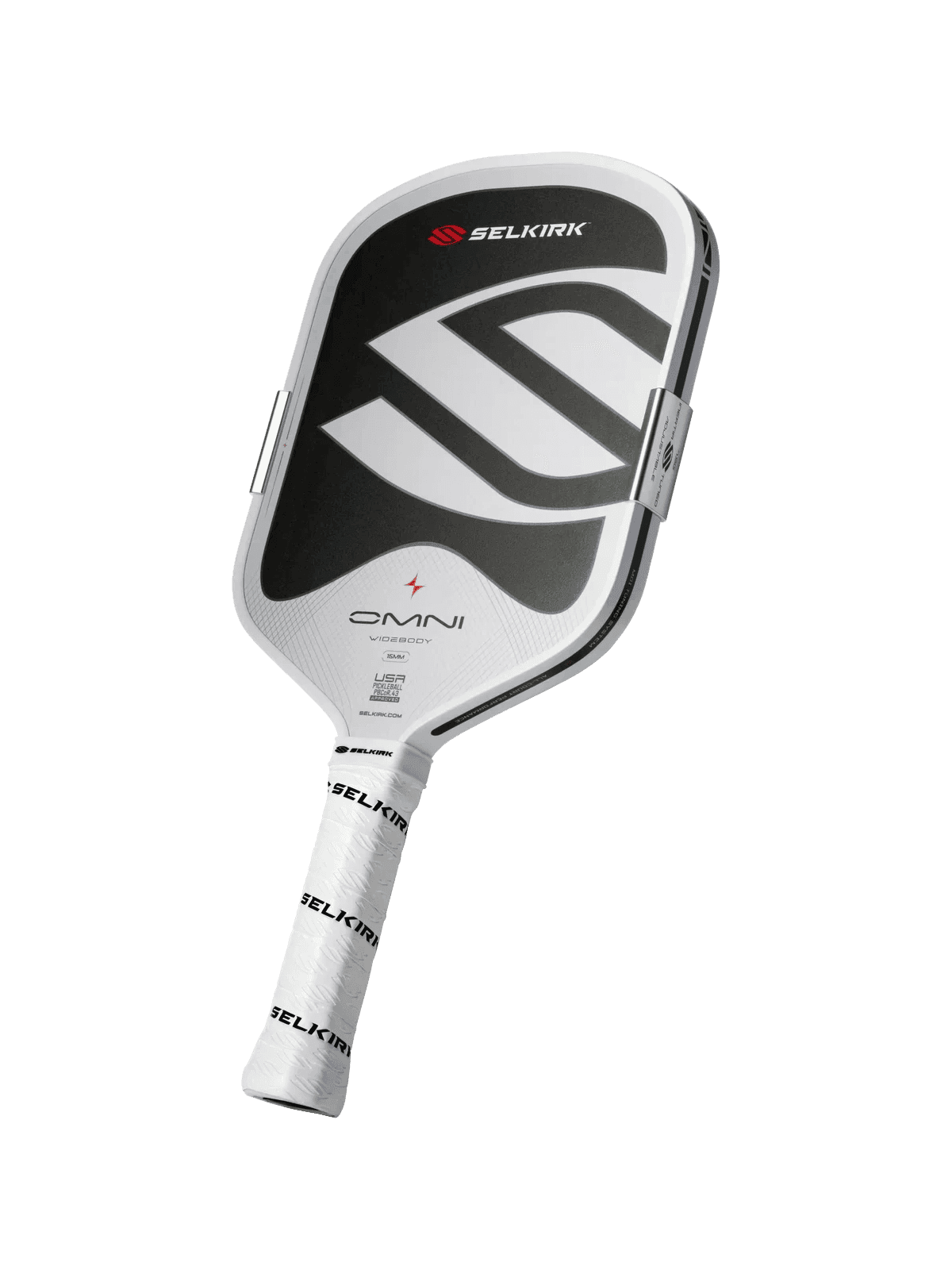
- Best overall foam core pickleball paddle: Selkirk OMNI
- Best foam core pickleball paddle for power: CRBN⁴ TruFoam Barrage
- Best foam core pickleball paddle for control: Gherkin USA DRACO 16mm
- Best value: Honolulu Sword & Shield J2CR and J6CR
- Best foam core pickleball paddle under $150: Bread & Butter LOCO Elongated
- Foam durability and break-in: what to actually expect
- Are foam core pickleball paddles tournament legal?
- Who should avoid foam core pickleball paddles?
- How we ranked these foam core pickleball paddles
- How to choose between the best foam core pickleball paddles
- FAQs
The best foam core pickleball paddles of 2026 are the Selkirk OMNI for all-court play, the CRBN⁴ TruFoam Barrage for power, the Gherkin USA DRACO 16mm Widebody for control, and the Bread & Butter LOCO Elongated if you want in under $150. Those are the short answers. The longer answer matters more, because "foam core" has quietly become the most abused phrase in paddle marketing.
Three completely different constructions are getting sold under the same label right now. A paddle with a 100% foam core plays nothing like a honeycomb paddle with foam injected around the rim, and neither plays like Selkirk's floating-foam design. Most 2026 buying guides lump all of them together, which is how people end up spending $300 on a paddle that does the opposite of what they wanted. The result is a category where the best foam core pickleball paddles for one player are actively the wrong answer for another.
Every one of the foam core pickleball paddles below is something we actually stock at our Great Neck and Long Beach shops, with real prices and real availability — not a link farm of paddles nobody can buy.
Quick picks: the best foam core pickleball paddles right now
| Paddle | Construction | Best for | Price |
|---|---|---|---|
| Selkirk OMNI | Foam perimeter + floating foam core (ReactCore™) | Best overall / all-court | $300 |
| CRBN⁴ TruFoam Barrage | 100% foam core | Best for power | $280 |
| Gherkin USA DRACO 16mm Widebody | 100% foam core | Best for control | $179.99 |
| Honolulu Sword & Shield J2CR | 100% foam core (Core Reactor™) | Best value under $200 | $195 |
| Bread & Butter LOCO Elongated | Foam core, 16mm | Best under $150 | $149.95 |
| Selkirk LABS Project Boomstik | Foam core power platform | No-ceiling power | $333 |
Prices and stock move. If something below is sold out by the time you read this, the full Spinwave paddle collection is the live source of truth. Six paddles, five categories. If you want the headline: the best foam core pickleball paddles of 2026 split cleanly by construction, and which one is right depends almost entirely on whether you value consistency or maneuverability.
What actually counts as a foam core pickleball paddle?
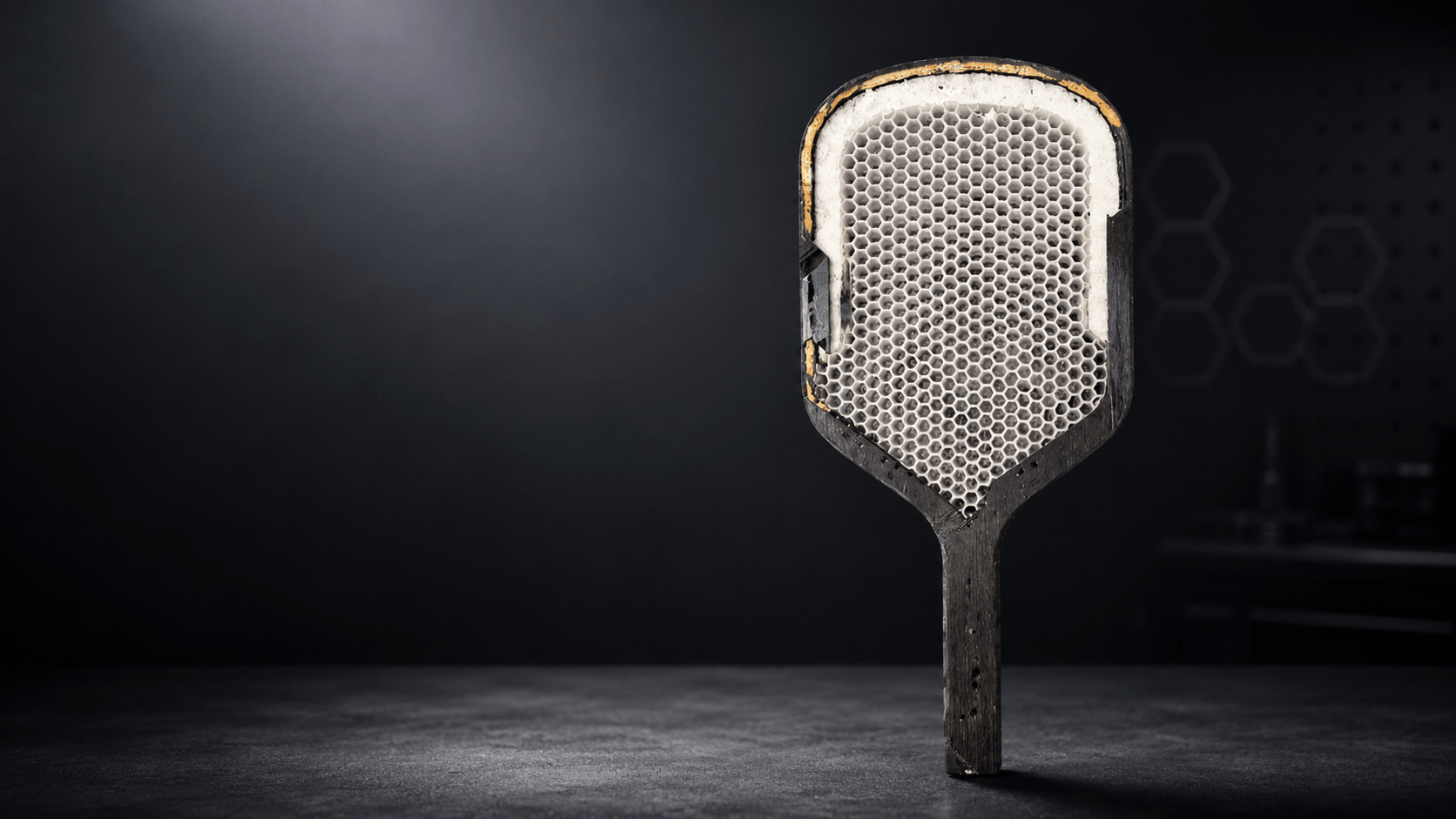
A foam core pickleball paddle uses foam — not polypropylene honeycomb — as some or all of the structural material between the two faces. That's the only thing every paddle in this category has in common. How much foam, where it sits, and what density it is are what separate a $150 paddle from a $333 one.
Here are the four constructions currently sold as foam core pickleball paddles, plus the honeycomb baseline you should measure them against.
Full foam (100% foam core)
The entire core is foam. No honeycomb cells anywhere. CRBN's TruFoam line pioneered this and marketed it as the first Gen-4 paddle, and Honolulu, Gherkin and Bread & Butter have since shipped their own versions. Full foam gives you the most uniform response across the face — the ball behaves roughly the same whether you catch it dead center or three inches off. That's the entire pitch, and it's a real one.
The tradeoff: full foam paddles tend to be denser through the head, which means more mass to move. If you already struggle to get around on fast hands exchanges, this is not automatically your category.
Foam perimeter and floating foam
Foam runs around the edge of the core, or a foam ring surrounds a suspended center section, while the middle uses a different material. Selkirk's ReactCore™ in the OMNI is the clearest current example — a PureFoam™ floating center with a PureFoam™ ring around it. The goal is to widen the sweet spot without adding the head weight of a fully solid core.
These generally feel closer to a traditional paddle than full foam does. If you're switching from a honeycomb paddle and don't want your timing thrown off, this is the gentler on-ramp.
Foam-injected honeycomb
This is the one that muddies the water. The core is still polypropylene honeycomb — foam is injected into the perimeter cells to kill vibration and stabilize off-center hits. JOOLA's Agassi Pro IV and Six Zero's Black Opal both work this way. These are good paddles. They are not full foam paddles, and a guide that ranks them head-to-head against a TruFoam without saying so isn't being straight with you.
Multi-density foam
The newest wrinkle: different foam densities in different zones of the same core — firmer where you want response, softer where you want dwell. Honolulu markets the J2NF as a multi-density all-foam build. There isn't enough independent data yet to say whether multi-density delivers a meaningfully different result from single-density foam, so treat the marketing with appropriate skepticism and go by feel.
The control group: conventional honeycomb
Worth keeping in the comparison. The Six Zero Coral and Coral Pro, both honeycomb, remain two of our best-selling paddles and beat plenty of foam paddles on touch. Foam is a different answer, not a strictly better one. If your game lives at the kitchen line, don't assume you need to switch.
Full foam vs foam perimeter: which construction fits your game
This is the decision most people get wrong, so here's the honest breakdown before we get to specific foam core pickleball paddles.
| Full foam | Foam perimeter / floating foam | |
|---|---|---|
| Sweet spot | Most uniform face response available | Wide, but center is still noticeably best |
| Feel | Muted, solid, "dead" thud on contact | More feedback and connection to the ball |
| Head weight | Typically heavier through the head | Easier to swing, faster hands |
| Consistency over time | The main selling point — less break-in drift | Good, but more variable by model |
| Best for | Baseline drivers, two-handed backhands, singles | All-court doubles, fast hands at the net |
If you can only take one thing from this section: full foam buys you consistency and costs you maneuverability. Everything else is a variation on that trade.
Best overall foam core pickleball paddle: Selkirk OMNI
$300 · Elongated and Widebody · Foam perimeter (ReactCore™)
Selkirk OMNI Elongated Pickleball Paddle
$300.00
At the heart of the OMNI is the innovative ReactCore™ — a PureFoam™ floating center with a new PureFoam™ Ring surrounded by an EVA Power Ring for a dynamic core with adaptive flexibility. This double-ring technology takes the EVA… read more

The OMNI is our pick for most players because it does the hardest thing in this category — it delivers foam-core stability without making the paddle feel like a brick. Selkirk took the foam-core power platform from Project Boomstik and rebuilt it around a floating PureFoam™ center with a foam ring, aiming at all-court play rather than pure power.
Who it's for: 3.5–4.5 doubles players who want one paddle to do everything, and who care about the fact that Selkirk actually stands behind warranty claims. The Elongated adds reach and leverage for drives; the Widebody is the more forgiving of the two and the safer pick if you're coming from a standard-shape paddle.
The tradeoff is honest: $300 is real money, and if you're a pure banger the Boomstik hits harder. The OMNI is the paddle you buy when you want to stop buying paddles. If you only demo one of the foam core pickleball paddles in this guide, make it this one.
Best foam core pickleball paddle for power: CRBN⁴ TruFoam Barrage
CRBN⁴ TruFoam Barrage (Hybrid, Aerocurve) Pickleball Paddle
$229.99
$280.00
Considering the TruFoam Barrage? Read our hands-on review covering power, control, spin, and feel after extended play. Read the CRBN TruFoam Barrage review → CRBN⁴ TruFoam™ Barrage Paddle Built for players who attack every rally, the Barrage delivers explosive power,… read more

$280 · Hybrid AeroCurve · 100% foam core
CRBN's TruFoam line is the reference point for full-foam construction, and the Barrage generation is the most refined version of it. The ⁴ shape — hybrid with the AeroCurve profile — is the one we hand people most often, because it keeps enough head speed to defend at the net while still driving through the ball.
The full TruFoam Barrage family covers four shapes: the CRBN¹ elongated for maximum reach, the CRBN² square for the biggest face, the CRBN³ elongated, and the CRBN⁴ hybrid. All four sit at $280. If you're choosing blind, take the ⁴.
Where it beats the OMNI: raw pop off the baseline and a more locked-in, uniform face. Among full-foam builds, these are the foam core pickleball paddles that hit hardest without going full specialist. Where it loses: it's a heavier-feeling paddle and the muted foam contact takes some players two or three sessions to trust on drop shots.
CRBN⁴ TruFoam Barrage (Hybrid, Aerocurve) Pickleball Paddle
$229.99
$280.00
Considering the TruFoam Barrage? Read our hands-on review covering power, control, spin, and feel after extended play. Read the CRBN TruFoam Barrage review → CRBN⁴ TruFoam™ Barrage Paddle Built for players who attack every rally, the Barrage delivers explosive power,… read more
If you want the absolute ceiling: Selkirk LABS Project Boomstik
Selkirk LABS Project Project Boomstik 16mm Pickleball Paddle - Widebody
$333.00
New to Selkirk's lineup? See how this paddle compares to every other Selkirk shape before you commit. Read the complete Selkirk Guide → 🚀 Explosive Power: BoomCore™ Technology delivers instant, long-lasting pop. 🎯 Elite Spin & Control: InfiniGrit™ Surface generates… read more

At $333, the Boomstik is the most expensive paddle in this guide and the most single-minded. It is a power paddle. It is not trying to be versatile. Advanced players who generate their own pace and want a paddle that amplifies it will love it; anyone still developing a reset game will find it punishing. Available in Elongated and Widebody.
Selkirk LABS Project Project Boomstik 16mm Pickleball Paddle - Elongated
$333.00
New to Selkirk's lineup? See how this paddle compares to every other Selkirk shape before you commit. Read the complete Selkirk Guide → 🚀 Explosive Power: BoomCore™ Technology delivers instant, long-lasting pop. 🎯 Elite Spin & Control: InfiniGrit™ Surface generates… read more
Best foam core pickleball paddle for control: Gherkin USA DRACO 16mm
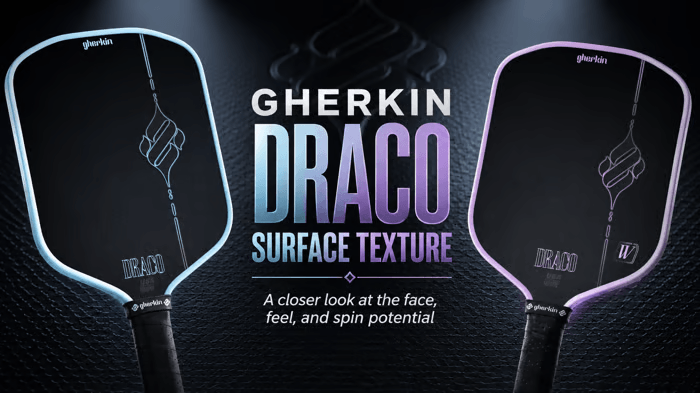
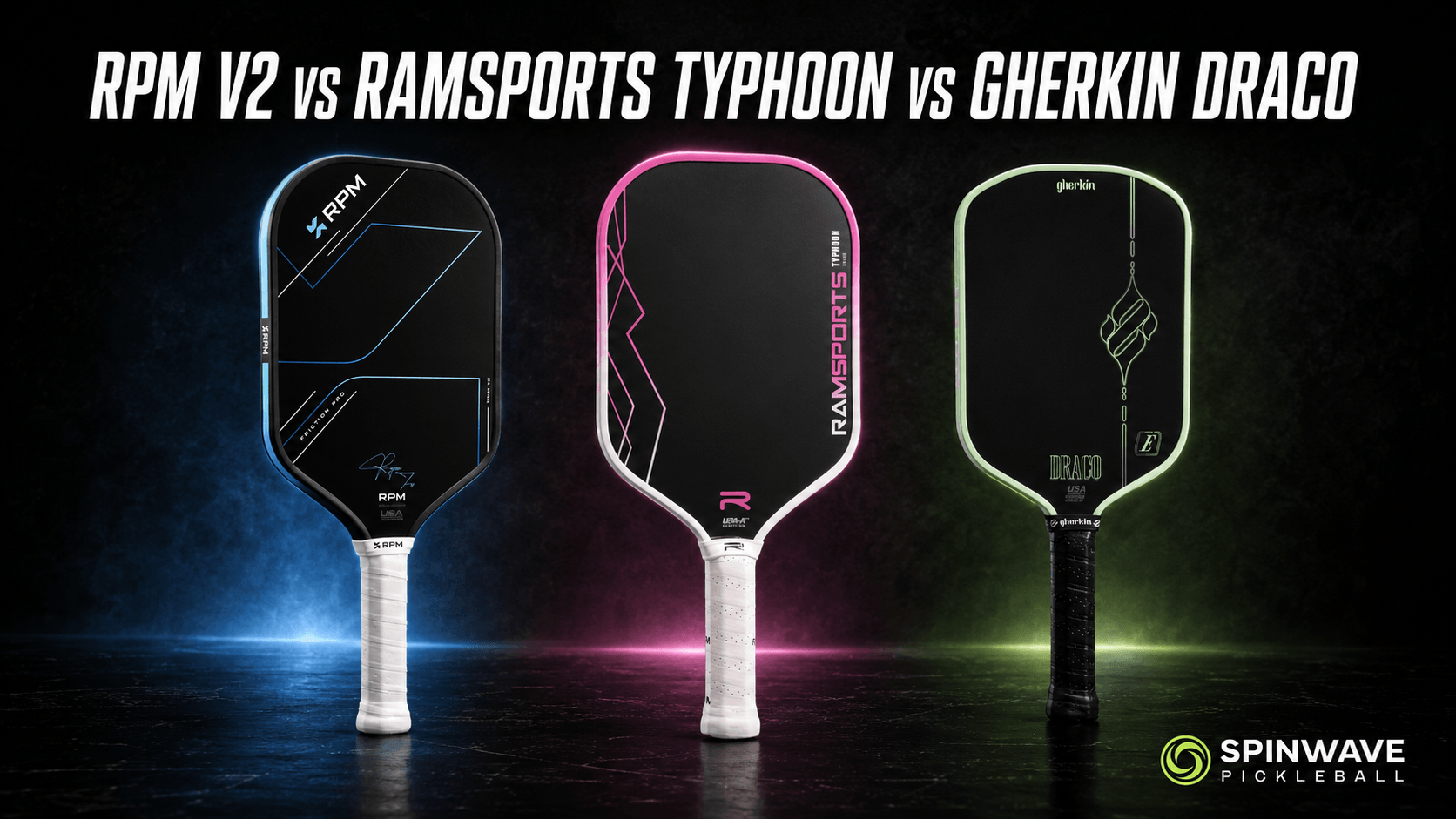
check out this blog to learn more about the Gherkin Draco
$179.99 · Widebody, Hybrid and Elongated · 100% foam core, 16mm
The DRACO is the most underrated paddle in this guide. It's a genuine full-foam build at 16mm — the thicker core adds dwell time, and foam adds face uniformity, and together that produces one of the softest, most predictable full-foam paddles we stock. The Widebody in particular is a legitimate control paddle that happens to be foam.
At $179.99 across all three shapes it's also roughly $100 less than the CRBN and $120 less than the OMNI. If your priority is resets, dinks and third-shot drops, and you want foam-core consistency without foam-core price, start here.
The catch: Gherkin is a smaller brand with a shallower support and warranty footprint than Selkirk or JOOLA. That matters to some buyers and not at all to others. Be honest with yourself about which one you are.
Gherkin USA DRACO 16mm Pickleball Paddle - Widebody
$179.99
New to Gherkin's lineup? See how this paddle compares to every other Gherkin shape before you commit. Read the complete Gherkin Guide → Gherkin USA DRACO Wide-Body Pickleball Paddle The Gherkin USA DRACO Wide-Body is built for players who want… read more

Gherkin USA DRACO 16mm Pickleball Paddle - Widebody
$179.99
New to Gherkin's lineup? See how this paddle compares to every other Gherkin shape before you commit. Read the complete Gherkin Guide → Gherkin USA DRACO Wide-Body Pickleball Paddle The Gherkin USA DRACO Wide-Body is built for players who want… read more
Best value: Honolulu Sword & Shield J2CR and J6CR
$195 · Full foam Core Reactor™ · Crystal Blue Endurance Surface™
Honolulu has become the quiet volume leader in full-foam paddles, and the reason is simple: $195 for a 100% foam core is aggressive pricing against a category that mostly sits between $250 and $333.
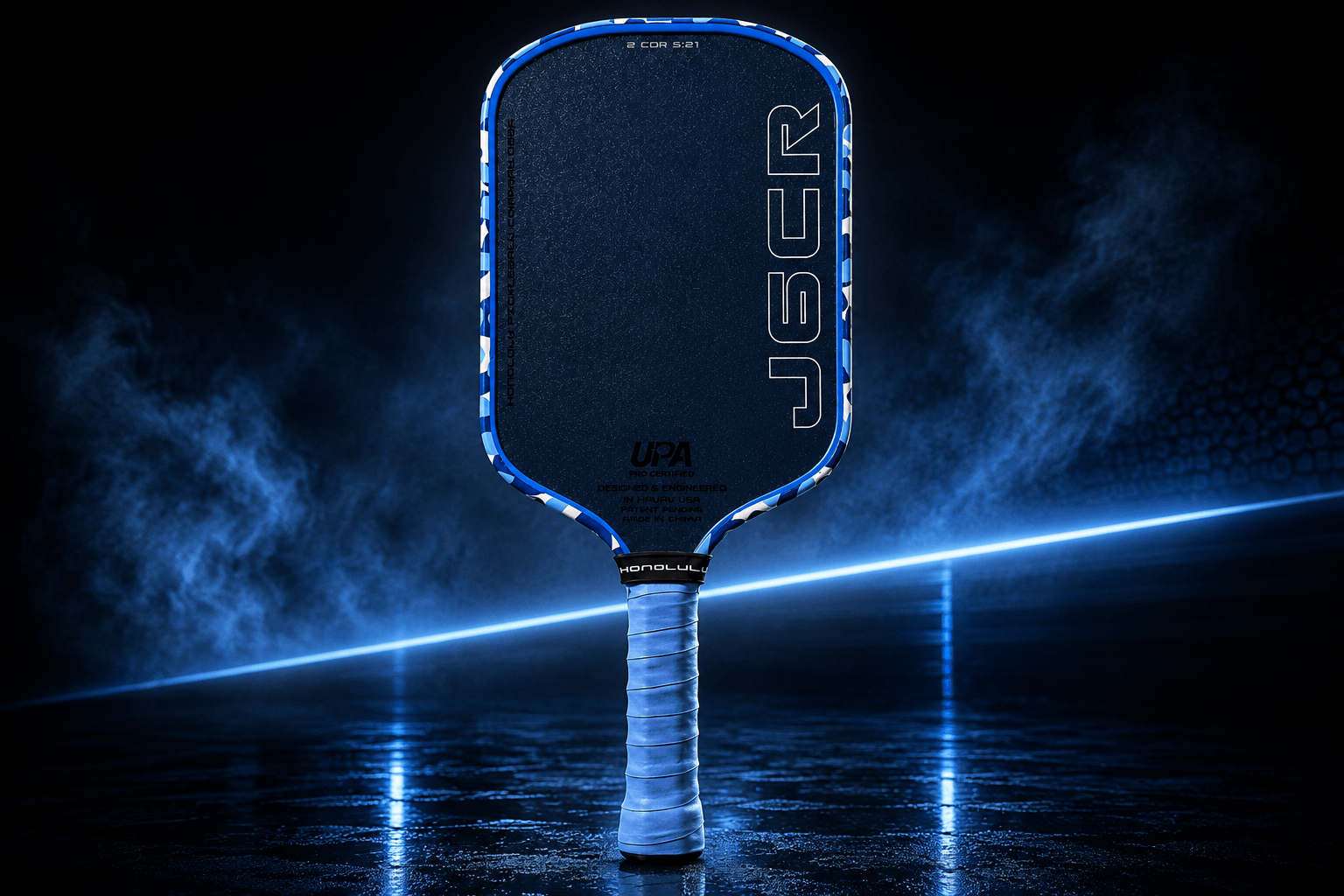
The two shapes split cleanly. The J2CR is the hybrid — more forgiving, faster hands, the better doubles paddle and the one we'd recommend to most players. The J6CR is elongated, with more reach and more leverage on drives; take it if you play singles or hit a two-handed backhand. Both are also available with a 6" long handle.
Honolulu's older NF-series paddles — the J2NF, J3NF and J7NF — run the same all-foam philosophy at $155–$195 and are worth a look if you want to spend less. The J3NF at $165 is the value play in that group.
Honolulu Pickleball Sword & Shield J6CR Crystal Blue Endurance Surface™
$195.00
HONOLULU Pickleball Company J6CR Pickleball Paddle The J6CR is Honolulu's next-generation power paddle. Featuring Core Reactor™ with Dynamic PowerFlex Technology™ and an industry-first Control Joint Technology™, the J6CR delivers the most power in our lineup, with increased pop while retaining… read more

Honolulu Pickleball Sword & Shield J2CR Crystal Blue Endurance Surface™
$195.00
HONOLULU Pickleball Company J2CR Pickleball Paddle The J2CR is Honolulu's next-generation hybrid power paddle, built for players who want explosive pop, heavy spin, quick hand speed, and a large, confidence-inspiring sweet spot. Featuring Core Reactor™ with Dynamic PowerFlex Technology™, Control… read more

Honolulu Pickleball Sword & Shield J2CR Crystal Blue Endurance Surface™
$195.00
HONOLULU Pickleball Company J2CR Pickleball Paddle The J2CR is Honolulu's next-generation hybrid power paddle, built for players who want explosive pop, heavy spin, quick hand speed, and a large, confidence-inspiring sweet spot. Featuring Core Reactor™ with Dynamic PowerFlex Technology™, Control… read more
Best foam core pickleball paddle under $150: Bread & Butter LOCO Elongated
$149.95 · Elongated · 16mm foam core
Under $150 the options thin out fast, and the LOCO Elongated is the one worth your money. It's a 16mm foam build with a genuinely balanced feel — enough plow-through for drives, enough softness to reset. Bread & Butter has never chased spec-sheet arms races, and the LOCO is a good example of a paddle designed to just play well rather than test well.
This is the paddle to buy if you're curious about foam construction but not ready to spend $280 finding out whether you like it. It's also the right call for a second paddle or a travel stick.
The Loco 16mm Pickleball Paddle - Elongated
$149.95
$199.00
Bread & Butter LOCO — Elongated Balanced. Bold. Elongated. Built for players who want more reach, more leverage, and more control—without losing touch. Use code LOCO to see discount in cart. 🎯 Control Plush Touch + Calm Resets 📏 Reach… read more

The Loco 16mm Pickleball Paddle - Elongated
$149.95
$199.00
Bread & Butter LOCO — Elongated Balanced. Bold. Elongated. Built for players who want more reach, more leverage, and more control—without losing touch. Use code LOCO to see discount in cart. 🎯 Control Plush Touch + Calm Resets 📏 Reach… read more
The cheaper way into premium foam
There's a second path most guides ignore: buy the expensive paddle used. Our Certified Pre-Owned paddle program regularly carries TruFoam Barrage, Honolulu Core Reactor and Selkirk Boomstik units, inspected and graded in-house at our Great Neck shop, typically well below retail. Every unit is one-of-one — when it's gone, it's gone. If you want a $280 foam paddle for $180–$210, that's where to look.
Foam durability and break-in: what to actually expect
The durability claim is the main reason people are buying foam core pickleball paddles in 2026, so it deserves a straight answer rather than a marketing one.
What foam genuinely helps with: honeycomb paddles develop dead spots as individual cells fatigue and collapse — that's the classic "my paddle feels different" complaint around the six-month mark. A solid foam core has no cells to crush, so the failure mode largely goes away. That's a real structural advantage, not spin.
What foam does not fix: face wear. Grit wears off carbon and raw carbon surfaces at roughly the same rate regardless of what's behind them, and spin drops as it does. Delamination — the face separating from the core — is also still possible. Foam changes how the core ages, not how the face ages.
Break-in: expect most foam paddles to feel slightly firmer out of the box and to settle over the first several sessions. Some players describe a modest gain in pop during that window. Don't judge a foam paddle on your first hour with it, and don't panic if a drop that felt short in session one lands fine in session four.
Practical advice: if you're spending $280 or more, hit it before you commit. Our Long Beach Tennis Center pro shop has five dedicated indoor demo courts, and the demo program exists precisely because foam-core feel is polarizing. Two hours on court beats two hours of reading reviews.
Are foam core pickleball paddles tournament legal?
Yes — foam construction is not disqualifying on its own, but certification is granted model by model, so you have to check your exact paddle and thickness. Several full-foam paddles carry USA Pickleball approval today, including models in this guide. Foam itself isn't the issue; how a specific build performs under testing is.
Three things worth knowing before you enter a sanctioned event:
- Approval is per model and per thickness. A 16mm version being approved does not mean the 14mm is. Look up the specific SKU on the official USA Pickleball approved paddle list before you register.
- Approval can be revoked. USA Pickleball pulls production units for post-market testing, and paddles that exceed the PBCoR threshold get removed from sanctioned play. This has happened to major brands, and it has happened to paddles people had already bought.
- Wear can make a legal paddle illegal. Delamination or a modified surface disqualifies a paddle regardless of what the list says. This applies to foam core pickleball paddles exactly as it applies to honeycomb.
Practical version: if you only play rec, none of this affects you. If you play sanctioned tournaments, verify the model on the official list before every season, not once at purchase.
Who should avoid foam core pickleball paddles?
Plenty of people, honestly. Foam is a trend, not an upgrade path everyone needs to be on.
- Players with slow hands at the net. Full-foam paddles generally carry more mass through the head. If you're already getting beaten in hands battles, adding swing weight makes it worse.
- Touch-first players. Foam mutes feedback. If you rely on feeling exactly where the ball sits on the face, a honeycomb paddle like the Six Zero Coral will tell you more.
- Anyone with an elbow or shoulder issue who hasn't tested one. The muted contact helps some players and the added swing weight aggravates others. This one is genuinely individual — demo it, don't guess.
- Players who upgrade every six months anyway. The durability advantage only pays off if you keep the paddle long enough to collect it.
- Anyone under 3.0. Spend $120 on a solid honeycomb paddle and the difference on lessons. It'll do more for your game.
How we ranked these foam core pickleball paddles
Transparency on method, since most rankings don't offer any.
These picks come from a retail shop, not a lab. We don't run PBCoR testing or publish swing-weight numbers we didn't measure ourselves. What we do have is a demo program across two locations, staff who play, and sell-through and return data on every paddle listed here — we can see which paddles come back and which ones people buy a second time for a partner.
The criteria, in order of weight: construction transparency (does the brand say what's actually in the core), consistency of face response, availability of the shape most players need, warranty and brand support, and price relative to the alternatives. We don't take payment for placement, and every paddle in this guide is one we stock — which is a bias worth naming rather than hiding.
Where a claim comes from a manufacturer rather than our own experience, we've said so. Where the evidence isn't there yet — multi-density foam being the clearest example — we've said that too.
How to choose between the best foam core pickleball paddles
Short version:
- Decide construction first, brand second. Full foam for consistency and power; foam perimeter for maneuverability and all-court play.
- Pick your shape. Hybrid for doubles, elongated for singles and two-handed backhands, widebody for forgiveness.
- Set your budget honestly. $150 gets you a real foam paddle. $200 gets you a very good one. $300 buys warranty, brand support and refinement — not a fundamentally different core.
- Demo before you commit at the top end. Foam feel is polarizing in a way honeycomb isn't.
If you'd rather talk it through than read another chart, come hit a few at one of our shops or message us — we'd genuinely rather you buy the right paddle once. You can also browse every current option in new paddle arrivals, or build exactly what you want through custom paddles with your choice of grip and shape.
The best foam core pickleball paddles of 2026 aren't the ones with the loudest marketing. They're the ones whose construction actually matches how you play — and now you know which is which.
FAQs
Are foam core pickleball paddles better than honeycomb?
Not universally. Foam gives you a more uniform face response and resists the dead spots that honeycomb develops over time. Honeycomb gives you more feedback, lighter head weight and usually a lower price. Foam is the better answer for baseline drivers and players who want long-term consistency; honeycomb is still better for touch-first players and fast hands at the net.
Do foam paddles last longer?
The core does. Honeycomb cells fatigue and collapse, which is what causes the "my paddle feels different" complaint around six months. A solid foam core has no cells to crush, so that failure mode largely disappears. Foam does nothing for face wear, though — grit still wears off at the same rate, and delamination is still possible.
What is a Gen 4 pickleball paddle?
"Gen 4" is an industry shorthand, not an official standard, for paddles that moved from thermoformed honeycomb (Gen 3) to foam-based cores. CRBN popularized the term with the TruFoam Genesis, marketed as the first 100% foam core paddle. Because no governing body defines it, brands apply it inconsistently — judge the construction, not the label.
Do foam paddles help tennis elbow?
It depends on the player, and there's no reliable data either way. The muted contact of a foam core reduces vibration, which helps some people. But full-foam paddles usually carry more mass through the head, and added swing weight aggravates elbow issues for others. If you're managing an injury, demo before buying and talk to a physical therapist rather than relying on a paddle to fix it.
Are foam core pickleball paddles tournament legal?
Foam construction isn't disqualifying on its own, and several full-foam models are USA Pickleball approved. But certification is granted per model and per thickness, and it can be revoked after post-market testing. Check your exact SKU on the official USA Pickleball approved paddle list before entering a sanctioned event.
What's the difference between full foam and foam perimeter paddles?
Full foam means the entire core is foam with no honeycomb anywhere — the most uniform face response, but a heavier feel through the head. Foam perimeter or floating-foam designs use foam around the edge or as a ring around a suspended center, which widens the sweet spot while keeping the paddle easier to swing. Full foam favors power and consistency; foam perimeter favors maneuverability.