
Table of Contents
- Is My Paddle Still Legal Under the USA Pickleball Spin Limit?
- What the USA Pickleball Spin Limit Actually Measures
- Why USA Pickleball Moved on Spin Now
- USAP vs. UPA-A: Two Rulebooks, Same Number
- What the USA Pickleball Spin Limit Changes on Store Shelves
- Should You Buy a Paddle Now or Wait?
- What to Watch Over the Next Year
- The Bottom Line
- FAQs
Short version: your paddle is fine. The new USA Pickleball spin limit takes effect October 1, 2026, capping certified paddles at 2,100 RPM. It applies to paddles certified after that date. Paddles already on the approval list stay approved, because USAP requires paddles to meet the standards in effect when they were certified. If you bought a USAP-approved paddle this year, you can keep playing with it.
That's the answer most people came for. The rest of this covers what the USA Pickleball spin limit actually measures, why it exists, how it differs from the pro-tour rule you may have already heard about, and what it means for what's on the shelf over the next twelve months.
Is My Paddle Still Legal Under the USA Pickleball Spin Limit?
Yes, assuming it's currently USAP approved. USA Pickleball's guidance to manufacturers is that certified paddles must comply with the standards of the period in which they were certified. A paddle approved in 2025 or early 2026 was tested against surface roughness and coefficient of friction standards, and it remains compliant against those.
The new USA Pickleball spin limit is a certification requirement for new paddles entering the approval list, not a retroactive ban. There is no amnesty deadline, no re-testing requirement for paddles you already own, and nothing you need to do before October 1. Everything in our pickleball paddle collection is USAP approved under the standards in force when it was certified.
There's also a practical reality worth stating plainly: at the recreational level, nobody is checking. Paddle compliance is enforced at sanctioned tournaments. Your Tuesday night open play is not a sanctioned tournament.
What the USA Pickleball Spin Limit Actually Measures
Until now, USAP evaluated a paddle's spin potential indirectly, by measuring how rough and grippy the face was. Surface roughness and coefficient of friction are proxies. They describe the texture, then infer what that texture will do to a ball.
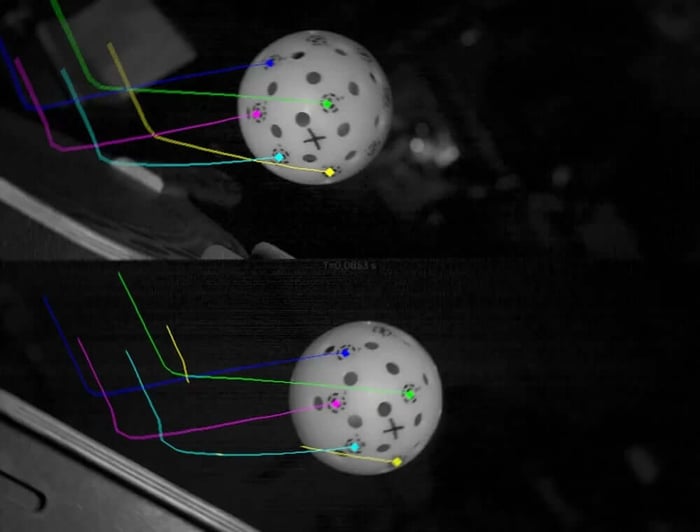
The new test measures the outcome directly: how fast the ball is actually spinning after it leaves the face, in revolutions per minute. The threshold is 2,100 RPM. Paddles certified after October 1, 2026 must come in under it, and paddles certified under the new standard won't appear on the approval list before that date.
Testing runs on a system called PaddleVision, built by Sweden-based Image Systems. It uses high-speed dual-camera imaging and motion analysis to calculate spin without manual measurement, which is the part USAP is really buying: repeatability. USAP's equipment compliance leadership has framed the goal as objectivity and repeatability over the long term.
The standard operating procedure went out to manufacturers on July 15, 2026, following a months-long comment period with paddle makers.
Why USA Pickleball Moved on Spin Now
Two things forced the issue.
The first is that surface texture stopped being a reliable proxy. When most paddles were painted fiberglass, grit told you most of what you needed to know. Raw carbon faces, thermoformed construction, and newer permanent-texture treatments generate spin through mechanisms that a roughness gauge doesn't fully capture. A paddle can measure tame and play hot.
The second is that the old test was getting embarrassing. Independent testing using USAP's own surface roughness methodology found that 40 of 42 approved paddles exceeded the certification limit. When almost every approved paddle fails the test that approved it, the test isn't measuring the right thing.
Add the pace of the market — hundreds of brands, new models weekly, foam cores rewriting how paddles behave — and a spin standard built for 2019 was never going to hold. The USA Pickleball spin limit is the correction.
USAP vs. UPA-A: Two Rulebooks, Same Number
This is where most of the confusion comes from, so it's worth being precise.
| USA Pickleball (USAP) | UPA-A | |
|---|---|---|
| Governs | Amateur and recreational play | Pro events: PPA, MLP, PPA Challenger |
| Spin cap | 2,100 RPM from Oct 1, 2026 | 2,100 RPM since Sept 1, 2025 |
| Power metric | PBCoR ≤ 0.43 | PEF ≤ 0.385 |
| Affects your paddle? | Only new certifications | Only if you compete professionally |
If you read about a 2,100 RPM spin cap sometime last year, that was the UPA-A rule for the pro tours. The number is the same, but the testing methods and the power metrics alongside them are not, and a paddle legal under one isn't automatically legal under the other. The new USA Pickleball spin limit brings the amateur standard into rough alignment with the pro one for the first time.
What the USA Pickleball Spin Limit Changes on Store Shelves
Between now and October 1, 2026, manufacturers can still get paddles onto the approval list under the existing surface roughness and coefficient of friction tests. Expect a wave of certifications between now and then as brands push models through under the old standard.
After October 1, new releases have to clear 2,100 RPM. Realistically, that means a few things:
- Fewer extreme-texture releases. The spin arms race of the last three years has a ceiling now, and it's measurable.
- More engineering attention on core and shape. If you can't win on surface grit, you differentiate on dwell time, twistweight, and shape. That's a healthier direction for the equipment generally.
- A likely lag in new approvals in Q4 2026. New test, new equipment, new process. Approval lists rarely move fast when the methodology changes.
- No change at all to the paddles currently in your bag.
If you play a control-first game, the change is close to irrelevant — browse beginner and control paddles or all-court balanced paddles and buy on feel. It matters more if you shop power and competitive paddles, where surface texture has been doing more of the work.
Should You Buy a Paddle Now or Wait?
Buy when you need a paddle. We'd rather tell you that than manufacture a deadline out of the USA Pickleball spin limit.
The case for buying now is thin but real: if you specifically want a high-spin paddle certified under the current standard, the window for new models certified that way closes October 1. Paddles already approved stay approved indefinitely, so there's no risk in buying one.
The case for waiting is also thin: nothing about the USA Pickleball spin limit makes today's paddles worse, cheaper, or obsolete. If your current paddle plays well and the face still has bite, keep playing it.
If budget is the real constraint, Spinwave Certified Pre-Owned paddles are all previously approved models, which means they carry the same grandfathered status as anything new on the shelf.
The one scenario where timing genuinely matters is competitive play. If you compete in USAP-sanctioned tournaments and you're buying a paddle you expect to use for the next two or three seasons, buying something on the current approval list is the safe move — it's grandfathered, and it isn't going anywhere.
The Six Zero Coral Pro is a good illustration of where spin-forward design currently sits. Its Double Diamond Tough surface is built for durable bite rather than aggressive short-lived grit, which is the direction the USA Pickleball spin limit pushes the whole category — texture that lasts rather than texture that maxes out a test.
Six Zero Coral Pickleball Paddle 16mm - Lightweight

$200.00
Six Zero Coral Lightweight Pickleball Paddle Built on the award-winning Next Gem™ platform, the Six Zero Coral Lightweight delivers the same balanced all-court performance players love with a quicker, more responsive feel. With a lighter base weight of 7.6–7.9 oz,… read more
The AIREO Cyclone Hybrid takes the other route: a foam core doing the work rather than the face. Paddles built this way are less exposed to a spin-rate ceiling, because their performance doesn't hinge on how rough the surface reads.
AIREO Cyclone 2.0 16mm Pickleball Paddle

$199.00
AIREO Cyclone 2.0 — 16mm Pickleball PaddleNanoGraph Grit Surface • PulseFoam™ Power Core • Pro-Level PerformanceThe Cyclone is back, rebuilt. Version 2.0 pairs AIREO's NanoGraph grit surface with the PulseFoam™ power core for explosive pop that doesn't give up the… read more
What to Watch Over the Next Year
A few open questions we're tracking, and honestly nobody has firm answers yet:
How many current paddles would actually fail? Nobody's published broad testing against the 2,100 RPM threshold. Given how the surface roughness numbers came out, it would be surprising if some popular models didn't come in hot.
Will manufacturers re-certify voluntarily? There's a marketing angle in being able to say a paddle passes the new standard. Some brands will chase it; others will quietly ride out their existing certifications.
Does the amateur game notice? Most rec players aren't generating anywhere near 2,100 RPM regardless of paddle. The USA Pickleball spin limit constrains the equipment ceiling, not the average player's spin.
Will other bodies follow? International federations set their own equipment standards. Alignment between USAP and the UPA-A on a single number makes a broader convention more likely, but nothing has been announced.
The Bottom Line
The USA Pickleball spin limit is a certification change, not a confiscation. From October 1, 2026, new paddles must test under 2,100 RPM on a dual-camera system that measures actual ball rotation instead of guessing from surface texture. Paddles certified before that date remain approved under the standards they were tested against.
For the vast majority of players, the correct response to the USA Pickleball spin limit is to do nothing. For anyone competing in sanctioned play, the correct response is to make sure whatever you buy is on the USAP approval list — which it will be, and will stay.
If you want help figuring out whether a specific paddle is approved, or you're weighing a spin-heavy model against something that generates pace from the core instead, come into Great Neck or Long Beach and hit a few, or look at a custom paddle build if you want a specific shape and grip combination. That's a five-minute conversation in person and a much longer one over email.
FAQs
Is my current paddle banned under the new USA Pickleball spin limit?
No. USA Pickleball requires paddles to comply with the standards in effect when they were certified. A paddle approved before October 1, 2026 was tested against surface roughness and coefficient of friction standards and stays approved against those. There is no re-testing requirement and no deadline for players.
When does the 2,100 RPM spin limit take effect?
October 1, 2026. Paddles certified after that date must test under 2,100 RPM, and paddles certified under the new standard won't appear on the approval list before then. Manufacturers received the standard operating procedure on July 15, 2026.
How is spin rate measured?
Through a dual-camera system called PaddleVision, built by Image Systems in Sweden. It uses high-speed imaging and motion analysis to measure how fast the ball is actually rotating after it leaves the paddle face, in RPM. That replaces the older approach of measuring surface texture and inferring spin from it.
What's the difference between the USAP and UPA-A spin rules?
Both cap spin at 2,100 RPM, but they're separate rulebooks. UPA-A governs professional events (PPA, MLP, PPA Challenger) and has enforced its cap since September 1, 2025. USA Pickleball governs amateur and recreational play and begins enforcing October 1, 2026. They also use different power metrics — PBCoR for USAP, PEF for UPA-A.
Will paddles get less spinny after October 2026?
New certifications will have a measurable ceiling, so the texture arms race of the last few years slows down. Expect manufacturers to shift effort toward core construction, dwell time, and shape instead of surface grit. Paddles already on the market are unaffected.
Do I need to worry about this for recreational play?
No. Paddle compliance is enforced at sanctioned tournaments, not open play. And most recreational players don't generate anywhere near 2,100 RPM regardless of what paddle they're holding.