

Table of Contents
Short answer: 14mm gives you more pop and faster hands, 16mm gives you more dwell time and a bigger margin for error. If you're not sure, play 16mm — it's the more forgiving core and it's what most players end up preferring once they stop chasing power. The full 14mm vs 16mm picture is a little more interesting than that, though, and foam cores have started to complicate the old rule of thumb.
What 2mm Actually Changes
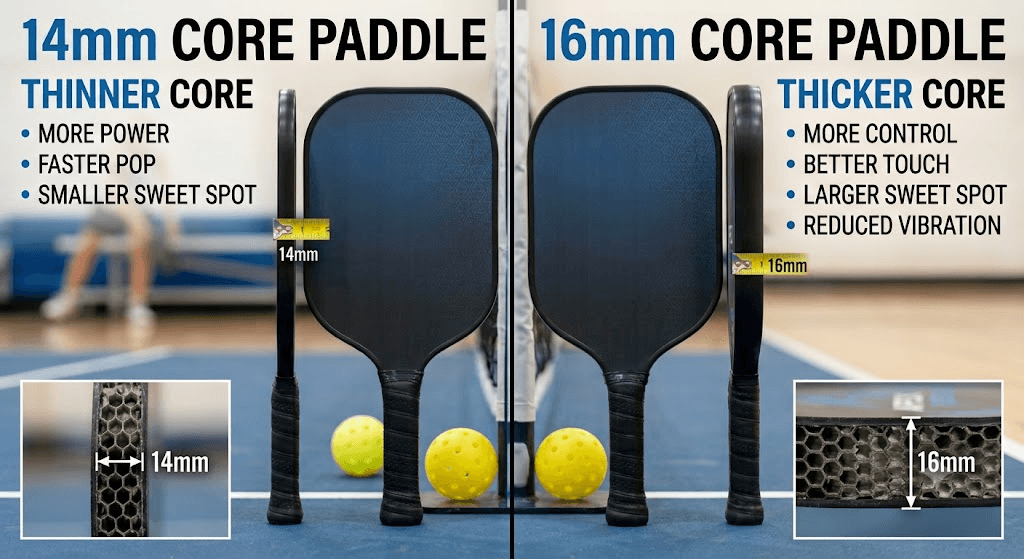
Core thickness controls dwell time — how long the ball stays on the face during contact.
A thinner core is stiffer. The ball compresses less, leaves faster, and comes off with more pop. A thicker core has more material to absorb and return energy, so the ball sits on the face fractionally longer. That extra fraction of a millisecond is what players describe as "feel" or "connected," and it's what makes a drop shot land where you aimed it instead of somewhere near there.
Everything else in the 14mm vs 16mm debate flows from that one difference:
- Pop: 14mm wins. Balls jump off the face on counters and speed-ups.
- Control on soft shots: 16mm wins. More dwell means more time to shape the ball.
- Forgiveness: 16mm wins. Off-center hits stay playable instead of dying or flying.
- Hand speed: 14mm usually wins, because thinner cores tend to weigh slightly less.
- Plow-through on drives: 16mm usually wins, for the same reason in reverse.
- Vibration: 16mm wins. More core between the ball and your arm.
The Same Paddle, Both Cores
Most 14mm vs 16mm comparisons put two completely different paddles side by side, which tells you nothing — you're measuring shape, face, and weight distribution at the same time as thickness.
The JOOLA Agassi Pro IV is a cleaner test, because it exists in both cores at the same price with everything else held constant.
| Agassi Pro IV 14mm | Agassi Pro IV 16mm | |
|---|---|---|
| Average weight | 7.9 oz (7.7–8.1) | 8.1 oz (7.9–8.3) |
| Core | 14mm Honeycomb Propulsion | 16mm Honeycomb Propulsion |
| Shape | Elongated, 16.5" × 7.5" | Elongated, 16.5" × 7.5" |
| Face | Textured carbon fiber | Textured carbon fiber |
| Grip / handle | 4¼", 5.5" | 4¼", 5.5" |
| Approvals | USAP, UPA-A | USAP, UPA-A |
| Price | $179.99 | $179.99 |
JOOLA Agassi Edge 16mm Pickleball Paddle
$99.95
Agassi Edge 16mm Pickleball Paddle Harness your passion for the game with the Agassi Edge 16mm Pickleball Paddle—the perfect partner for developing your on-court style. Inspired by the iconic tennis rackets that made Andre Agassi a household name, this paddle… read more

Identical everything except 2mm of core and 0.2 oz of weight. JOOLA's own framing is that the 14mm is the more explosive paddle in the line and the 16mm adds dwell time, softer feel, and stability.
The 14mm version is the one to pick if you win points by speeding up the ball and finishing at the net. Its tapered shape moves quickly through hand battles, and the lighter stock weight helps.
The 16mm version is the same paddle for a patient game. Resets settle instead of popping, drops land shorter, and drives carry more weight through the ball. Same price, same shape, different personality.
14mm vs 16mm, Shot by Shot
| Shot | Better core | Why |
|---|---|---|
| Speed-ups and counters | 14mm | Pop and faster response off the face |
| Third-shot drops | 16mm | Dwell time makes the arc easier to control |
| Resets from mid-court | 16mm | Softer core absorbs pace instead of returning it |
| Serves and drives | Close | 14mm gives pop, 16mm gives plow-through |
| Dinking | 16mm | More margin, less accidental pop-up |
| Blocking hard drives | 16mm | Deadens the ball rather than rebounding it |
| Put-aways at the net | 14mm | Quick, snappy response when there's no swing |
Count how many of your lost points come from popping up a reset versus getting beaten in a fast exchange. That tally answers the 14mm vs 16mm question better than any spec sheet.
14mm vs 16mm: You Should Play 14mm If…
- You win points with hand speed at the kitchen rather than patience.
- Your soft game is already reliable and you want more offense.
- You come from tennis or table tennis and prefer a crisp, immediate response.
- You're a smaller or lighter player who needs help generating pace.
- You play mostly singles, where drives and put-aways matter more than dink battles.
The honest downside: a 14mm core punishes inconsistent contact. Off-center hits come off unpredictably, and pop-ups happen more easily when you're rushed.
You Should Play 16mm If…
- You're still developing consistency and want the larger margin for error.
- You play a lot of doubles, where the soft game decides most points.
- You want less vibration reaching your elbow and shoulder.
- You'd rather the paddle do the work on drives than supply the pace yourself.
- You're unsure. 16mm is the safer default for the large majority of players.
The honest downside: 16mm paddles feel duller on counters, and if your game is built on speed-ups you'll notice the ball leaving slower than you want.
If you're weighing this at the intermediate stage, our guide to intermediate pickleball paddles ranked by swingweight covers the other spec that decides fit.
Where the Usual Advice Gets It Wrong
"Thicker equals more control" is too simple. A 16mm core gives you more control on soft shots. On fast hands battles, the thinner core is often easier to control because the ball goes where you point it before you have time to do anything wrong. Control isn't one thing.
Foam cores have blurred the line. The old rule assumed a polymer honeycomb core, where thickness was the main variable. Modern full-foam and multi-density builds — EPP cores with EVA or TPE rings, floating and pivoting constructions — tune feel through material density rather than millimeters. A 14mm foam paddle can feel softer than a 16mm honeycomb one. When a paddle is foam-cored, thickness tells you much less than it used to.
14mm vs 16mm is not a skill ladder. Plenty of 4.5+ players use 14mm, and plenty of beginners are handed 16mm and never leave it. It describes a playing style, not a rating.
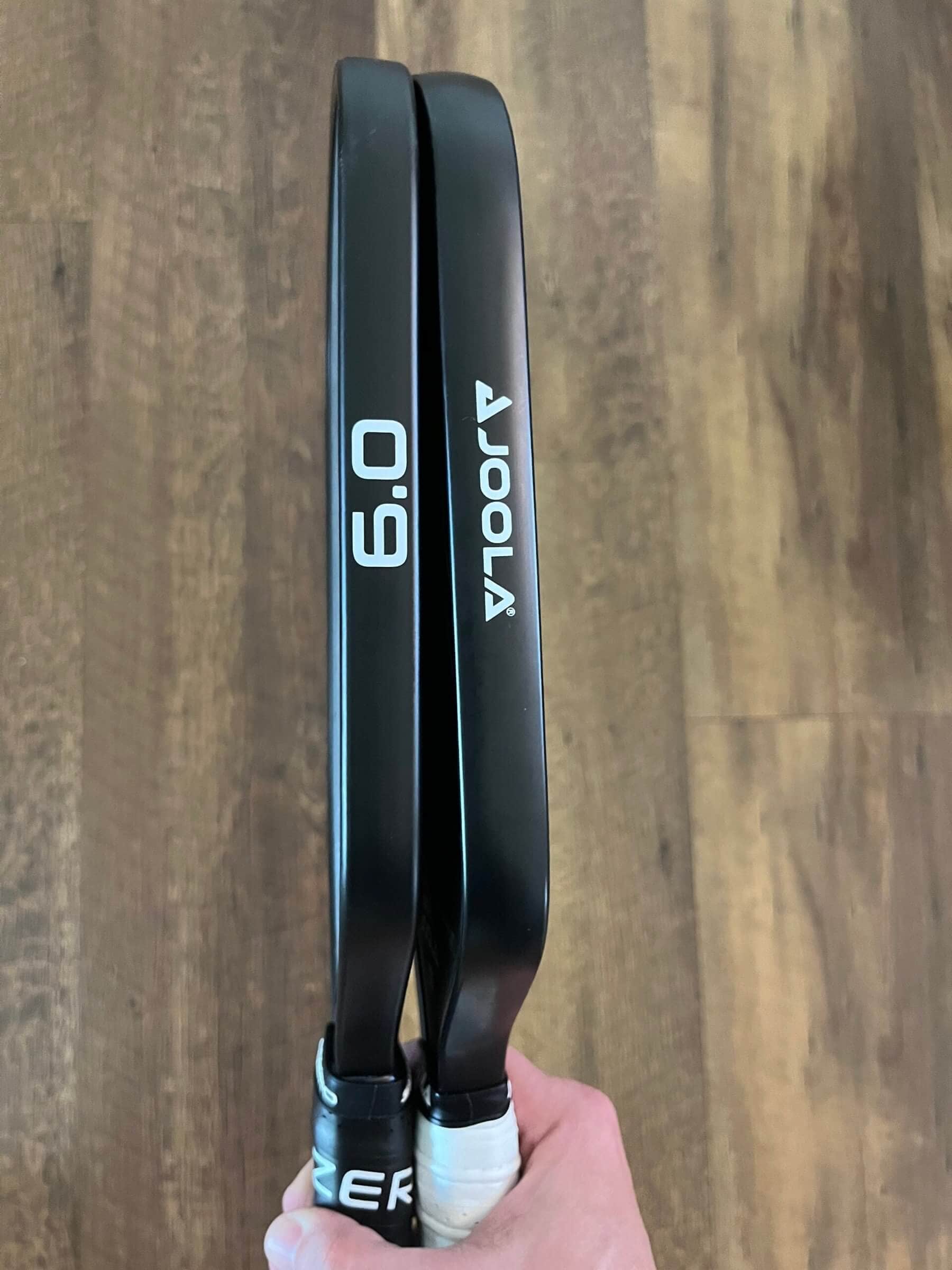
The weight difference is smaller than people expect. On the Agassi pair it's 0.2 oz — about the weight of two overgrips. If you want a heavier or lighter paddle, choose the thickness that suits your game and adjust with lead tape.
Or Buy One Paddle That Does Both
A few manufacturers now sell a single model in both cores so you can switch without changing platforms. The Paddletek HoneyFoam Esquared offers 14mm and 16mm builds of the same foam-core paddle, which is a reasonable way to test the 14mm vs 16mm difference on a construction you already like.
How to Decide Without Guessing
Three steps will settle 14mm vs 16mm for your game.
First, look at your losses, not your wins. Popping up resets and dinks means go thicker. Getting beaten in fast exchanges means go thinner.
Second, check what core you're on now. Most players don't know. If your current paddle works and you like it, staying in the same thickness and changing shape is usually the better upgrade.
Third, hit both. The 14mm vs 16mm difference is obvious within a few minutes on court and essentially invisible on paper. Our demo program exists for exactly this, and both shops keep paired models on hand.
If you'd rather test a thickness without paying full price, Spinwave Certified Pre-Owned paddles are a low-risk way to find out which core suits you.
The Bottom Line
14mm vs 16mm comes down to one trade: pop versus dwell time. Thinner gives you a faster, livelier paddle that rewards clean contact and quick hands. Thicker gives you a softer, more forgiving paddle that rewards patience and makes the soft game easier.
Most players are better served by 16mm, which is why it dominates the market — but "most players" isn't a diagnosis. If your soft game is solid and you lose points by being late rather than by popping the ball up, 14mm will suit you better and you shouldn't let the conventional wisdom talk you out of it.
Browse the full Spinwave paddle lineup, or narrow to all-court balanced paddles and power and competitive paddles. Not sure which way to go? Tell us how your last few games went and we'll point you at a core.