
Table of Contents
- Quick picks by budget
- Key takeaways on pickleball paddle deals
- What your money actually buys at each price tier
- Under $60: the honest entry tier
- $60 to $120: the first real upgrade
- $120 to $200: where the pickleball paddle deals actually are
- $200 and up: paying for the current generation
- Three things that matter more than the price
- Buying discounted or pre-owned without getting burned
- Finding your number
- FAQs
Great Pickleball Paddle Deals for Every Budget (2026)
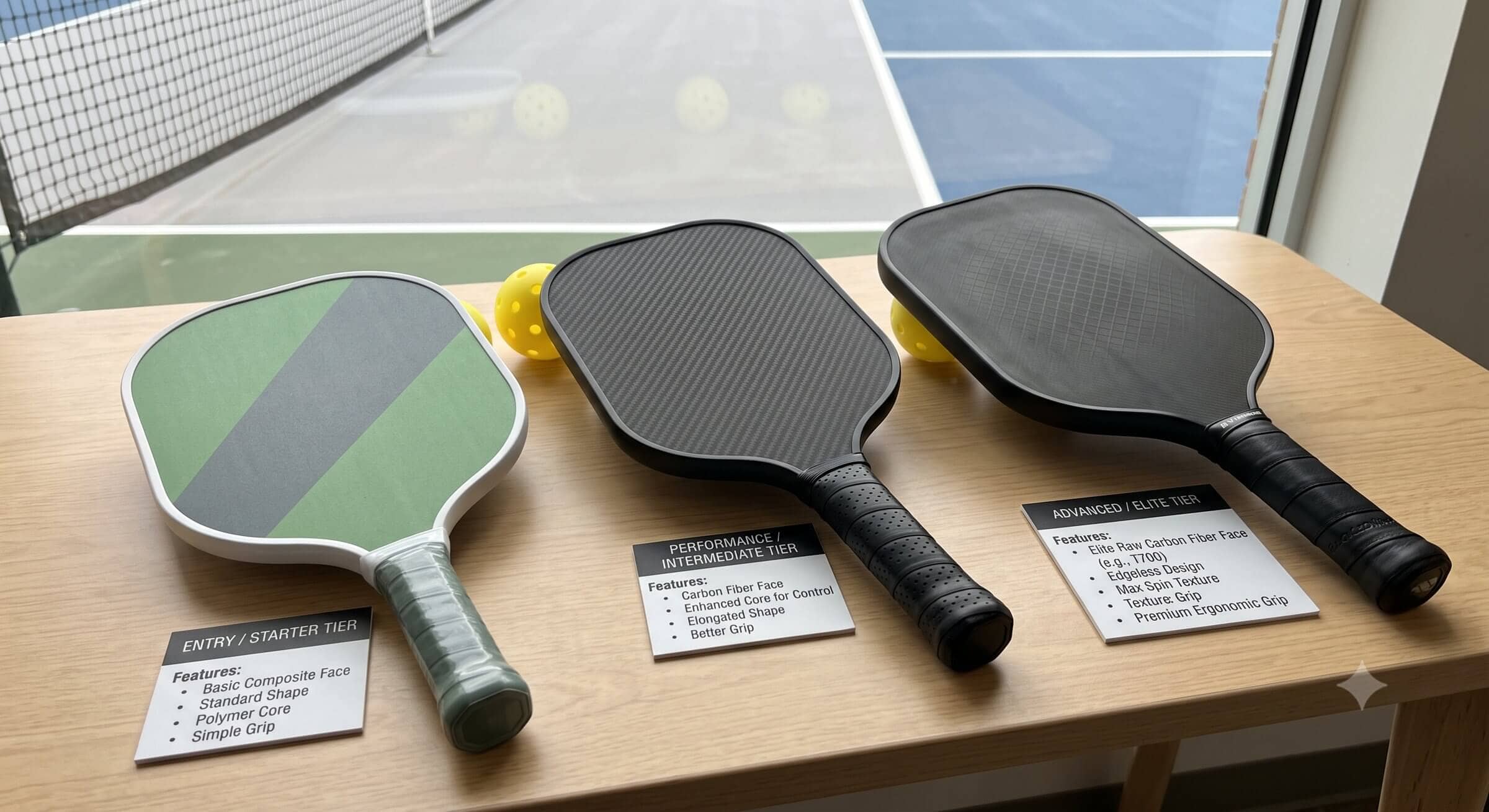
Paddle prices run from about $40 to past $330, and that spread hides more than it explains. The best pickleball paddle deals right now are not where most buying guides send you, because editorial sites sort by list price and list price is not what you pay.
If you already have a number in mind, start here.
Quick picks by budget
| Your budget | Our pick | Price |
|---|---|---|
| Under $60 | JOOLA Simone Jardim Hyperion C2 CFS | $59.95 |
| Around $70 | Selkirk SLK Latitude 2.0 | $69.99 |
| Around $100, sore elbow or wrist | ProKennex Black Ace Ovation | $99.00 |
| Around $120, no idea what shape you want | Ronbus Quanta R4.16 | $119.00 |
| $150 to $200, best value overall | Ronbus Ripple V2 R4.14 | $159.00, down from $280 |
| $200 and up | JOOLA Perseus Pro IV 16mm | $249.95 |
JOOLA Ben Johns Perseus Pro IV 16mm Pickleball Paddle
$149.95
Also Available Perseus Pro IV — 14mmSnappier feel, more pop on counters, and a lighter swing. Better for fast hands and aggressive net play. View 14mm → The JOOLA Ben Johns Perseus Pro IV 16mm Pickleball Paddle takes performance to… read more

ProKennex Black Ace 16mm Pickleball Paddle
$250.00
$280.00
The ProKennex Kinetic Black Ace 16 Pickleball Paddle marks the next evolution in the Black Ace line, delivering a powerful combination of precision, control, and cutting-edge technology. Designed for players who demand consistency and thrive on accuracy, this middleweight paddle… read more

Below is why each of those wins at its number, and what changes as you move up.
Key takeaways on pickleball paddle deals
- Price tier mostly tracks construction generation and face material grade, not "quality." Knowing which generation you're buying explains the price jump better than any spec sheet.
- The strongest value in our catalog today is the $120 to $200 band, where discounted previous-generation flagships land below or beside current-generation mid-tier paddles.
- Under $60 gets you a genuinely playable, tournament-legal paddle. It's also the tier most likely to use a painted or carbon-look finish, which is the fastest-fading surface type.
- Grit durability doesn't track price. Raw carbon appears on $50 paddles and $300 paddles alike, and it holds its texture less well than purpose-built durable-grit surfaces.
- Warranty doesn't track price either. Coverage runs from 90 days to limited lifetime, and some premium brands sit at the short end.
What your money actually buys at each price tier
Paddle price is largely a proxy for how the paddle was built. Manufacturing has moved through four broad generations, and each one costs more to produce than the last. Understanding that ladder is what separates real pickleball paddle deals from a number that just looks low.
The first generation is a cold-pressed sandwich: a polypropylene honeycomb core between two face sheets, held together at the perimeter by an edge guard. Simple, cheap, and still perfectly legal. The second is thermoformed unibody construction, where faces, core, and a carbon seam edge are fused in a mold under heat and pressure into one sealed structure, with foam built into the edges rather than applied afterward. The third adds injected foam and a core partly decoupled from the perimeter. The fourth replaces honeycomb with engineered foam entirely.
Face material moves alongside it. Fiberglass gives you power and a smaller sweet spot. Raw carbon gives you a softer feel, a more forgiving sweet spot, and better spin.
One honest caveat before the tiers: nobody publishes a price-to-feature map. No governing body or manufacturer states that thermoforming begins at a particular dollar figure, and the boundaries drift month to month. Treat the tiers below as a read on the current market, not a fixed rule. It's also worth knowing that most "under $100" lists you'll find elsewhere are populated by paddles that retail at $99.99 to $119.99 and only clear $100 with a discount code.
| Tier | Typical construction | Typical face | What you give up |
|---|---|---|---|
| Under $60 | Cold-pressed or entry thermoformed | Carbon-look or basic carbon | Sweet spot size, and surface durability |
| $60 to $120 | Thermoformed unibody | Raw carbon | Foam tuning, swingweight consistency |
| $120 to $200 | Foam-injected, or discounted flagship | Raw T700 carbon or engineered grit | Very little, at current markdowns |
| $200 and up | Full foam core, current generation | Engineered durable grit | Nothing structural, you're paying for the newest platform |
That table describes list prices. Markdowns cut straight across it, which is exactly why the best pickleball paddle deals cluster where they do.
Under $60: the honest entry tier
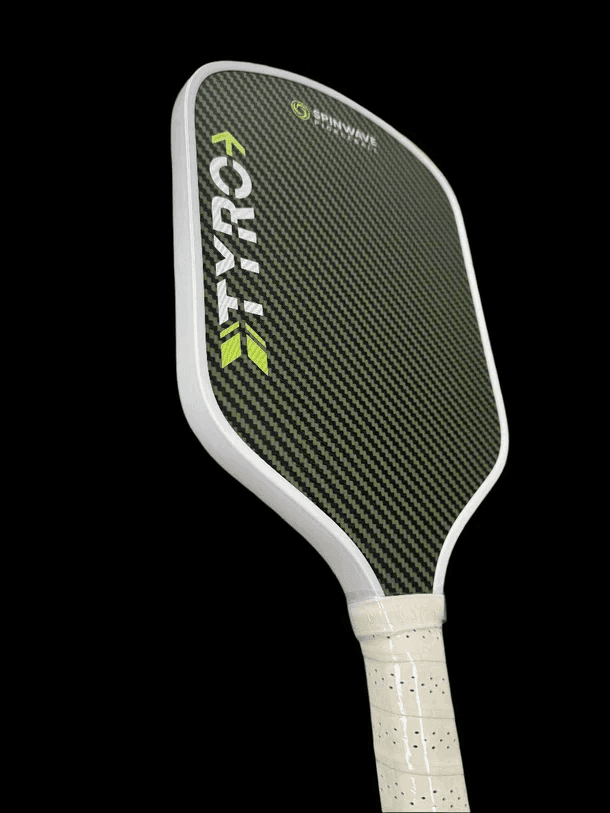
This tier is better than it has any right to be, but it's the one place where the compromise is real. You're getting a paddle that plays well on day one. What you're most likely giving up is the face: this tier leans on painted and carbon-look finishes, which are the fastest-fading surface type. That's exactly why the paddles we point you at here are the ones that don't.
The Spinwave Tyro at $40 is a thermoformed 16mm paddle with a Kevlar and 3K carbon fiber weave over a polypropylene honeycomb core, at 7.8 to 8.1 oz with a 5.5 inch handle. Thermoformed construction was until recently reserved for pricier paddles.
Spinwave Pickleball Tyro 16mm Kevlar/Carbon Paddle
$40.00
Introducing the Spinwave Tyro Paddle, a precision-engineered Thermoformed 16mm control paddle crafted from a Kevlar and carbon fiber weave. Designed for both beginners and seasoned players, the Tyro offers a perfect balance of power, finesse, and durability. Its advanced materials… read more

The ProDrive Ghost Raw Carbon 16mm at $50 gets you an actual raw carbon face, which is the most useful upgrade available at the bottom of the market.
The standout among sub-$60 pickleball paddle deals is the JOOLA Simone Jardim Hyperion C2 CFS at $59.95. It's a 14mm paddle with a reactive honeycomb core and a carbon friction surface, 8.0 oz, 16.5 by 7.5 inches, and it's USA Pickleball approved for tournament play. A carbon-surfaced JOOLA under $60 is unusual, and we'd point most first-paddle buyers here before anything else in this tier.
Who this tier suits: new players, occasional players, and anyone buying a spare to keep in the car. Who it doesn't: anyone playing three or more times a week, because the finishes common at this price wear fastest and frequent play is what exposes them.
$60 to $120: the first real upgrade
This is where raw carbon faces and properly tuned cores become standard rather than a bonus, and where pickleball paddle deals start to look like genuine value rather than compromise.
The SLK Latitude 2.0 at $69.99 is a 13mm entry paddle from Selkirk, and at this price we'd take a known brand over a cheaper unknown.
The ProKennex Black Ace Ovation at $99 uses ProKennex's kinetic damping system, which places tungsten-filled chambers in the paddle head to absorb impact shock before it travels up your arm. It's the first paddle we'd suggest at this price for anyone who mentions elbow or wrist soreness.
ProKennex Kinetic Black Ace Ovation Pickleball Paddle
$79.00
Boasting ProKennex's innovative oval shape, the Black Ace Ovation Pickleball Paddle with Kinetic technology provides aggressive power and response all over the court. Its one-piece Toray carbon fiber molded construction offers stability and a reactive feel so you can keep… read more

The Ronbus Quanta R4.16 at $119 is the shape we'd suggest if you don't know what shape you want. It's the do-everything hybrid in that line, and it's our staff pick in this band.
RONBUS Quanta R4.16 Pickleball Paddle
$119.00
New to Ronbus's lineup? See how this paddle compares to every other Ronbus Quanta shape before you commit. Read the complete Ronbus Guide → Paddle Features & Technologies 4th Generation Foam Core Technology – constructed with an EPP foam core… read more

Who this tier suits: the player on their second paddle who knows they're staying with the sport. For most recreational players, this is the point where paying more stops buying noticeably better results and starts buying refinement.
$120 to $200: where the pickleball paddle deals actually are
Here's the finding that matters most, and it's the reason this article is ordered the way it is.
Right now, discounted previous-generation flagships are selling below and beside current-generation mid-tier paddles. A paddle that listed at $280 is not a worse paddle today. Often it's simply the same paddle with a newer sibling on the shelf, though a markdown can equally mean overstock or an end-of-line run. Either way, if you're willing to buy one generation back, this band gives you flagship construction at mid-tier money.
The clearest example is the Ronbus Ripple V2 R4.14 at $159, down from $280. It's a 14mm hybrid with a carbon fiber lattice and EVA foam core, a raw Toray T700 textured face, 8.0 oz, swingweight 117, and it carries both USA Pickleball approval and PBCoR .43 certification. It has no honeycomb at all, which means core crush is not a failure mode it can have. That's a 43% reduction on a paddle with nothing entry-level about it.
JOOLA's Pro IV line sits at $179.99, down from $230. The Agassi Pro IV 16mm runs a honeycomb propulsion core with a hyper-foam edge wall and a textured carbon face, 8.1 oz, 16.5 by 7.5 inches with a 5.5 inch handle, approved under both USAP and the professional tour standard. The same $179.99 covers the Anna Bright Scorpeus, Ben Johns Hyperion, and Tyson McGuffin Magnus in the same generation.
CRBN's TruFoam paddles are the other side of this. The CRBN⁴ TruFoam Waves in the hybrid Aerocurve shape is $185.99, down from $280, and the CRBN² TF TruFoam Waves Square is $195.99 from the same $280. Both are full foam core builds, which is the newest construction generation, at a third off.
Two paddles here are worth naming at full price. The Engage Alpha Pro at $165 is thermoformed, and Engage is one of the few brands offering a limited lifetime warranty. The Honolulu J2CR at $195 uses an engineered durable-grit surface rather than raw carbon, which matters more than it sounds like it should. One caveat worth knowing: Honolulu lists the Crystal Blue Endurance Surface as approval pending, so if you play sanctioned tournaments, confirm its certification status before buying.
| Paddle | Now | Was | Construction | Suits |
|---|---|---|---|---|
| Ronbus Ripple V2 R4.14 | $159.00 | $280.00 | Carbon lattice and EVA foam 14mm, raw T700 face | All-court players wanting reach and speed |
| Engage Alpha Pro 16mm | $165.00 | Not discounted | Thermoformed 16mm, carbon face | Players who value long warranty coverage |
| JOOLA Agassi Pro IV 16mm | $179.99 | $230.00 | Honeycomb propulsion 16mm, textured carbon face | Tennis converts, two-handed backhands |
| CRBN⁴ TruFoam Waves | $185.99 | $280.00 | Full foam, raw carbon face | Control players wanting current-gen build |
| Honolulu J2CR | $195.00 | Not discounted | Full foam, engineered durable grit | Heavy spin players who play often |
| CRBN² TF Waves Square | $195.99 | $280.00 | Full foam, raw carbon face | Widebody preference, maximum forgiveness |
Who this tier suits: honestly, most people reading this. If you play twice a week or more and you're past your first paddle, this band holds the best pickleball paddle deals we can point you at. Check stock before you settle on one, since the discounted models run in limited quantities and the J2CR is currently on preorder.
Prices and stock move daily, so check current paddle markdowns before you commit to a number.
$200 and up: paying for the current generation
Above $200 you're buying the newest platform, and we'd rather be straight with you: the gap between this tier and a discounted flagship is real but small.
The Six Zero Coral 16mm at $200 and the Selkirk SLK ERA Power Widebody at $199.99 sit right at the boundary. Franklin's C45 Tempo at $229.99 is a thermoformed T700 build. The JOOLA Perseus Pro IV 16mm at $249.95 and the Perseus Pro V at $299.95 are the current signature lines. Selkirk's OMNI at $300 uses a floating foam core inside a power ring.
Selkirk OMNI Elongated Pickleball Paddle
$300.00
At the heart of the OMNI is the innovative ReactCore™ — a PureFoam™ floating center with a new PureFoam™ Ring surrounded by an EVA Power Ring for a dynamic core with adaptive flexibility. This double-ring technology takes the EVA… read more

If you want one paddle from this tier, we'd take the Perseus Pro IV 16mm at $249.95. It's the current signature build at the bottom of the signature price range, and stepping up to the Pro V costs another $50 for changes most players won't feel.
Who this tier suits: players competing regularly, players who've identified a specific spec they need, and players who simply want the current thing and can afford it. All legitimate reasons. What we'd push back on is the idea that a 4.0 player's results change meaningfully between a $180 discounted flagship and a $300 current release. In our experience fitting players, grip size and paddle shape change more shots than price does.
Three things that matter more than the price
Grit wears down, and that isn't a price question
This is the part almost every budget guide skips. Surface texture is what generates spin, and it doesn't last forever on any paddle. In published abrasion testing, raw carbon retained about 81% of its average surface roughness, while purpose-built durable-grit surfaces retained 93% to 98%.
That inverts the conventional wisdom twice over. "Raw carbon means best spin" was true compared to painted grit, which can smooth out in days of heavy play. It isn't true compared to the engineered surfaces of 2026. And because raw carbon shows up on $50 paddles and $300 paddles alike, surface durability tracks what the face is made of, not what you paid for it.
Worth being careful about what that testing does and doesn't show. Abrasion cycles are accelerated and don't map onto a calendar, so nothing here tells you how many months any given paddle lasts. The gap between 81% and the mid-90s is wide enough that we'd expect the ranking to hold up on court, but the timeline won't match the lab, and real wear depends on how often you play, the balls you use, and your court surface.
The practical version: if you play four times a week and spin is central to your game, the face material deserves more of your attention than the price tag does. That's true at every point on the pickleball paddle deals ladder.
Warranty doesn't track price either
Coverage across the market runs from 90 days at the short end to limited lifetime at the long end. It does not correlate with what you pay. Paddletek, Engage, and ProXR offer limited lifetime coverage, though that usually depends on registering the paddle within a short window after purchase. JOOLA, a premium brand by any measure, covers six months from receipt as its baseline. CRBN, Franklin, Gearbox, Six Zero, and ProKennex sit at one year.
At the low end of the market this matters more than it does at the top, because a 90-day warranty on a paddle you play four times a week is close to no warranty at all. Check it before you buy, not after something fails.
USA Pickleball approval is a ceiling test, not a quality badge
Approval testing caps performance. It sets a maximum kinetic coefficient of friction of 0.1875, limits how rough the hitting surface can be, and since late 2024 also limits the trampoline effect off the face through the PBCoR standard.
Every one of those is an upper limit. A budget paddle is in no danger of failing for being insufficiently good, which is why nearly all of them are approved, and why "USAP approved" on a cheap paddle's marketing tells you close to nothing.
Worth knowing separately: professional events run their own standard under the UPA-A, which has capped spin at 2,100 RPM since September 2025 and sets a minimum stiffness for both faces. USA Pickleball is adopting the same 2,100 RPM threshold for paddles certified after October 1, 2026 — see our breakdown of the USA Pickleball spin limit for what that does and doesn't change. Unless you're entering pro events, it shouldn't drive your purchase.
Buying discounted or pre-owned without getting burned
Thermoformed paddles earned a rough reputation in 2023, when a wave of failures hit the market. The industry lumped three separate problems under one word: plies separating inside the face, the face separating from the core, and the core itself crushing. The failures mattered because a broken paddle plays hotter, not worse, launching the ball with extra pop.
Manufacturers responded with more uniformly cut cores and revised molding methods, and the current generation is built differently as a result. Full foam core paddles sidestep core crush entirely, since there's no honeycomb to crush.
You can check any paddle yourself in about ten seconds. Tap across the face with a hard plastic object and listen. An intact paddle gives a uniform, high-pitched ping across the whole surface. A damaged area gives back a duller, lower thud. Do this on any used paddle before you hand over money.
If you want flagship construction at the bottom of your budget, Spinwave Certified Pre-Owned is where the quietest pickleball paddle deals live. Stock rotates constantly and units are graded by condition, so treat it as a category to check rather than a fixed list.
Finding your number
The short version: under $60, buy the Hyperion C2, because a genuine carbon surface at that price is the exception rather than the rule. At $120, the Ronbus Quanta R4.16 covers most players for a long time. And if you can stretch to $160 or $180, the discounted flagships in that band are the best pickleball paddle deals we're seeing in our own catalog right now.
Whichever number you land on, the paddle that fits your hand and your shape matters more than the one that fits your budget by a few dollars. Come hit a few at either shop if you're between options.
Ready to compare in person? Browse the full paddle range at Spinwave and filter by the number you had in mind.
FAQs
How much should I spend on a pickleball paddle?
Most players are well served between $120 and $200, where discounted previous-generation flagships sell alongside current mid-tier paddles. Under $60 gets you a genuinely playable, tournament-legal paddle if you're new or play occasionally. Above $200 you're buying the newest construction platform rather than meaningfully better results.
Are cheap pickleball paddles any good?
Yes, with one caveat. A $50 to $60 paddle today is thermoformed with a real carbon face and USA Pickleball approved. What you give up is surface durability — the painted and carbon-look finishes common at this price wear fastest, and frequent play is what exposes that.
Is a discounted older paddle better than a new mid-range one?
Often. A previous-generation flagship marked down to $159 usually has better construction than a current-generation paddle at the same price. A markdown normally means a newer sibling launched, not that anything is wrong with the paddle.
Does a more expensive paddle mean better spin?
No. Surface texture drives spin, and raw carbon appears on $50 and $300 paddles alike. Purpose-built durable-grit surfaces hold their texture better than raw carbon over time, and those aren't confined to the top of the price range.
What warranty should I expect?
It ranges from 90 days to limited lifetime and doesn't track price. Paddletek, Engage, and ProXR offer limited lifetime coverage, usually contingent on registering shortly after purchase. JOOLA covers six months. CRBN, Franklin, Gearbox, Six Zero, and ProKennex sit at one year.
How do I check a used paddle before buying?
Tap across the face with a hard plastic object and listen. An intact paddle rings uniformly high-pitched across the whole surface; a delaminated or crushed area sounds duller and lower. It takes about ten seconds and catches the most common failure modes.