
Table of Contents
- Can a paddle for tennis elbow actually improve comfort?
- Paddle features that reduce harsh impact and vibration
- Static weight vs. swingweight
- Why the lightest paddle for tennis elbow is rarely the right one
- Core thickness and impact feel
- Grip circumference, handle shape, and overgrips
- Head-light vs. head-heavy balance
- Spec cheat sheet for a paddle for tennis elbow
- Paddles worth starting with
- What to demo before you commit
- Tuning the paddle you already own
- When to stop playing and see a professional
- FAQs
Choosing a Pickleball Paddle for Tennis Elbow: A Spec-First Guide
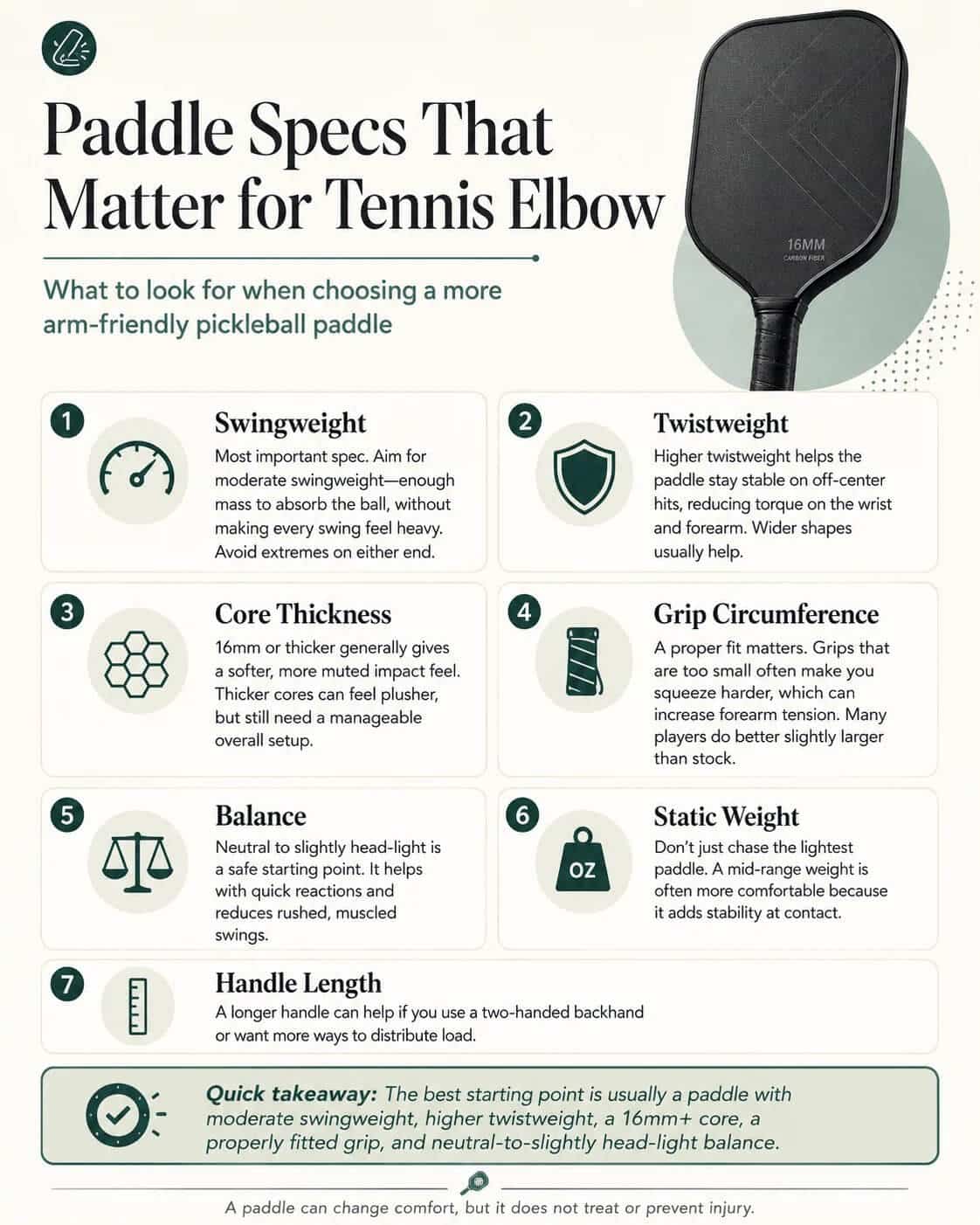
If you're searching for the best pickleball paddle for tennis elbow, start with an honest premise: a paddle is not a treatment. No paddle diagnoses, heals, or prevents an injury, and any seller who tells you otherwise is selling you something. What equipment can do is change how much shock reaches your hand, how hard you have to squeeze the handle, and how much muscular effort each swing demands. Those three things are worth taking seriously, and they are almost entirely a function of specs you can measure before you buy.
This guide walks through the specs that actually govern arm comfort — static weight, swingweight, twistweight, core thickness, grip circumference, handle shape, and balance — and explains how to read them together instead of chasing the lightest paddle on the wall. If you're already dealing with elbow or forearm pain, talk to a physician or physical therapist first. Then come back and set your equipment up so it isn't working against you.
Can a paddle for tennis elbow actually improve comfort?
Yes — but indirectly, and less dramatically than most marketing implies.
The honest framing is that no paddle for tennis elbow reduces pain on its own. It changes the mechanical demands you place on your forearm, and those demands are measurable.
Every ball contact sends a shock pulse and a vibration signature into the handle. How much of that reaches your forearm depends on where you hit the ball, how stable the paddle is at that contact point, how much the core and face damp the impulse, and how tightly you're gripping. A paddle that twists in your hand on off-center contact transmits more of that energy to your wrist and elbow than one that stays planted. A grip that's too small makes you squeeze harder, and grip tension is the single most controllable variable in the chain.
What a paddle cannot do is undo an overuse problem. Lateral epicondylitis is a degenerative overuse condition of the forearm extensor tendons — it develops from accumulated repetition, not from one bad paddle. Volume, technique, warm-up, and recovery all sit upstream of equipment. Any paddle for tennis elbow is one lever among several, not the whole answer.
Paddle features that reduce harsh impact and vibration
The features most associated with a softer, less jarring feel are: a thicker core (16mm or more), a moderate swingweight rather than an extreme one, high twistweight for off-center stability, a grip circumference that fits your hand without forced squeezing, and a balance point that doesn't demand a rushed, muscled swing.
Notice what isn't on that list: low static weight. That's the most common recommendation in arm-comfort content and the one most likely to backfire when you're shopping for a paddle for tennis elbow. Here's how each of the real variables works.
Static weight vs. swingweight
These two numbers get conflated constantly, and the difference matters more than almost anything else in this article.
Static weight is what the paddle reads on a scale — typically somewhere in the 7.3 to 8.5 ounce range for most modern paddles. It tells you what your arm carries between points and how much load your shoulder holds through a long session.
Swingweight measures how heavy the paddle feels while it's moving, accounting for how that mass is distributed away from your hand. Two paddles can weigh an identical 8.0 ounces and feel completely different: one with mass concentrated near the handle swings light and quick, while one with the same mass out toward the top swings noticeably heavier.
Swingweight is the number that drives muscular effort per swing, which makes it the single most important spec on any paddle for tennis elbow. A very high swingweight makes fast hands battles and quick resets physically demanding, especially late in a session when you're fatigued and your technique starts to slip. A very low swingweight feels effortless to whip around but gives the ball less to push against, so more of the impact energy comes back at you instead of going into the ball.
For arm comfort, the goal is moderate swingweight — enough mass in motion to absorb the ball, not so much that you're straining to get the paddle into position. USA Pickleball places no restriction on paddle weight, so the range on the market is wide and you have real room to fit yourself.
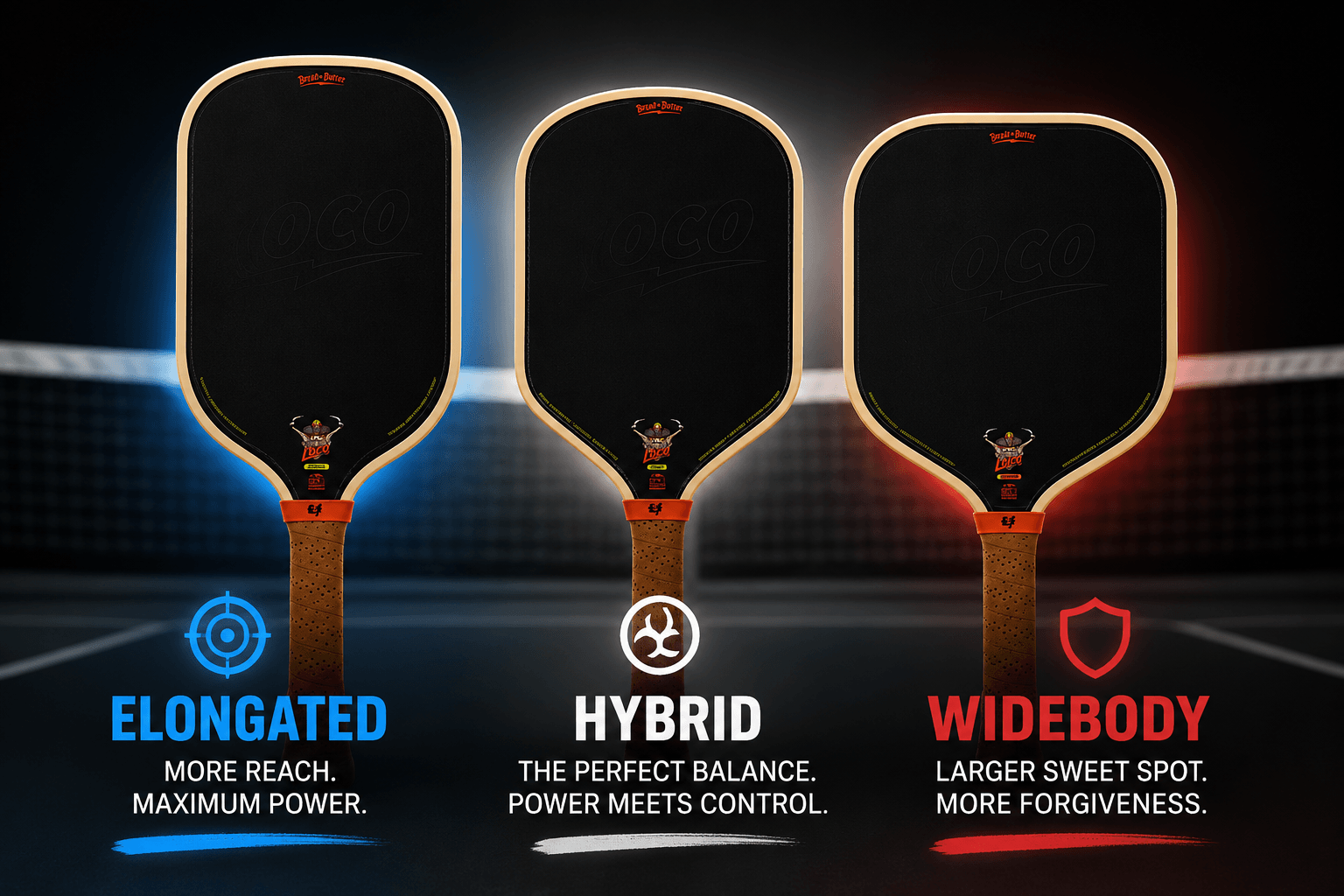
Third variable worth knowing: twistweight, which describes resistance to rotation when you hit off the centerline. Low twistweight means the head torques in your hand on mishits, and that torque loads your wrist and forearm. Wider paddle shapes generally produce higher twistweight than elongated ones. If you shank a lot of balls — most recreational players do — twistweight deserves real attention when comparing any paddle for tennis elbow.
Why the lightest paddle for tennis elbow is rarely the right one
The standard advice is "get the lightest paddle you can find." It's intuitive and often wrong.
A very light paddle carries less momentum into contact. Physics doesn't skip the transaction: when there's less paddle mass resisting the ball, a larger share of the collision energy travels back into the handle. Light paddles also tend to get pushed around on hard drives and fast exchanges, and the compensation is unconscious — you squeeze harder to keep the face stable, and you swing harder to generate the pace the paddle isn't providing. Both of those add load to the forearm.
There's a real point below which a paddle becomes counterproductive for a given player, and it varies by strength, style, and how much pace you face. Many players end up more comfortable a few tenths of an ounce heavier, with the added mass placed where it improves stability rather than swing speed. When choosing a paddle for tennis elbow, the right question isn't "how light can I go" but "what's the lightest paddle that still feels solid at contact."
Core thickness and impact feel
Thickness is the spec most shoppers reach for first when comparing a paddle for tennis elbow, and it does matter — just not in isolation.
Core thickness is the most reliable single proxy for impact feel. There is no rule restricting paddle thickness, so manufacturers build across a wide range, but the market has mostly settled into three tiers.
Thinner cores around 13mm hit firmer and more directly. The ball leaves faster with less dwell time, and the feedback through the handle is crisper — some players describe it as "harsh," others as "connected." Thicker cores around 16mm compress more on contact, hold the ball marginally longer, and generally return a softer, more muted sensation to the hand. Cores at 19mm and above push further in that direction, trading pop for plush feel and forgiveness.
Thicker isn't automatically better for you. A 16mm paddle that requires a bigger, faster swing to generate the same pace may cost you more in effort than the softer feel gains you. And a thick core paired with a very high swingweight is a demanding combination regardless of how nice the contact feels — which is why a paddle for tennis elbow has to be evaluated on the whole spec sheet rather than one number.
Foam-perimeter and foam-injected constructions are worth a mention here. They typically raise twistweight and expand the usable hitting area, which helps mishit stability — but many of them are also built for power and carry more mass toward the head. Evaluate them on the full spec sheet, not on the construction buzzword.
Our 14mm vs 16mm comparison breaks down the thickness tradeoff in more detail, using the same model in both cores.
Grip circumference, handle shape, and overgrips
This is where the fastest, cheapest gains usually are, and it's the section most buyer guides skip. If you only change one thing on your paddle for tennis elbow, change this.
A grip that's too small forces you to close your hand further and squeeze harder to keep the paddle from rotating. Sustained grip tension keeps the forearm extensors under continuous load through the entire session. A grip that's too large has the opposite problem — you lose fine control of the face and can't release your hand freely at contact.
Most pickleball handles ship in a narrow band, roughly 4 to 4.5 inches in circumference, which is smaller than what many players coming from tennis are used to. If your hand feels cramped or your fingers dig into your palm, you are almost certainly on a grip that's too small for you.
Ways to adjust:
- Overgrips — each wrap adds roughly 1/16 inch of circumference. Cushioned overgrips add slightly more padding than tacky thin ones; two wraps of a tacky grip and one wrap of a cushioned grip feel very different even at similar diameters.
- Contoured grip systems — Hesacore and similar molded grips change the handle's cross-section, not just its size. The shaped surface is designed to let you hold the paddle securely with less squeeze pressure, which is the specific mechanism players with arm complaints tend to care about. Sizing runs differently from standard grips, so check the chart rather than guessing.
- Handle length and shape — a longer handle lets you choke up or use a two-handed backhand, which redistributes load off a single forearm. Thicker, more rectangular handle profiles generally reduce squeeze pressure compared to thin, rounded ones.
The Hesacore Tour Grip is worth considering for anyone who grips tightly under pressure or has been told to reduce forearm load. It changes handle geometry rather than just adding padding, and it noticeably increases grip circumference — if you're already at the top of your comfortable size, that's a real tradeoff to test before committing. Players who prefer a very fine, tennis-style handle feel sometimes find it too bulky. It comes in Small and Medium, and sizing does not map to standard grip sizes.
Head-light vs. head-heavy balance
Balance is the last major variable in fitting a paddle for tennis elbow, and the one players most often ignore.
Balance describes where the paddle's mass sits relative to your hand, and it drives how the paddle behaves in the two situations that stress the arm most: fast hands at the kitchen, and reaching for a ball you're late to.
Head-light paddles get into position quickly and are easy to reset with. Less effort per swing, faster reaction speed, less strain in quick exchanges. The tradeoff is less mass behind the ball, so you supply more of the power yourself — and for some players that means swinging harder, which is its own kind of load.
Head-heavy paddles carry more mass through contact and generate pace with a shorter, calmer swing. That plow-through can genuinely feel easier on the arm on drives and serves. But they demand more from your shoulder and forearm during quick exchanges and when you're stretched wide.
For most players evaluating a paddle for tennis elbow, a neutral-to-slightly-head-light balance with adequate total mass is the safer starting point. It reduces the rushed, muscled swings that tend to cause trouble while keeping enough weight behind the ball to avoid the light-paddle problem described above.
Spec cheat sheet for a paddle for tennis elbow
| Spec | What it changes | Generally more arm-friendly |
|---|---|---|
| Static weight | Load carried between points; stability at contact | Mid-range — not the lightest available |
| Swingweight | Muscular effort per swing | Moderate; avoid extremes at either end |
| Twistweight | Torque on your wrist during off-center hits | Higher; wider shapes tend to help |
| Core thickness | Firmness and vibration character at contact | 16mm or thicker for a softer feel |
| Grip circumference | How hard you squeeze all session | Properly fitted — often larger than stock |
| Balance | Swing effort and reaction speed | Neutral to slightly head-light |
| Handle length | Two-handed options; load distribution | Longer if you use a two-handed backhand |
Paddles worth starting with
These aren't cures, and none of them is right for every player — but each one gets a specific variable from the sections above pointed in the arm-friendly direction. Match a paddle for tennis elbow to the part of your game that hurts, then demo before you commit.
ProKennex Black Ace Ovation — built around impact damping
If any paddle in the shop was engineered for the problem this article describes, it's this one. ProKennex's Kinetic system places tungsten-filled chambers in the head that absorb a portion of the impact shock before it travels down the shaft to your hand — a mechanism aimed directly at the shock-pulse pathway, not just a softer core. The oval head also runs a naturally higher twistweight than an elongated shape, so off-center contact torques the handle less. It's the first paddle we hand anyone who mentions elbow or wrist soreness, and at $99 it's the most affordable serious option here. The tradeoff: the damping feel is distinctive, and players who want maximum pop sometimes find it too muted — which is rather the point.
ProKennex Kinetic Black Ace Ovation Pickleball Paddle
$79.00
Boasting ProKennex's innovative oval shape, the Black Ace Ovation Pickleball Paddle with Kinetic technology provides aggressive power and response all over the court. Its one-piece Toray carbon fiber molded construction offers stability and a reactive feel so you can keep… read more

Six Zero Coral 16mm Lightweight — low swingweight, high stability
This is the paddle for the swingweight problem. It's genuinely light in hand at 7.6–7.9 oz, but the Widebody version pairs that with a twistweight of 6.70 — among the highest in our catalog — so you get an easy swing and a stable face on mishits, the exact combination the balance and swingweight sections argue for. The thinned handle profile also leaves room to add an overgrip and reach your correct grip size without ending up with a bulky handle. Take the Widebody over the Hybrid if arm comfort is the priority; it swings lighter and resists twisting more. Tradeoff: light paddles give up plow-through on drives, so if you generate pace by leaning on the paddle, you'll want to add a little weight.
Six Zero Coral Pickleball Paddle 16mm - Lightweight
$200.00
Six Zero Coral Lightweight Pickleball Paddle Built on the award-winning Next Gem™ platform, the Six Zero Coral Lightweight delivers the same balanced all-court performance players love with a quicker, more responsive feel. With a lighter base weight of 7.6–7.9 oz,… read more

Custom Six Zero Coral Lightweight with Hesacore Tour Grip — grip-first build
The grip section calls grip tension the single most controllable variable in the chain — this build acts on it directly. It's the same low-swingweight, high-twistweight Coral Lightweight platform, assembled with a Hesacore Tour grip whose contoured cross-section lets you hold the paddle securely with less squeeze pressure. If you've been told to reduce forearm load, or you catch yourself death-gripping the handle in fast exchanges, this is the most targeted paddle for tennis elbow we build. Tradeoff: the hexagonal feel takes a few sessions to adjust to and runs bulkier than a standard round handle, so it's worth trying in-store first if you prefer a fine, tennis-style grip.
RONBUS Quanta R1.16 — adjustable on a budget
At $119, this is the value pick for anyone who wants to tune rather than replace. The foam-based core with an EVA and TPE ring dampens vibration better than standard honeycomb, and the widebody-leaning shape carries a forgiving twistweight. More to the point, it's a sensible platform to experiment on: add an overgrip, add a few grams at 3 and 9 o'clock, and you can move several of the specs in this guide without spending $200 first. Tradeoff: it's a simpler build than the premium options, without the engineered damping of the ProKennex or the tuned lightweight feel of the Coral.
RONBUS Quanta R1.16 Pickleball Paddle
$119.00
New to Ronbus's lineup? See how this paddle compares to every other Ronbus Quanta shape before you commit. Read the complete Ronbus Guide → Paddle Features & Technologies 4th Generation Foam Core Technology – built with an advanced EPP foam… read more

What to demo before you commit
Spec sheets narrow the field. They don't pick the paddle. Feel at contact is individual enough that demoing is the only way to know, and paddles in this category are expensive enough that guessing is a bad trade.
A useful demo set for a paddle for tennis elbow spans the variables rather than clustering around one:
- A 16mm control-oriented paddle in a standard or widebody shape — the baseline soft-feel option, high twistweight, forgiving on mishits.
- A 16mm elongated paddle with a longer handle — more reach and a two-handed backhand option, but lower twistweight, so you'll feel whether off-center contact bothers you.
- A thicker 19mm-class paddle — plusher contact, less pop; tells you whether you value dampening enough to give up some power.
- Optionally, a foam-perimeter construction — expanded sweet spot and high stability, usually at the cost of a higher swingweight.
Play at least a full session with each, not a few dinks. Comfort problems show up in the third game, not the first ten minutes — which is exactly why in-store swings and 20-minute trials are misleading.
Our demo program covers this, and both the Great Neck and Long Beach shops keep a rotating selection on hand. If a build isn't quite right off the shelf, we also assemble custom paddles with your choice of grip and thickness.
Tuning the paddle you already own
Before replacing anything, it's worth finding out whether your current paddle can be adjusted into range — the cheapest paddle for tennis elbow is often the one already in your bag. USA Pickleball permits alterations including weighted tape, grip inserts, and grip wraps, provided the paddle still meets all specifications, so this is legal for tournament play, not just rec games.
Three adjustments, in the order we'd try them:
- Fix the grip first. Add an overgrip and see what happens over a couple of sessions. It costs a few dollars and changes the variable with the largest effect on forearm tension. If one wrap isn't enough, try two, or move to a contoured grip system.
- Add weight at 3 and 9 o'clock. Tape placed on the sides at the widest point raises twistweight substantially with a modest swingweight increase. This is the highest-leverage placement for mishit stability. Start with 2–4 grams per side and play with it before adding more.
- Add weight at the handle or butt cap. Mass here increases total weight and shifts balance toward head-light without adding swing effort. Useful for counterbalancing after adding weight up top.
Avoid loading weight at 12 o'clock if arm comfort is your goal — it raises swingweight fastest and increases effort per swing, which is usually the wrong direction for a paddle for tennis elbow.
Tungsten tape is the material worth knowing about here: its density means you add mass in a smaller footprint than lead tape, which matters at 3 and 9 o'clock where space along the edge is limited. If you're only adding a gram or two, standard weighted tape does the same job for less.
When to stop playing and see a professional
Equipment changes are for managing effort and impact. They are not a response to pain, and no section of this article should be read that way. There is no such thing as a paddle for tennis elbow that substitutes for treatment.
Stop playing and get evaluated by a physician or physical therapist if you notice pain that persists after you finish playing, pain during everyday tasks like lifting a mug or turning a doorknob, noticeable loss of grip strength, numbness or tingling in the hand or fingers, or discomfort that has been building over weeks rather than showing up once after a long session. Most cases respond to non-surgical management — but that management involves load reduction and a structured program, both of which require actually knowing what you're dealing with.
Buying a new paddle while playing through worsening pain is the most expensive way to make the problem last longer.
If you want help matching specs to your game, come into either shop. Describing how your arm feels after a typical session tells us more than any spec sheet, and we'd rather fit you properly than sell you the wrong paddle for tennis elbow twice.
FAQs
Can a pickleball paddle cause tennis elbow?
Not on its own. Lateral epicondylitis is an overuse condition that develops from accumulated repetition. A poorly fitted paddle — undersized grip, low twistweight, extreme swingweight — increases the load per swing, which can accelerate the process. Volume, technique, and recovery matter more than equipment.
Is a lighter paddle better for tennis elbow?
Usually not as light as people assume. A very light paddle carries less momentum into contact, so more collision energy returns to your hand, and you tend to squeeze and swing harder to compensate. The goal is the lightest paddle that still feels solid at contact, not the lightest paddle available.
What core thickness is best for arm comfort?
16mm or thicker generally gives a softer, more muted impact than a 13mm or 14mm core. But thickness alone doesn't decide it — a thick core paired with a high swingweight can demand more effort overall than a thinner, easier-swinging paddle.
Will a bigger grip help my elbow?
It's the cheapest thing to try and often the most effective. A grip that's too small forces continuous squeezing, which keeps the forearm extensors loaded all session. Add an overgrip, play two sessions, and see. Contoured grips like Hesacore change the handle's cross-section so you can hold it securely with less pressure.
Where should I add weight to make a paddle more arm-friendly?
At 3 and 9 o'clock, which raises twistweight substantially with only a modest swingweight increase — the best trade for mishit stability. Adding weight at the butt cap increases total mass without adding swing effort. Avoid 12 o'clock, which raises swingweight fastest.
Should I keep playing through elbow pain with a new paddle?
No. Equipment changes manage effort and impact; they are not a response to pain. See a physician or physical therapist if pain persists after play, shows up during daily tasks, or has been building over weeks. Changing paddles while playing through worsening pain usually extends the problem.