
Table of Contents
- Honolulu J6CR Crystal Blue Review: Quick Verdict
- J6CR Crystal Blue Specifications
- What Is the Crystal Blue Endurance Surface?
- The Blue Grit Consistency Question
- Tournament Approval: The Part Most Retailers Get Wrong
- Power, Pop and Spin
- Sweet Spot, Stability and Forgiveness
- The Elongated Shape and Six-Inch Handle
- J6CR Crystal Blue vs Standard J6CR vs J2CR Crystal Blue
- Recommended Setup and Weighting
- Who Should Buy It, and Is It Worth $195?
- Final Verdict
- FAQs
This Honolulu J6CR Crystal Blue review exists because the paddle is harder to recommend than its spec sheet suggests. On paper it's an easy yes: elongated 16mm foam core, six-inch handle, one of the most aggressive durable-grit surfaces on the market, $195. In practice, the same qualities that make it dangerous in experienced hands make it demanding for players who don't consistently find the center of the face — and its certification status rules it out for a large group of buyers entirely.
Below: verified specifications, what the Crystal Blue surface actually is, the approval problem, how it compares to the standard J6CR and the J2CR, and who should skip it.
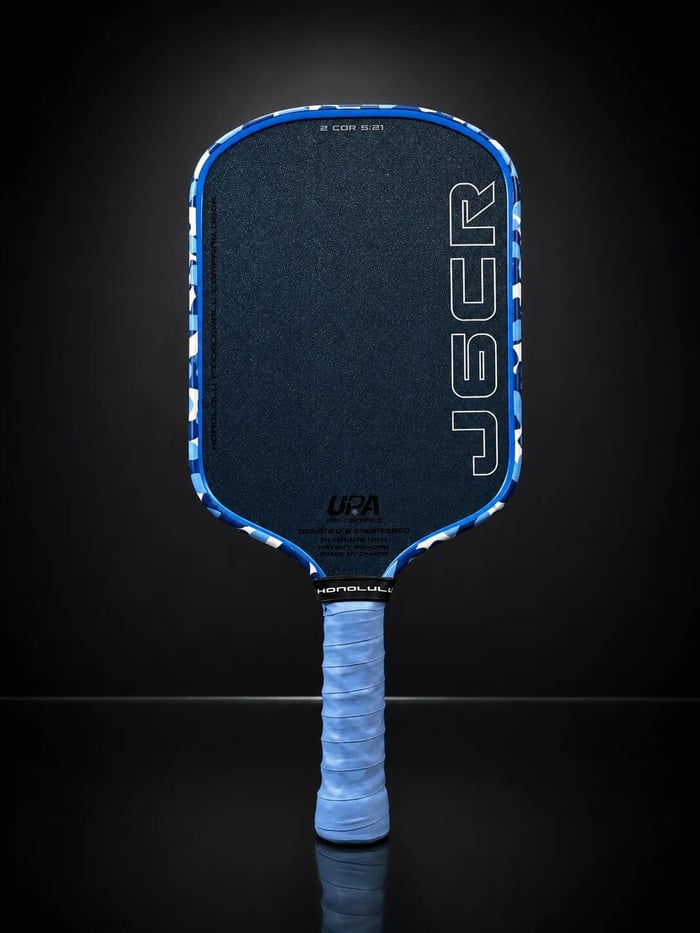
Honolulu J6CR Crystal Blue Review: Quick Verdict
A power-leaning elongated paddle whose headline feature is surface bite, not raw output. Best suited to aggressive intermediate and advanced players who already prefer elongated shapes and already generate spin. Less forgiving laterally than the hybrid J2CR. Approved by UPA-A, not USAP.
| Profile | Power-leaning elongated |
| Standout feature | Crystal Blue surface bite and ball shaping |
| Main drawback | Lower lateral forgiveness than the J2CR or J3CR |
| Certification | UPA-A approved — verify before USAP events |
| Price | $195, includes waterproof cover |
| Our advice | Demo before buying if you're not already an elongated player |
Buy it if
- You already know you prefer elongated paddles
- You generate topspin and slice deliberately, not incidentally
- You use a two-handed backhand
- You want reach and leverage without an extreme swing weight
- You play recreationally or in UPA-A-eligible competition
Skip it if
- You need a USAP-approved paddle
- Your contact point is still inconsistent
- You want maximum kitchen-line hand speed
- You prefer a muted, control-first feel
- Visible cosmetic variation in the face will bother you
Ready to move? Shop the Honolulu J6CR Crystal Blue.
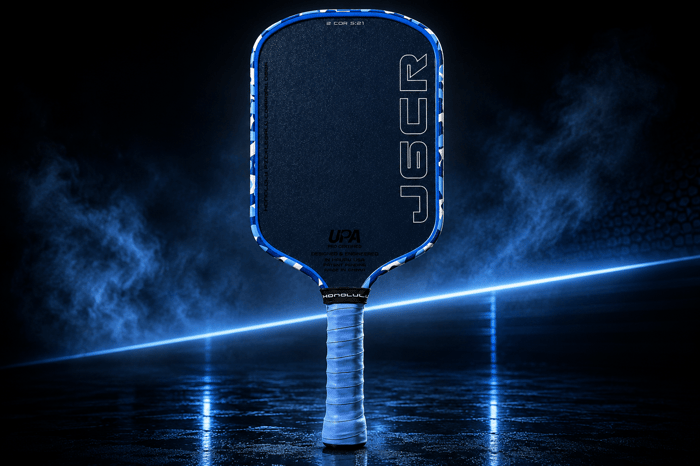
Honolulu Pickleball Sword & Shield J6CR Crystal Blue Endurance Surface™

$195.00
Shipping 9/8 - 9/10 HONOLULU Pickleball Company J6CR Pickleball Paddle The J6CR is Honolulu's next-generation power paddle. Featuring Core Reactor™ with Dynamic PowerFlex Technology™ and an industry-first Control Joint Technology™, the J6CR delivers the most power in our lineup, with… read more
J6CR Crystal Blue Specifications
Every J6CR Crystal Blue review quotes the same numbers, so here they are with the two that actually need explaining flagged underneath. All figures are Honolulu's published specifications for the Crystal Blue version specifically.
| Specification | Manufacturer figure |
|---|---|
| Shape | Optimized elongated |
| Dimensions | 16.48" × 7.52" |
| Core | Multi-density foam, 16mm |
| Face | Carbon fiber, fiberglass, carbon fiber |
| Surface | Crystal Blue Endurance Surface (Blue Grit) |
| Construction | Thermocompression formed, perimeter balanced |
| Average weight | 8.0–8.2 oz |
| Swing weight | 111–116 |
| Twist weight | 6.2–6.7 |
| Grip length | 6" (includes tapered area above the grip wrap) |
| Grip circumference | 4.125" |
| Certification | UPA-A |
| Warranty | One year |
| Included | Waterproof cover with hanging clip |
| Price | $195 |
Two specs deserve a note. The six-inch grip length includes the tapered section above the grip wrap, so usable handle length measured independently will read shorter — worth knowing if you're cross-shopping against a brand that measures differently. And the swing weight range of 111 to 116 is wide enough that two paddles from the same batch can feel meaningfully different in hand.
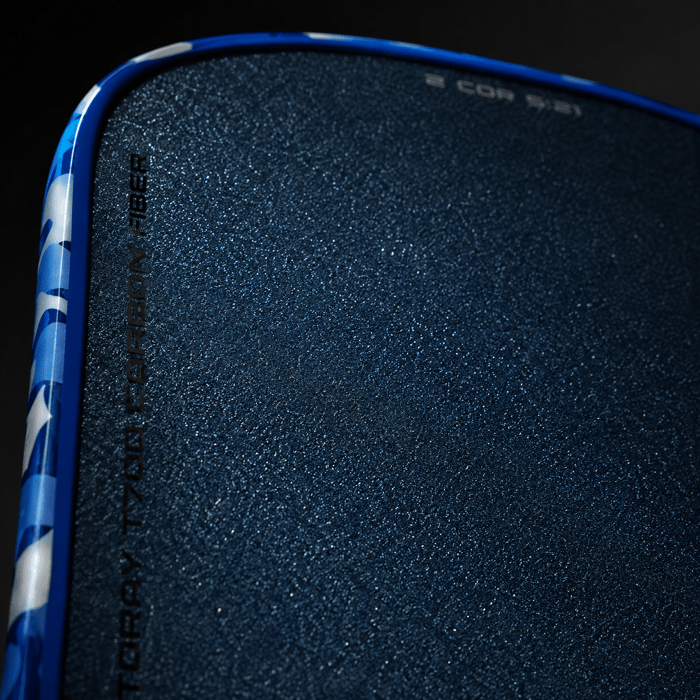
What Is the Crystal Blue Endurance Surface?
This is the reason most people are searching for the paddle, so any useful Honolulu J6CR Crystal Blue review has to be precise about what's claimed versus what's demonstrated.
What Honolulu says
Honolulu describes Blue Grit as a patent-pending process in which crystal-based particulate media is mechanically interlocked into the face, with the stated goal of delivering controlled texture and long-term surface durability. That's the manufacturer's description of their own process, not independently verified engineering.
Why it behaves differently from raw carbon
A raw carbon face gets its texture from the finishing process — peel-ply leaves an impression in the resin. That texture is thin and abrades. A particulate surface embeds harder material into the face instead, so there's more depth of texture to wear through. The practical claim is longer-lasting bite rather than higher peak spin. We covered how different brands approach this in our breakdown of durable grit paddle surfaces.
Worth separating two things buyers routinely conflate: how rough a paddle feels to your thumb, and how much spin it generates in play. Surface texture is one input. Dwell time, swing path, and your own mechanics are the others, and they matter more.
Is it genuinely one of the grittiest surfaces available?
Independent surface-roughness testing has placed Crystal Blue among the roughest faces measured, and the same testing put both the J2CR and J6CR Crystal Blue near the top of its spin rankings. That supports the claim. It doesn't follow that this is automatically the best paddle for you — usable, repeatable spin matters more than a roughness figure, and a very aggressive surface amplifies inconsistent swing paths as readily as consistent ones.
The Blue Grit Consistency Question
Buyers have reported uneven roughness between the two faces and visible cosmetic irregularity. Most coverage skips this; a J6CR Crystal Blue review that ignores it is not useful to someone about to spend $195.
Honolulu's position
Honolulu states plainly that each paddle has a naturally varied appearance, that lighting significantly changes how the finish looks, and that surface roughness is tested against their functional specification. They note that additional printing or coating would improve visual uniformity but reduce performance, and that cosmetic variation within their approved tolerance is not eligible for exchange or warranty. Their framing is that visual character and performance are in tension and they've chosen performance.
That's a defensible engineering position and an unusual one to state so bluntly on a product page. It also means a buyer expecting a uniform finish will be disappointed and will not have a warranty remedy.
What to inspect when yours arrives
- Compare both faces in the same lighting, then again in different lighting
- Run your hand across the entire face, not one patch
- Check for loose fibers or abnormal finishing at the edges of the hitting area
- Confirm the edge guard is fully seated
- Hit a few balls off each face and compare response
Cosmetic variation is expected. A functional difference in how the two faces grip the ball is a different problem — contact your retailer promptly rather than playing with it for a month first.
Tournament Approval: The Part Most Retailers Get Wrong
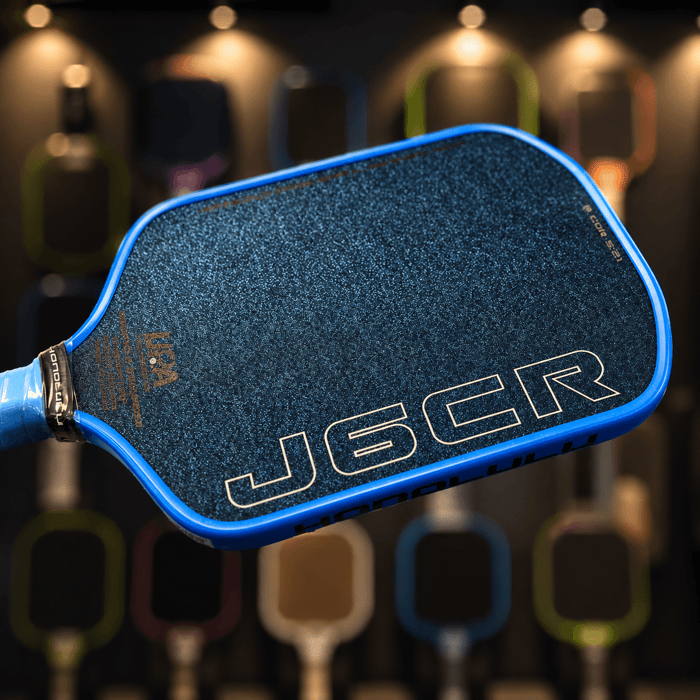
This is the single most important section of any Honolulu J6CR Crystal Blue review, and current search results contain contradictory information about it.
The Crystal Blue version is UPA-A approved. The standard J6CR is the USAP-approved model. These are not interchangeable. UPA-A certification governs professional PPA and MLP competition. It does not make a paddle legal in every USAP-sanctioned event.
Practical guidance:
- Recreational and open play: no issue
- UPA-A-sanctioned events: eligible
- USAP-sanctioned tournaments: verify with the event before buying — do not assume
- Club and facility leagues: many set their own equipment rules; check
If you need USAP eligibility, buy the standard J6CR instead. It shares the elongated platform and foam core with a conventional carbon face.
Power, Pop and Spin
Honolulu positions the J6CR as the most powerful paddle in their lineup, built on the J2 long-handle platform with an extended face and a chopped top curve that shifts mass toward the head. The mechanism is straightforward: more mass further from your hand produces more swing weight, which produces more plow-through for the same effort.
Published head-to-head comparisons position it as power-leaning but not the hardest-hitting elongated foam paddle available — one comparison against the Friday Aura Pro Elongated gave the Aura more raw drive power while giving the J6CR the advantage in spin and soft-game control. That's a more useful characterization than "power paddle": it produces serious pace when you swing for it, with a response that stays readable rather than launching everything.
On spin, the reasonable claim is that the surface rewards players who already shape the ball. Topspin drives, shaped serves, roll volleys and slice returns are where an aggressive face pays. If you're hoping the paddle will manufacture spin you don't currently produce, the more likely outcome is that your misses become less predictable rather than your winners more frequent.
One thing worth flagging that no J6CR Crystal Blue review seems to say outright: power and spin here are coupled, not independent. The surface is what brings your drives down inside the baseline, so if you swing hard without shaping the ball, the paddle will feel hot and unpredictable rather than powerful. Read every J6CR Crystal Blue review claim about pop with that caveat attached.
Sweet Spot, Stability and Forgiveness
This is where a balanced Honolulu J6CR Crystal Blue review has to depart from the marketing. Honolulu lists a twist weight range of 6.2 to 6.7. Independent analysis has described the paddle's torsional stability as below average depending on the unit.
What that means in play: centered contact is rewarded heavily, and contact toward the side edges twists the face more than it would on a wider paddle. This is a geometry consequence, not a defect — at 7.52 inches wide, there's less mass out at the edges to resist rotation. The J2CR and J3CR are more forgiving across the width because they're wider, as we broke down in our full Honolulu CR Series comparison.
Note the tension here. Honolulu's own listing describes the player level as advanced beginners through pro, and lists a large sweet spot among the paddle's attributes. That's a defensible claim vertically — an elongated face gives you a taller usable area. It's less defensible laterally. If you miss side to side more than high and low, the shape is working against you.
Side weighting improves this measurably and is the standard fix. It won't make a 7.52-inch face behave like an 8-inch one.
The Elongated Shape and Six-Inch Handle
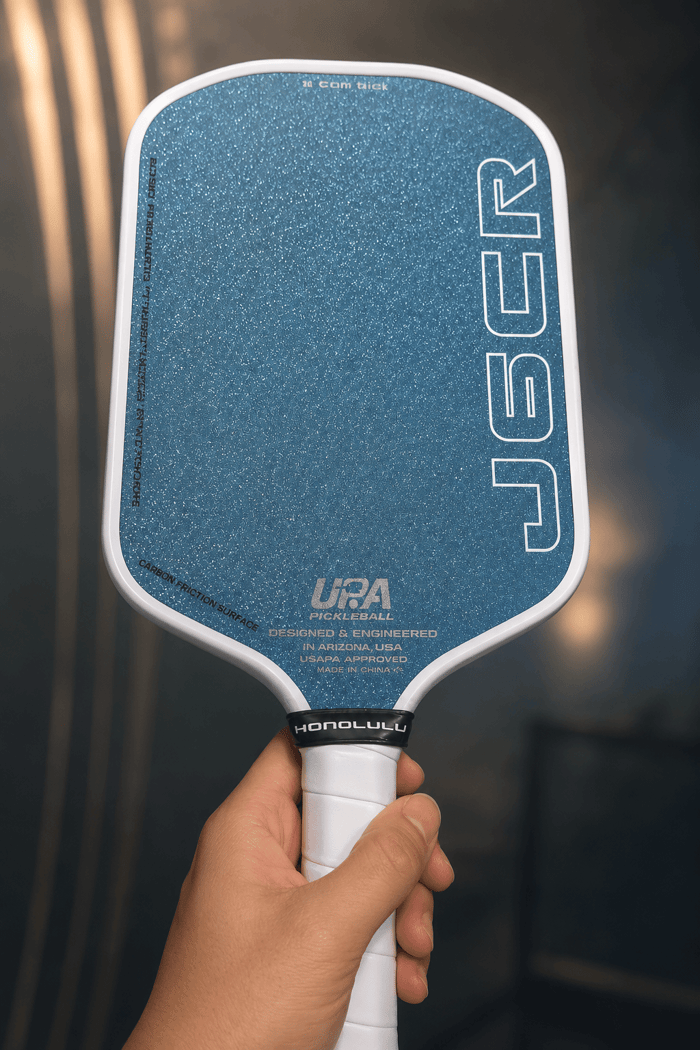
The six-inch handle is genuinely useful for two-handed backhands and adds serve leverage. The elongated face adds reach at the kitchen and on stretch volleys. Both come at the cost of hand speed in fast exchanges and lateral forgiveness.
The decision rule is simple: this paddle makes sense for someone who has already decided they like elongated shapes. The Crystal Blue surface is not a good enough reason to switch shapes. If you're currently playing a hybrid or widebody and considering this because of the grit, the J2CR Crystal Blue gives you the same surface in a shape that will likely suit you better.
J6CR Crystal Blue vs Standard J6CR vs J2CR Crystal Blue
The comparison below is the practical core of this J6CR Crystal Blue review, because the surface is effectively identical across the two Crystal Blue models.
| Category | J6CR Crystal Blue | Standard J6CR | J2CR Crystal Blue |
|---|---|---|---|
| Shape | Elongated | Elongated | Hybrid |
| Surface | Blue Grit | Conventional carbon | Blue Grit |
| Certification | UPA-A | USAP | UPA-A |
| Hand speed | Slower | Slower | Faster |
| Lateral forgiveness | Lower | Lower | Higher |
| Reach | Higher | Higher | Moderate |
| Choose it for | Max bite plus reach | USAP eligibility | All-court doubles |
Published testing describes the surface as essentially the same story across the J2CR and J6CR, which makes shape the actual purchasing decision. For most doubles players, the J2CR is the safer recommendation. The J6CR is the better choice when elongated reach, leverage and a full power-paddle swing are non-negotiable.
Honolulu Pickleball Sword & Shield J2CR Crystal Blue Endurance Surface™

$195.00
HONOLULU Pickleball Company J2CR Pickleball Paddle The J2CR is Honolulu's next-generation hybrid power paddle, built for players who want explosive pop, heavy spin, quick hand speed, and a large, confidence-inspiring sweet spot. Featuring Core Reactor™ with Dynamic PowerFlex Technology™, Control… read more
Recommended Setup and Weighting
Most J6CR Crystal Blue review coverage skips setup entirely. Play it stock first. The swing weight range is wide enough that your specific unit may already sit where you want it, and modifying before you know the stock behavior wastes the baseline.
If you want more stability, the standard approach is small equal amounts of tungsten tape at roughly 3 and 9 o'clock, added incrementally, with static weight and balance re-measured after each change. Avoid loading 12 o'clock early — it raises swing weight and slows your hands, which is the opposite of what this paddle needs help with. If you'd rather have it dialed in before it ships, our custom paddle build service handles the weighting and re-measurement for you.
Who Should Buy It, and Is It Worth $195?
At $195 with a premium cover included and a one-year warranty, the J6CR Crystal Blue is priced below several flagship foam-core competitors while offering a genuinely differentiated surface. For an aggressive elongated player in recreational or UPA-A-eligible play, that's strong value, and it's the conclusion most of this J6CR Crystal Blue review points toward.
It's poor value in two cases: if you need USAP approval, in which case you're buying the wrong paddle regardless of price; and if you'd be better served by the J2CR's wider face, in which case you're paying for reach you'll spend the season fighting. If budget is the constraint rather than fit, our certified pre-owned paddles are a lower-risk way to test an elongated foam-core shape first.
Final Verdict
The J6CR Crystal Blue is one of the more interesting elongated power paddles available right now, because it pairs usable foam-core power with a surface that measurably outperforms conventional carbon on bite and is designed to hold that bite longer. It rewards aggressive drives, shaped serves and two-handed backhands. If there's one line to take from this J6CR Crystal Blue review, it's that the paddle amplifies whatever mechanics you bring to it.
It is not the default choice in Honolulu's Crystal Blue lineup. The J2CR remains easier to recommend for most doubles players because it is faster and more forgiving across the width of the face. And the certification split is the decision point everything else hangs on: this is a UPA-A paddle, and buyers headed for USAP-sanctioned events should be looking at the standard J6CR.
Three ways to proceed: buy the J6CR Crystal Blue if you're a committed elongated player who wants maximum surface bite; choose the J2CR Crystal Blue for faster hands and broader forgiveness; or demo both before deciding if you're genuinely unsure. Our Great Neck and Long Beach locations stock both shapes, and a free paddle consultation will get you a specific recommendation faster than another hour of reading.
FAQs
Is the Honolulu J6CR Crystal Blue USAP approved?
No. The Crystal Blue version is UPA-A approved. The standard J6CR is Honolulu's USAP-approved model. Check your tournament's equipment requirements before buying.
What is the difference between the J6CR and J6CR Crystal Blue?
Same elongated platform and foam core. The Crystal Blue uses Honolulu's durable particulate surface and is UPA-A approved; the standard J6CR uses a conventional carbon face and is USAP approved.
Is the J6CR Crystal Blue a power or control paddle?
Power-leaning. The elongated shape and foam construction produce strong offensive output, with enough dwell time and spin to keep the response more readable than some hotter elongated paddles.
Is the J6CR Crystal Blue good for beginners?
Better suited to intermediate and advanced players. Its power, surface aggression and lower lateral stability punish inconsistent contact, though an athletic beginner with racket-sport background may adapt.
Does the J6CR Crystal Blue have a large sweet spot?
Usable for an elongated paddle, and tall. But the 7.52-inch width and twist weight of 6.2–6.7 make side-to-side mishits more noticeable than on the J2CR or J3CR.
How long is the J6CR handle?
Honolulu lists six inches, measured to include the tapered area above the grip wrap. Independently measured usable handle length will read shorter.
Does the Crystal Blue surface wear out?
All surfaces wear. The particulate construction is designed to retain texture longer than a conventional peel-ply face, but longevity depends on playing hours, ball type and environment.