
Table of Contents
- Pickleball Paddle Shape Dimensions
- Widebody Paddles: Advantages and Drawbacks
- Hybrid Paddles: Advantages and Drawbacks
- Elongated Paddles: Advantages and Drawbacks
- How Shape Affects Swing Weight and Twist Weight
- Elongated vs Hybrid Pickleball Paddle: Which Shape for Which Situation?
- The Three-Shape Demo Sequence
- Shopping by Shape at Spinwave
- FAQs
The elongated vs hybrid pickleball paddle question usually gets answered in one sentence: elongated gives you reach, hybrid gives you balance. That's true and almost useless, because it skips the two things that actually determine whether a shape works for you — swing weight and twist weight.
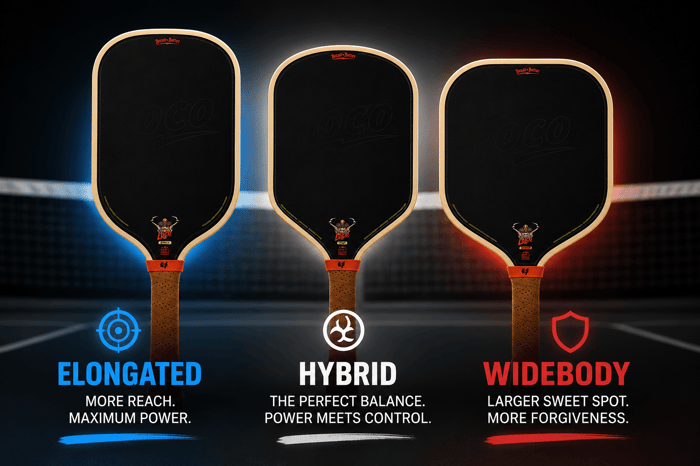
Here's the short answer. A hybrid paddle is roughly 16 to 16.3 inches long and about 7.75 inches wide; an elongated paddle is roughly 16.5 inches long and 7.5 inches wide. That half-inch of length moves mass away from your hand, which raises swing weight, adds leverage on drives, and slows your hands down at the kitchen. A widebody sits at the opposite end: shortest, widest, fastest, most forgiving, least reach. Below is how each shape actually behaves, what the specs mean in match situations, and a demo sequence that answers the question faster than any article can.
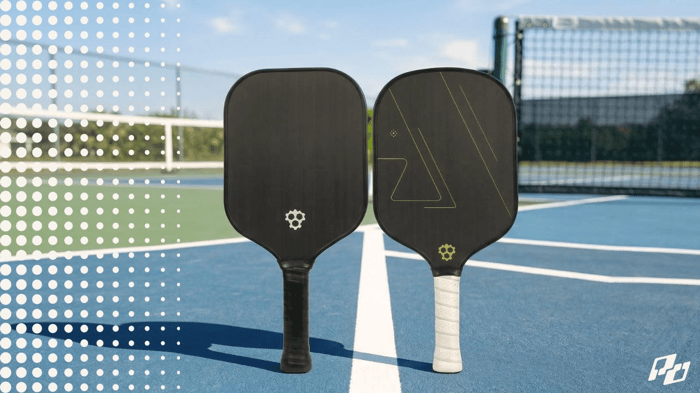
Pickleball Paddle Shape Dimensions
Every paddle shape exists inside the same regulatory box. Under USA Pickleball's equipment standards, length plus width cannot exceed 24 inches and length cannot exceed 17 inches. Shape is what manufacturers do with that budget. Spend it on length and you lose width. Spend it on width and you lose reach. There is no shape that wins everywhere.
| Shape | Typical Face | Typical Handle | What You're Buying |
|---|---|---|---|
| Widebody (standard) | 15.5–16" × 8–8.5" | 4.5–5" | Largest sweet spot, fastest hands |
| Hybrid | 16–16.3" × 7.75–8" | 5.25–5.5" | Reach without losing maneuverability |
| Elongated | 16.5–16.75" × 7.25–7.5" | 5.5–6" | Maximum reach and leverage |
Treat those as bands, not rules. Manufacturers apply these labels loosely, and handle length complicates it further — a paddle under 16 inches with a 5.5-inch handle often gets marketed as a hybrid despite widebody face dimensions. Always check the actual numbers on the product page rather than trusting the category name. A lot of the elongated vs hybrid pickleball paddle confusion comes from two brands labeling nearly identical dimensions differently.
Widebody Paddles: Advantages and Drawbacks
Selkirk OMNI Widebody Pickleball Paddle

$300.00
Selkirk OMNI Widebody Pickleball Paddle At the heart of the OMNI Widebody is the innovative ReactCore™ — a PureFoam™ floating center with a new PureFoam™ Ring surrounded by an EVA Power Ring for a dynamic core with adaptive flexibility. This… read more
The widebody is the original pickleball shape and remains the most forgiving one available. Width is what creates a sweet spot horizontally, and the extra inch across the face means off-center contact still produces a playable ball.
Where it wins: hand battles at the kitchen, defensive resets, blocking hard drives, and any situation where you're reacting rather than initiating. Mass sits closer to your hand, so the paddle changes direction faster. Table tennis converts tend to feel at home immediately.
Where it costs you: reach on wide balls and stretch volleys, leverage on drives and serves, and top-end spin potential — a shorter face means less distance between contact point and the pivot in your wrist. Widebodies are genuinely good for beginners, but framing them as beginner paddles is wrong. Plenty of high-level doubles players use them deliberately. If you've already narrowed to elongated vs hybrid pickleball paddle options, hit a widebody once before you commit — it's the shape most players skip and then wish they hadn't.
Hybrid Paddles: Advantages and Drawbacks
Six Zero Coral Hybrid Pickleball Paddle 16mm

$200.00
Six Zero Coral 16mm Hybrid Pickleball Paddle Balanced control + plush power. Built for all-court confidence. The Six Zero Coral 16mm Hybrid is built for players who want a perfectly balanced all-court paddle—blending plush dwell, stability, and controlled power. It… read more
The hybrid is now the best-selling shape on the market, and the reason is unglamorous: it has no severe weakness. It picks up meaningful reach and a longer handle over a widebody while keeping enough width that mishits aren't punished the way they are on a true elongated.
Where it wins: players who do a bit of everything, anyone with a two-handed backhand who still plays a lot of doubles, and anyone unsure where their game is heading. In the elongated vs hybrid pickleball paddle matchup, the hybrid is the lower-risk purchase almost every time.
Where it costs you: it doesn't specialize. If you're a singles player who wants every inch of court coverage, a hybrid leaves reach on the table. If you're a counter-punching doubles player who lives in fast hands exchanges, a widebody is quicker. The hybrid is the shape you choose when versatility is worth more to you than a specific edge.
Elongated Paddles: Advantages and Drawbacks
Elongated paddles trade width for length, and everything about how they play follows from that trade.
Where it wins: reach at the kitchen line and on stretch volleys, leverage on serves and drives, and spin ceiling — the longer face lets you generate more head speed through contact for the same arm speed. Former tennis players usually adapt fastest, partly from the familiar longer handle and partly because they already swing with a longer lever.
Where it costs you: the sweet spot narrows, and it narrows in the direction you miss most. Off-center contact toward the edges twists the paddle in your hand more aggressively. Hand speed drops in tight exchanges. Is an elongated paddle harder to control? For a developed player with consistent contact, no. For a player still finding the center of the face, yes, noticeably. That gap in contact consistency is what settles most elongated vs hybrid pickleball paddle choices.
Selkirk LABS Project Project Boomstik 16mm Pickleball Paddle - Elongated

$333.00
New to Selkirk's lineup? See how this paddle compares to every other Selkirk shape before you commit. Read the complete Selkirk Guide → 🚀 Explosive Power: BoomCore™ Technology delivers instant, long-lasting pop. 🎯 Elite Spin & Control: InfiniGrit™ Surface generates… read more
How Shape Affects Swing Weight and Twist Weight
This is where most shape guides stop short. Two paddles can weigh the same on a scale and play completely differently, because static weight tells you almost nothing about how a paddle behaves in motion.
Swing weight
Swing weight measures resistance to rotation around the handle — how heavy the paddle feels to accelerate. Length drives it. As a general rule, elongated shapes carry the highest swing weight, hybrids sit in the middle, and widebodies the lowest. Higher swing weight means more plow-through and more power for the same effort. It also means slower recovery between shots. This is the real mechanism behind "elongated paddles hit harder" — it's mass distribution, not magic. It's also why the elongated vs hybrid pickleball paddle gap feels much larger on court than a half-inch on paper suggests.
Twist weight
Twist weight measures resistance to rotation around the long axis — how much the face turns when you hit off-center laterally. Width drives it. Widebodies have the highest twist weight, elongated the lowest. This is the single most underrated spec in the elongated vs hybrid pickleball paddle decision, because twist weight is what people actually mean when they say a paddle is "forgiving." A narrow paddle punishes lateral mishits with a twisted face and a ball that leaves at the wrong angle.
Both are adjustable within limits. Lead tape at 3 and 9 o'clock raises twist weight and stability; tape at 12 raises swing weight and power; tape near the throat raises swing weight least. You can make an elongated paddle more stable, but you can't make it as wide. Our guide to static weight versus swing weight covers the measurements in more depth, and our paddle customization guide walks through tape placement.
Elongated vs Hybrid Pickleball Paddle: Which Shape for Which Situation?
| Your Situation | Best Fit | Why |
|---|---|---|
| Mostly singles | Elongated | Court coverage and serve leverage matter more than hand speed |
| Mostly doubles, aggressive | Hybrid | Reach for put-aways without giving up kitchen speed |
| Mostly doubles, defensive | Widebody | Highest twist weight for blocks, resets and counters |
| Losing hand battles | Widebody | Lowest swing weight, fastest direction changes |
| Two-handed backhand | Hybrid or elongated | Handle length is the constraint, not face shape |
| Coming from tennis | Elongated | Familiar lever length and handle |
| Still finding center contact | Widebody or hybrid | Mishits stay playable |
What paddle shape is best for singles?
Elongated, for most players. Singles is a coverage problem before it's a hands problem — you're stretching for wide balls and driving from the baseline far more than you're trading speed-ups at the net. The extra reach and serve leverage outweigh the sweet spot penalty. The exception is a singles player whose whole game is built on redirecting pace, where a hybrid keeps more of the defensive stability.
Which shape is fastest at the kitchen?
Widebody, clearly. Lower swing weight means faster direction changes, and higher twist weight means a blocked ball off the edge still goes where you aimed. If you're consistently late in hands battles, shape is a more effective fix than reflex training. Hybrids give up some of this; elongated paddles give up the most.
Which paddle shape has the biggest sweet spot?
Widebody, but the phrasing hides something. Sweet spots aren't circles. A widebody's is wider than it is tall; an elongated paddle's is taller and narrower. An elongated paddle can be more forgiving than a widebody on contact high or low on the face — it's lateral misses that hurt. Match the shape to the direction you actually miss.
Best shape for a two-handed backhand
RPM Friction Pro V2 Elongated 16mm Pickleball Paddle - Ella Oh Pink Signature

$249.99
RPM Friction Pro V2 — Elongated 16mm, Ella Oh Pink Signature This is the paddle that built on 2025 Paddle of the Year and made it meaner. The Friction Pro V2 pairs RPM new Axial Carbon Layup with the grippy… read more
Handle length is the spec that matters here, not face shape. You need roughly 5.5 inches to get a full second hand on the grip without your top hand riding onto the face. Elongated paddles almost always clear that; many hybrids do; most widebodies don't. Check the handle measurement directly rather than assuming from the shape label — this is the one case where the shape category will actively mislead you.
The Three-Shape Demo Sequence
The elongated vs hybrid pickleball paddle debate ends the moment you hit both back to back. Shape preference is largely proprioceptive, and most players are wrong about which shape they'll prefer until they've tried all three. Run this sequence in one session, same day, same partner:
- Start with the hybrid. It's the middle reference point. Anything you notice with the other two, you'll notice relative to this.
- Move to the widebody. Play twenty minutes of hands battles and resets specifically. If your blocks suddenly land where you aimed, twist weight is your limiting factor and you should stop here.
- Finish with the elongated. Hit serves, drives and stretch volleys. Then play a full game. If the reach feels like a gift and the mishits don't bother you, take it. If you find yourself late at the kitchen twice a game, you have your answer.
Do this before you buy, not after. Our demo program exists for exactly this, and our Great Neck and Long Beach locations let you hit all three shapes in one visit. The Boca Raton location has a full court on site.
Shopping by Shape at Spinwave
Once you've settled the elongated vs hybrid pickleball paddle question for your own game, narrow by shape first and material second. Shape determines how a paddle behaves; face material and core thickness fine-tune it.
Widebody
Prioritize twist weight and handle comfort. Browse widebody paddles.
Hybrid
Check the handle measurement before assuming a two-handed backhand will fit. Browse hybrid paddles.
Elongated
Look at swing weight, not static weight, and expect an adjustment period. Browse elongated paddles.
If you want to try a shape without paying full retail, certified pre-owned paddles are a low-risk way to test whether a category suits you. And if you'd rather skip the guesswork, our paddle finder narrows by playing style and skill level, or tell us how you play and what's going wrong and we'll make a specific recommendation.
FAQs
What is the difference between a hybrid and elongated pickleball paddle?
A hybrid is roughly 16 to 16.3 inches long and about 7.75 inches wide. An elongated paddle is roughly 16.5 inches long and 7.5 inches wide. The elongated shape trades width for length, which adds reach and leverage but narrows the sweet spot laterally and slows hand speed.
Is an elongated pickleball paddle harder to control?
For a player with consistent center contact, no. For a player still developing contact, yes — the narrower face has lower twist weight, so off-center hits toward the edges twist the paddle more and send the ball off-angle.
Which paddle shape has the biggest sweet spot?
Widebody, measured across the width. But sweet spots aren't circular: a widebody's is wider than it is tall, and an elongated paddle's is taller and narrower. Match the shape to the direction you actually mishit.
Are widebody paddles better for beginners?
They're more forgiving, which helps beginners, but they aren't beginner paddles. High-level doubles players choose widebodies deliberately for hand speed and stability on blocks and resets.
What paddle shape is best for singles?
Elongated, for most players. Singles rewards court coverage and serve leverage more than kitchen hand speed, so the reach outweighs the smaller sweet spot.
Which shape is fastest at the kitchen?
Widebody. Lower swing weight means faster direction changes and higher twist weight means blocked balls off the edge hold their line. Hybrids give up some of this, elongated paddles the most.
Does paddle shape matter for a two-handed backhand?
Handle length matters, not face shape. You want about 5.5 inches to fit a second hand without riding onto the face. Most elongated paddles clear that, many hybrids do, most widebodies don't — check the spec directly.