
Table of Contents
- What Is Static Weight?
- What Is Swing Weight?
- Why Some Paddles Feel Heavy Even When They Are Not
- How Balance Point Changes Paddle Feel
- Why Elongated Paddles Often Feel Heavier
- What Is Twist Weight?
- How Lead Tape Changes Swing Weight
- Who Should Use a Lower Swing Weight Paddle?
- Who Should Use a Higher Swing Weight Paddle?
- How to Choose the Right Paddle Feel
- Related Spinwave Links
- Final Thoughts: Static Weight Does Not Tell the Whole Story
- FAQs
- What is static weight in a pickleball paddle?
- What is swing weight in pickleball?
- Why does my paddle feel heavier than the listed weight?
- Is a lighter pickleball paddle always better?
- Do elongated paddles have higher swing weight?
- Does lead tape increase swing weight?
- Where should I add lead tape if I want more stability?
- Who should avoid high swing weight paddles?
- Who should use a higher swing weight paddle?
- How do I know if my paddle swing weight is too high?
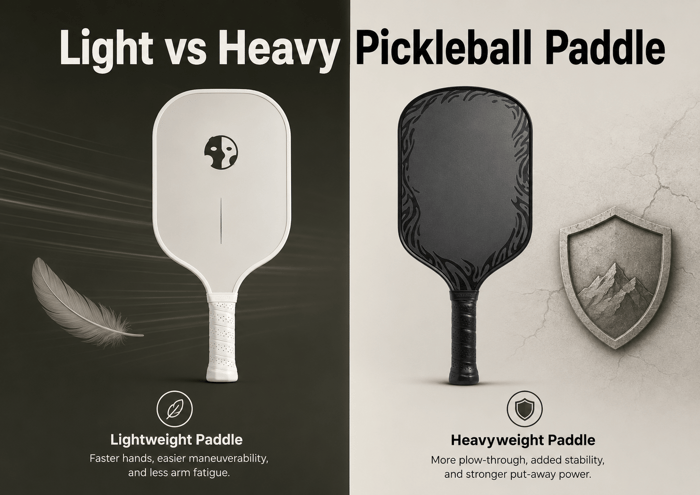
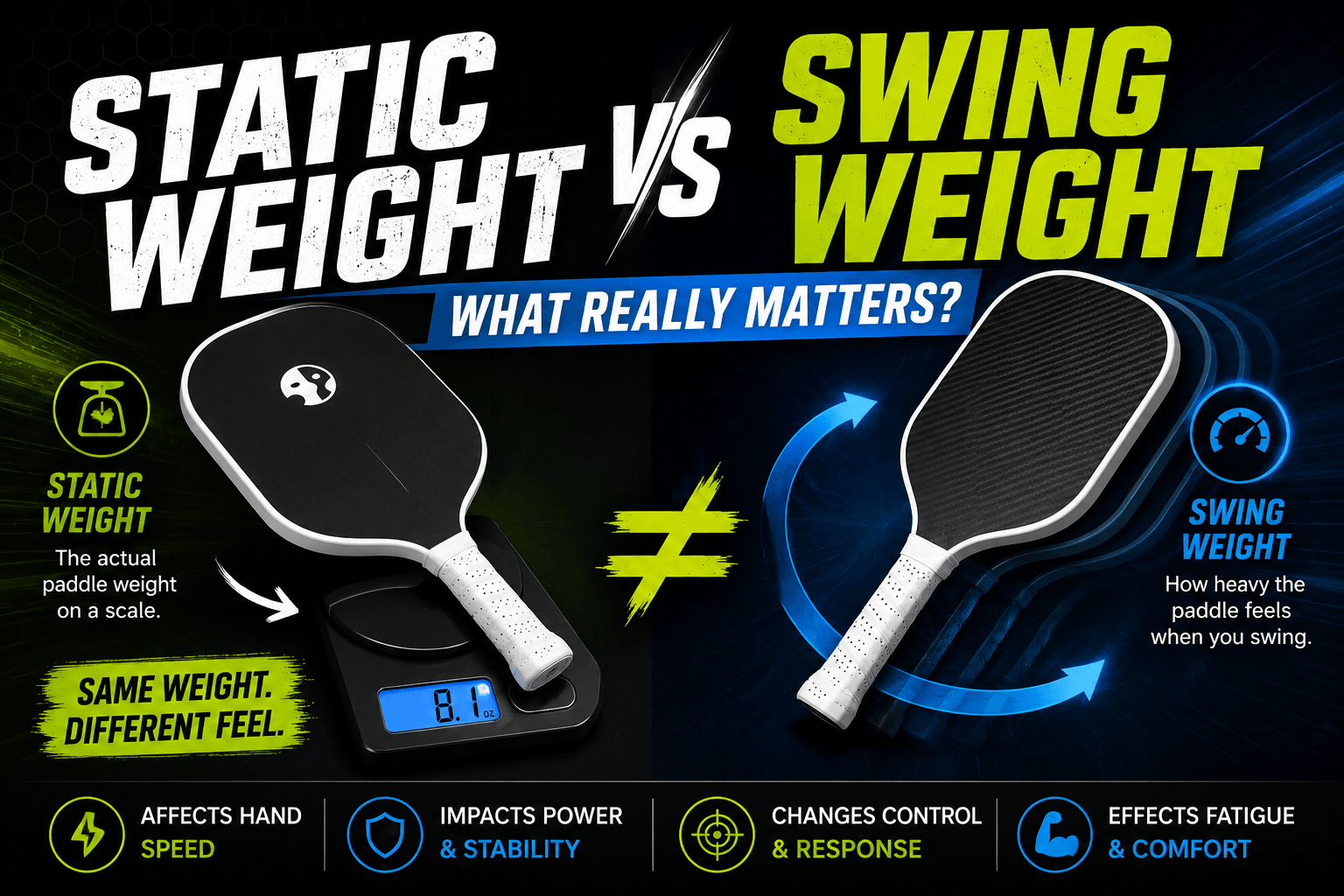
Have you ever picked up a pickleball paddle that was listed at 8.0 oz, only for it to feel way heavier than another paddle with the exact same listed weight? You are not crazy. The static weight vs swing weight pickleball distinction is real, and the number on the scale does not always tell the full story.
When players talk about paddle weight, they usually focus on static weight. That is the actual weight of the paddle when you place it on a scale. But what you feel during a game is often more affected by swing weight, which is how heavy the paddle feels when you move it through the air. That's the heart of the static weight vs swing weight pickleball conversation.
Understanding the difference between static weight and swing weight can help you choose a paddle that feels faster, more stable, more powerful, or easier on your arm.
What Is Static Weight?
Static weight is the actual weight of the paddle when it is sitting still on a scale. This is the weight number you usually see on a product page. For example, a paddle might be listed at 8.0 oz, 8.1 oz, or 8.3 oz.
Static weight is important because it gives you a basic idea of how heavy the paddle is overall. A lighter paddle may feel easier to move, while a heavier paddle may feel more solid and stable.
But static weight alone does not tell you how the paddle will feel during a real point. Two paddles can both weigh 8.1 oz and feel completely different in your hand. That is the core of the static weight vs swing weight pickleball issue, and that is where swing weight comes in.
What Is Swing Weight?
Swing weight is how heavy the paddle feels when you swing it, block with it, counter with it, or move it quickly at the kitchen line.
In simple terms, swing weight is about how the paddle's weight is distributed. If more weight is toward the head of the paddle, the paddle usually feels heavier and slower to maneuver. If more weight is closer to the handle, the paddle may feel quicker and easier to control.
This is why a paddle with a lower static weight can still feel heavy. If that weight is concentrated toward the top of the paddle, it can feel sluggish even if the scale says it is light. On the other hand, a paddle with a slightly higher static weight can still feel quick if the balance is closer to the handle. That paradox is why the static weight vs swing weight pickleball debate matters so much when picking a paddle.
Why Some Paddles Feel Heavy Even When They Are Not
The most common reason a paddle feels heavier than expected is because the weight is distributed toward the top of the paddle.
When the paddle is more head-heavy, it takes more effort to start, stop, and redirect. You may notice this most during fast hand battles, quick counters, speedups, blocks, and defensive resets.
This is why a paddle can feel fine during warmups but tiring during actual games. Once points get faster and you have to react quickly, swing weight becomes much more noticeable.
A paddle may feel heavy because of:
- Extra length
- A head-heavy balance point
- Added lead tape near the top
- A thicker or denser core
- A shape with more mass above your hand
- Accessories added to the paddle
If your paddle feels slow even though the listed weight seems normal, the static weight vs swing weight pickleball mismatch is probably the reason — specifically, swing weight is doing more work than static weight.
How Balance Point Changes Paddle Feel
The balance point is the spot where the paddle naturally balances. A paddle can be more head-heavy, more handle-heavy, or somewhere in the middle. Balance point is one of the most important variables in the static weight vs swing weight pickleball equation.
A head-heavy paddle usually gives you more plow-through and power. It can feel strong on drives, serves, counters, and blocks because there is more mass behind the ball.
A handle-heavy or more evenly balanced paddle usually feels faster in the hand. It may be easier to maneuver at the kitchen, easier to reset with, and less tiring over long sessions.
Neither one is automatically better. It depends on what you want from your paddle.
Head-Heavy Feel
- More power
- More plow-through
- More stability on hard shots
- Can feel slower in hand battles
- May feel more tiring over time
More Balanced or Handle-Weighted Feel
- Quicker hand speed
- Easier maneuverability
- Better for fast exchanges
- Often more comfortable for newer players
- May have less free power
A great example of a balanced, handle-weighted paddle that stays quick in the hands is the Six Zero Coral Hybrid — popular with doubles players for exactly this reason.
Why Elongated Paddles Often Feel Heavier
Elongated paddles often feel heavier than widebody or hybrid paddles, even when the listed static weight is similar. That is one of the clearest real-world examples of the static weight vs swing weight pickleball gap.
The reason is simple: more of the paddle extends farther away from your hand.
That extra length can be great for reach, serves, drives, and two-handed backhands. But it can also increase swing weight. The paddle may feel slower to move, especially during quick exchanges at the kitchen.
This does not mean elongated paddles are bad. Many players love them because they provide extra reach and leverage. But if you already struggle with hand speed, wrist fatigue, or elbow discomfort, an elongated head-heavy paddle may not be the easiest option.
Hybrid and widebody paddles usually feel quicker because the weight is more compact and closer to your hand. That can make them easier to control in doubles, especially if you play a lot at the kitchen line.
For a strong example of an elongated head-heavy paddle that trades hand speed for reach and power, look at the AIREO Cyclone 2.0:
What Is Twist Weight?
Twist weight is different from swing weight. Swing weight is about how heavy the paddle feels when you move it. Twist weight is about how stable the paddle feels when you hit the ball off-center. It's the third number that gets left out of the static weight vs swing weight pickleball conversation but matters just as much.
A paddle with higher twist weight usually feels more stable when the ball hits near the edges of the paddle face. It is less likely to twist in your hand.
A paddle with lower twist weight may feel faster, but it can be less forgiving if you miss the sweet spot.
This matters because many players want both speed and stability. But there is usually some tradeoff. A very fast paddle may not feel as stable. A very stable paddle may not feel as quick.
If you often mishit the ball or feel the paddle twisting in your hand, you may want a paddle with more stability or a wider sweet spot.
How Lead Tape Changes Swing Weight
Lead tape is one of the easiest ways to customize a pickleball paddle, but where you place it matters a lot — and it directly changes the static weight vs swing weight pickleball balance of your paddle.
Adding a few grams of weight may not sound like much, but if that weight is placed near the top of the paddle, it can dramatically change how the paddle feels.
Lead Tape at 12 O'Clock
Adding weight to the very top of the paddle usually increases power and plow-through the most. It can help the paddle feel stronger on drives and serves, but it also increases swing weight the most. This setup may make the paddle feel slower in hand battles.
Lead Tape at 3 and 9 O'Clock
Adding weight to the sides of the paddle can improve stability and make the sweet spot feel wider. This is a popular setup for players who want more forgiveness without making the paddle feel too top-heavy.
Lead Tape at 4 and 8 O'Clock
Adding weight lower on the sides can improve stability while keeping the paddle a little easier to maneuver than weight placed high on the paddle.
Weight Near the Handle
Adding weight near the handle has less impact on swing weight than adding weight near the head. This can make the paddle feel more solid without making it feel as sluggish.
This is why accessories like overgrips, Hesacore grips, and grip buildup can change the feel of the paddle without always making it feel slower.
Who Should Use a Lower Swing Weight Paddle?
A lower swing weight paddle is usually better for players who value speed, control, and maneuverability. In the static weight vs swing weight pickleball tradeoff, these players prioritize hand speed.
You may prefer a lower swing weight paddle if you:
- Play a lot of doubles
- Need faster hands at the kitchen
- Like quick counters and speedups
- Get tired during long sessions
- Have wrist, elbow, or shoulder sensitivity
- Are newer to pickleball
- Prefer control over raw power
Lower swing weight paddles can make the game feel easier, especially when points get fast. They are often more forgiving for players who are still developing timing, hand speed, and compact swings.
Who Should Use a Higher Swing Weight Paddle?
A higher swing weight paddle can be great for players who want more power, stability, and plow-through. These players win the static weight vs swing weight pickleball tradeoff by prioritizing ball weight over hand speed.
You may prefer a higher swing weight paddle if you:
- Want more power on drives and serves
- Like elongated paddles
- Have strong hands and good timing
- Play singles often
- Want more stability when blocking pace
- Prefer a heavier, more solid feel
- Do not mind sacrificing some hand speed
Higher swing weight can help you hit a heavier ball, but it can also make the paddle more demanding. If your paddle feels late during hands battles or tiring after a few games, the swing weight may be too high for your game.
How to Choose the Right Paddle Feel
The best paddle is not always the lightest paddle. It is the paddle that feels right for how you play. The static weight vs swing weight pickleball question doesn't have a single right answer — it depends on your game.
If you are a newer player, a balanced 16mm hybrid paddle is usually a safe place to start. It should give you enough control, enough forgiveness, and enough maneuverability without feeling too extreme in any direction. A great example is the Gherkin Draco 16mm — balanced, forgiving, and a popular benchmark in this category:
If you are a power player, you may like a paddle with more head weight or an elongated shape. Just make sure it does not slow you down too much at the kitchen.
If you are a control player, doubles player, or someone who plays long sessions, you may want a paddle that feels quicker and easier to maneuver.
Before choosing a paddle, ask yourself:
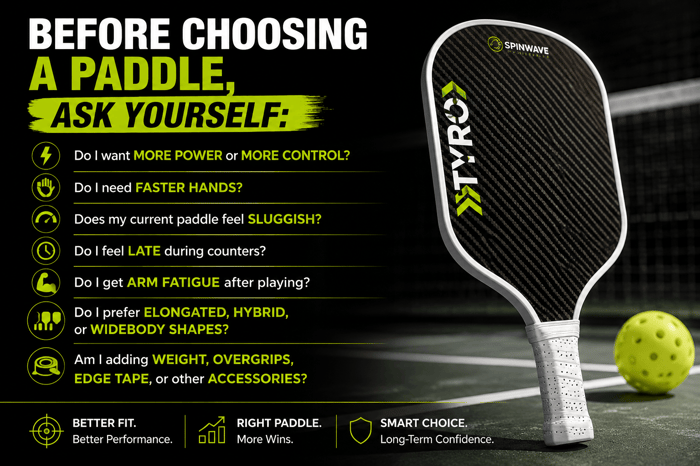
- Do I want more power or more control?
- Do I need faster hands?
- Does my current paddle feel sluggish?
- Do I feel late during counters?
- Do I get arm fatigue after playing?
- Do I prefer elongated, hybrid, or widebody shapes?
- Am I adding weight, overgrips, edge tape, or other accessories?
The goal is not just to find the right number on a spec sheet. The goal is to find the paddle that feels best in your hand during real points.
Related Spinwave Links
Want to dig deeper into the static weight vs swing weight pickleball conversation?
- Shop all pickleball paddles
- Shop all-court balanced paddles
- Shop power & competitive paddles
- Shop beginner & control paddles
- Shop Hesacore grips
- Shop pickleball grips & overgrips
- Get a free paddle consultation
- Read the pickleball weight placement guide
- Read elongated vs hybrid vs standard paddle guide
- Read The Overgrip Bible
Final Thoughts: Static Weight Does Not Tell the Whole Story
Static weight matters, but it is only part of the picture. That's why the static weight vs swing weight pickleball distinction matters so much.
A paddle can weigh 8.0 oz and still feel heavy if the weight is toward the head. Another paddle can weigh slightly more but feel faster because the balance is closer to the handle.
That is why swing weight, balance point, shape, and weight placement are so important. They explain why one paddle feels quick and another feels sluggish, even when the listed weight looks almost the same.
If your paddle feels heavy, slow, or tiring, do not only look at the static weight. Look at how the weight is distributed, what shape the paddle is, and whether accessories or lead tape are changing the way it plays.
Need help finding the right paddle feel? Visit Spinwave Pickleball in Great Neck or Long Beach, or book a free paddle consultation. We can help you find a paddle that matches your game, your hand speed, and the way you actually play.
FAQs
SP
SP
What is swing weight in pickleball?
Swing weight is how heavy the paddle feels when you swing it or move it during play. It is affected by where the weight is distributed throughout the paddle. Two paddles with the same static weight can have very different swing weights depending on whether the mass is closer to the head or the handle.
Why does my paddle feel heavier than the listed weight?
Your paddle may feel heavier because it has a higher swing weight, a head-heavy balance point, an elongated shape, or added weight near the top of the paddle. This is the most common static weight vs swing weight pickleball gap players run into.
Is a lighter pickleball paddle always better?
No. A lighter paddle may feel faster, but it may not be as stable or powerful. The best paddle depends on your playing style, strength, hand speed, and comfort. Sometimes a slightly heavier paddle with a handle-weighted balance actually feels quicker than a lightweight head-heavy paddle.
Do elongated paddles have higher swing weight?
Many elongated paddles feel heavier because more of the paddle extends farther away from your hand. This can increase reach and power, but it can also slow down hand speed. It's one of the cleanest real-world examples of the static weight vs swing weight pickleball difference.
Does lead tape increase swing weight?
Yes. Lead tape can increase swing weight, especially when it is placed near the top of the paddle. Lead tape closer to the handle has less effect on swing weight. This is why where you place lead tape matters far more than how much you add.
Where should I add lead tape if I want more stability?
Many players add weight at 3 and 9 o'clock or 4 and 8 o'clock to improve stability and forgiveness without making the paddle feel as head-heavy as weight at 12 o'clock. These positions raise twist weight more than swing weight.
Who should avoid high swing weight paddles?
Players who struggle with hand speed, fatigue, wrist pain, elbow discomfort, or fast kitchen exchanges may prefer a lower swing weight paddle. Doubles players who spend most of their time at the kitchen also tend to benefit from lower swing weights.
Who should use a higher swing weight paddle?
Players who want more power, plow-through, stability, and reach may like a higher swing weight paddle, especially if they have strong hands and good timing. Singles players, tennis converts, and aggressive baseliners often gravitate to higher swing weights.
How do I know if my paddle swing weight is too high?
Your paddle swing weight may be too high if you feel late during counters, tired after a few games, slow at the kitchen, or uncomfortable in your wrist, elbow, or shoulder. These are the classic signs that you're on the wrong side of the static weight vs swing weight pickleball equation.