
Table of Contents
- Quick Answer: Which Ronbus Quanta Paddle Should You Choose?
- How the Ronbus Quanta Feels on Court
- Understanding the Ronbus Quanta Shapes
- Quick Shape Cheat Sheet
- What Most Players Get Wrong About Paddle Shape
- Customization: Where the Quanta Really Shines
- Related Paddle Guides and Collections
- Final Take: Which Shape Is Best?
- FAQs

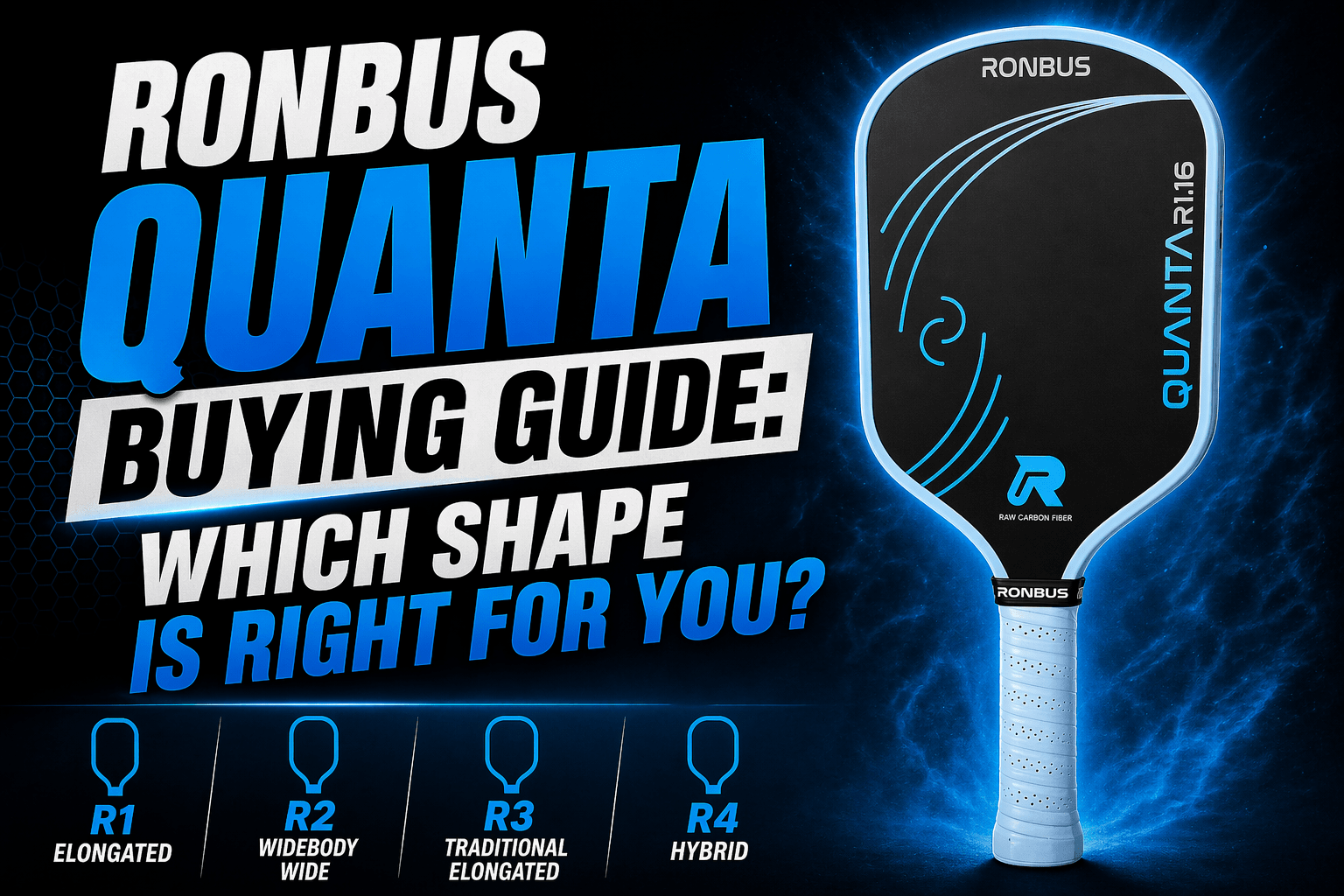
This Ronbus Quanta paddle guide breaks down the full lineup, including the R1, R2, R3, and R4 shapes. If you are trying to decide which paddle fits your game, the choice comes down to three things: how you play at the kitchen line, how much reach you want, and whether you value maximum forgiveness or faster hands.
There is no single best shape across the lineup. The best one is the shape that matches how you actually play. Some players need reach and full-swing power. Others need forgiveness, hand speed, and control in doubles. The Quanta lineup gives you all of those options inside one affordable foam paddle platform.
What makes this series especially interesting is the price-to-performance value. At around $119, the lineup sits in a rare spot: modern foam paddle feel, strong playability, and a ton of room for customization without the usual premium paddle price tag.
On top of that, these paddles start unusually light and neutral out of the box. That makes them one of the easiest paddle lines to tune with grips, weight tape, edge tape, or handle weight depending on what you want to feel on court.
Quick Answer: Which Ronbus Quanta Paddle Should You Choose?
Choose the R2 Widebody if you want the most forgiveness, the fastest hands, and the easiest control in doubles. Choose the R1 or R3 Elongated if you want more reach, more leverage, and better full-swing power. Choose the R4 Hybrid if you want the safest all-around option.
For most players who are unsure where to start, the R4 Hybrid is the easiest recommendation. It does not over-specialize, and it gives you a balanced mix of reach, forgiveness, power, and hand speed.
How the Ronbus Quanta Feels on Court
The lineup uses a floating foam core paired with a carbon-fiber-only face. On court, that creates a slightly hollow, plush feel compared with more traditional honeycomb-core paddles.
In stock form, the Quanta plays like a true all-court paddle. You get moderate pop, usable power, strong spin potential, and very quick maneuverability. It is not a paddle line that feels overly stiff, overly heavy, or locked into one playing style.
The real magic is how well the platform responds to small changes. Because these paddles start light and neutral, even modest customization can noticeably change the feel, balance, and overall performance.
Understanding the Ronbus Quanta Shapes
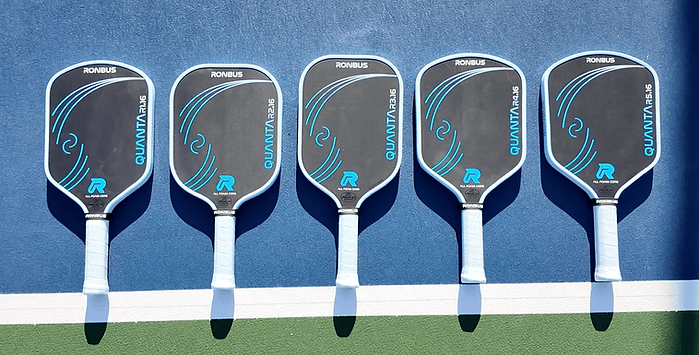
The Quanta lineup comes in four shapes, but they really break down into three shape families: elongated, widebody, and hybrid. Each shape solves a different problem.
Widebody gives you forgiveness and hand speed. Elongated gives you reach and leverage. Hybrid gives you the most balanced all-court profile. The key is not picking the most aggressive-looking paddle. The key is picking the shape that helps you win more points.
Ronbus Quanta R2 Widebody: Fast Hands and Forgiveness
The R2 is the standard or widebody shape. This is the control-first, confidence-first option in the lineup.
The R2 offers the broadest sweet spot, the best maneuverability, and the easiest handling in fast exchanges. For a lot of doubles players, this is the safest and most forgiving entry point into the Quanta family.
It also has the highest pop in the lineup, but the lowest power ceiling on full swings. In other words, it gives you the quickest response on compact contact, but it is not the shape most players will choose for maximum drive power or extended reach.
The Trade-Off
With the R2, you lose some reach and some leverage on deep serves, overheads, and full baseline swings. That is the natural trade-off for getting a wider face and quicker hands.
Best For
- Doubles players
- Players who care about hand speed and control
- Players who want the biggest sweet spot
- Players who value forgiveness and defensive consistency
Ronbus Quanta R1 and R3 Elongated: Reach and Power
The elongated shapes are built for players who want extra reach, more leverage, and a more aggressive feel on serves, drives, and overheads.
R1 and R3: What Is the Difference?
Both the R1 and R3 are elongated paddles, but they are not identical. The R1 has a curved, aero-style top, while the R3 uses a more traditional rectangular elongated face.
The curved top on the R1 shifts the sweet spot slightly lower, while the R3 keeps a more standard elongated sweet spot position. In real play, most players probably will not notice a dramatic difference in sweet spot location, but the R1 is noted as feeling a little quicker in hand.
What Elongated Does Best
The elongated shapes have the lowest pop in the lineup, but also the highest power ceiling on full swings. That means they are less jumpy on short contact while still rewarding players who take full cuts on drives, serves, and overheads.
The Trade-Off
You give up some forgiveness. The elongated paddles have the smallest sweet spots in the lineup, and they are also the least maneuverable overall, especially compared with the wider shapes.
Best For
- Players coming from tennis
- Players who like to attack from the baseline
- Players who want more reach at the net
- Players who prefer leverage and full-swing power over maximum forgiveness
RONBUS Quanta R1.16 Pickleball Paddle
$119.00
New to Ronbus's lineup? See how this paddle compares to every other Ronbus Quanta shape before you commit. Read the complete Ronbus Guide → Paddle Features & Technologies 4th Generation Foam Core Technology – built with an advanced EPP foam… read more

Ronbus Quanta R4 Hybrid: The Best All-Around Option
The R4 sits between the elongated and widebody shapes. Pop, power, sweet spot size, and maneuverability all land right in the middle of the lineup.
That is exactly why the R4 Hybrid works for so many players. It gives you elements of both reach and forgiveness without forcing you too far toward either extreme.
If you are not sure where to start, the R4 is the easiest recommendation because it does not over-specialize. It gives most players a clean all-court profile and leaves plenty of room for customization.
The Trade-Off
The R4 does not dominate one category. It is not as long and leverage-driven as the elongated shapes, and it is not as forgiving and hand-fast as the widebody.
Best For
- Players who want a versatile all-court paddle
- Players who like balance more than extremes
- Players moving from beginner into intermediate play
- Players who are unsure which shape fits them best
RONBUS Quanta R4.16 Pickleball Paddle
$119.00
New to Ronbus's lineup? See how this paddle compares to every other Ronbus Quanta shape before you commit. Read the complete Ronbus Guide → Paddle Features & Technologies 4th Generation Foam Core Technology – constructed with an EPP foam core… read more

Quick Shape Cheat Sheet
| If This Sounds Like You | Start Here |
|---|---|
| Tennis background or baseline-heavy game | Elongated: R1 or R3 |
| Balanced all-court play | Hybrid: R4 |
| Doubles, control, and consistency | Widebody: R2 |
| Want the most forgiving option | Widebody: R2 |
| Not sure where to start | Hybrid: R4 |
What Most Players Get Wrong About Paddle Shape
A lot of players assume elongated paddles are automatically better because they look more aggressive. That is not always true.
For many doubles players, hybrid and widebody shapes are actually the smarter choice. In real play, hand speed, forgiveness, and consistency often matter more than a little extra reach.
If a paddle feels inconsistent or harder to control than it should, sometimes the issue is not your game at all. Sometimes it is just the wrong shape. That is why the Ronbus Quanta lineup is helpful: it gives you multiple shapes on the same general platform.
Customization: Where the Quanta Really Shines
One of the biggest strengths of this paddle line is customization. Because the paddles start light and neutral, you have room to tune the balance, stability, grip feel, and power level.
Grip Options
Most players start by adding an overgrip. That protects the stock grip, slightly changes the handle feel, and adds a little weight to the handle, which can make the paddle feel a bit more head-light.
Players who want more comfort, better vibration dampening, or more grip definition can add an under-grip such as Hesacore.
For More Stability
Add weight to the middle sides or lower corners. This helps enlarge the sweet spot, improve stability, and make off-center hits feel more solid.
For More Power
Add weight toward the top sides or head of the paddle. This increases plow-through and gives the paddle more force on drives and serves.
For More Weight Without a Huge Swing-Weight Jump
Add weight to the handle or butt cap. This lowers the balance point and lets you build up total weight without making the paddle feel dramatically slower in hand.
Simple Rule: Start Small
Small changes go a long way with the Quanta platform. Start light, test, and build gradually instead of throwing a lot of weight on all at once.
Shop pickleball grips or shop edge guard tape if you want to start tuning your setup.
Related Paddle Guides and Collections
Still comparing paddle shapes or trying to find the right setup? These Spinwave links can help:
- Shop all pickleball paddles
- Shop all-court pickleball paddles
- Shop power pickleball paddles
- Shop control pickleball paddles
- Get a free paddle recommendation
- Read the pickleball weight placement guide
- Read The Overgrip Bible
Final Take: Which Shape Is Best?
The Ronbus Quanta lineup is one of the better paddle platforms for players who like to tune their equipment instead of forcing themselves to adapt to one stock setup.
If you want more reach and full-swing offense, start with the R1 or R3. If you want the most forgiving and hand-fast option, start with the R2. If you want the safest all-around recommendation, start with the R4.
And if the stock setup does not feel perfect right away, that does not mean the shape is wrong. One of the biggest strengths of this line is how easily it can be customized to match your game.
FAQs
Which Ronbus Quanta paddle is best for most players?
The Ronbus Quanta R4 Hybrid is the best starting point for most players because it gives the most balanced mix of reach, forgiveness, hand speed, power, and control. It does not over-specialize, which makes it the safest all-around option.
What is the difference between the Ronbus Quanta R1, R2, R3, and R4?
The R1 and R3 are elongated paddles built for reach and full-swing power. The R2 is the widebody option built for forgiveness and fast hands. The R4 is the hybrid shape built for balanced all-court play.
Which Ronbus Quanta shape is best for doubles?
The Ronbus Quanta R2 Widebody is the best choice for many doubles players because it offers the most forgiveness, the fastest hands, and the easiest control in quick kitchen exchanges.
Which Ronbus Quanta paddle is best for tennis players?
The Ronbus Quanta R1 or R3 elongated shapes are the best fit for many tennis players because they offer more reach, more leverage, and a stronger full-swing power ceiling.
Is the Ronbus Quanta good for customization?
Yes. The Ronbus Quanta line is very good for customization because the paddles start light and neutral. Small changes with overgrips, handle weight, or weight tape can noticeably change the balance, stability, and power.
Is the Ronbus Quanta a good value paddle?
What's the difference between Ronbus Quanta R1 and R3?
Both are elongated paddles with the same general performance profile, but the R1 has a curved aero-style top while the R3 has a more traditional rectangular elongated face. The R1's curved top shifts the sweet spot slightly lower and feels a little quicker in hand. The R3 keeps a more standard elongated sweet spot position. Most players won't notice a dramatic difference in real play.
How much does the Ronbus Quanta cost?
The Quanta lineup retails at around $119 — one of the strongest price-to-performance value picks in the modern foam paddle category. You get a floating foam core, carbon fiber face, and a platform built for customization without the usual premium paddle price tag.
Is the Ronbus Quanta good for beginners?
Yes — especially the R2 Widebody and R4 Hybrid. Both shapes offer forgiving sweet spots, easy maneuverability, and a balanced all-court feel that helps beginners build consistency. The light, neutral stock setup also gives newer players room to grow into the paddle as their game develops, since you can customize the balance and weight as you improve.
How do you customize a Ronbus Quanta paddle?
For more stability, add weight tape to the middle sides or lower corners — this enlarges the sweet spot and makes off-center hits feel solid. For more power, add weight to the top sides or head. For more total weight without slowing the paddle down, add weight to the handle or butt cap. Most players also add an overgrip and sometimes a Hesacore under-grip for comfort. Start small — these paddles respond quickly to even minor changes.
What's the Ronbus Quanta's feel on court?
The Quanta uses a floating foam core with a carbon fiber face, which creates a slightly hollow, plush feel compared to traditional honeycomb paddles. In stock form, it plays like a true all-court paddle — moderate pop, usable power, strong spin potential, and very quick maneuverability. It's not stiff, not heavy, and not locked into one playing style.