

Table of Contents
- Quick Answer: What Is a DUPR Pickleball Rating?
- What Is DUPR?
- How Does a DUPR Pickleball Rating Work?
- DUPR Rating Range: What the Numbers Mean
- How Do I Get a DUPR Rating?
- What Affects Your DUPR Rating?
- What Is a DUPR Reliability Score?
- DUPR App, Login, and Account Basics
- DUPR Tournaments, Leagues, and Club Play
- DUPR vs Self-Rating: What Is the Difference?
- How to Improve Your DUPR Rating
- Common DUPR Mistakes New Players Make
- Related Spinwave Links
- Final Thoughts
- FAQs
- What is a DUPR pickleball rating?
- How do I get a DUPR rating for pickleball?
- What is a good DUPR rating?
- How is a DUPR pickleball rating calculated?
- What is a DUPR reliability score?
- Is DUPR free?
- How is DUPR different from a self-rating?
- Can my DUPR rating go down?
- Do I need DUPR to play tournaments?
- How often does my DUPR rating update?
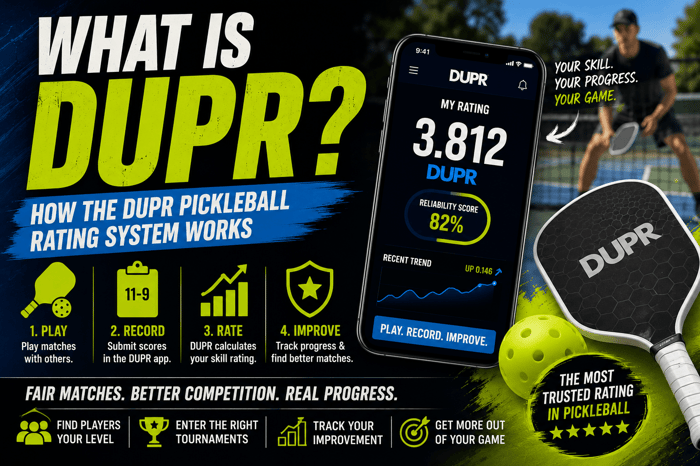
A DUPR pickleball rating is one of the easiest ways to understand your current skill level, find better games, enter the right tournaments, and track your progress over time. If you have ever heard players say, "What's your DUPR?" they are asking where you fall on the most common performance-based rating system in pickleball.
For newer players, DUPR can feel confusing at first. You may hear people talk about the DUPR app, DUPR login, reliability score, DUPR tournaments, verified matches, club ratings, and rating movement after matches. It sounds technical, but the basic idea is simple: DUPR uses match results to estimate how strong you are compared to other pickleball players.
This guide explains how the DUPR pickleball rating system works, what the numbers mean, how to get a rating, why your reliability score matters, and how to use DUPR without obsessing over every single point.
Quick Answer: What Is a DUPR Pickleball Rating?
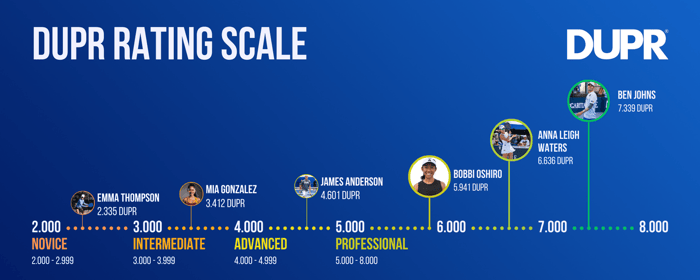
A DUPR pickleball rating is a number that represents your estimated pickleball skill level based on recorded match results. DUPR ratings typically run from 2.000 to 8.000, with recreational players usually falling somewhere between the 2.0 and 5.0 range, and elite/pro players rating higher.
The rating is designed to help players find more balanced games. Instead of guessing whether someone is a beginner, intermediate, advanced, or tournament-level player, DUPR gives everyone a more objective number based on match history.
In simple terms:
- Your DUPR rating shows your estimated skill level.
- Your reliability score shows how trustworthy that rating is based on your match data.
- Your match results are what move your rating over time.
The more quality matches you log, the more useful your DUPR pickleball rating becomes.
What Is DUPR?
DUPR stands for Dynamic Universal Pickleball Rating. It is a pickleball rating system used by players, clubs, leagues, tournaments, and events to help organize fairer and more competitive games.
Before rating systems became more common, many players relied on self-rating. Someone might call themselves a 3.5 or 4.0 based on experience, confidence, or local reputation. The problem is that self-ratings can be inconsistent. A 3.5 player at one club may not be the same level as a 3.5 player somewhere else.
DUPR tries to solve that by using actual match results. When players log matches, the system compares performance, opponents, teammates, and results to build a more objective rating.
That makes the DUPR pickleball rating useful for:
- Finding fair open play games
- Joining the right skill-level groups
- Entering tournaments at the correct level
- Tracking improvement over time
- Helping clubs organize leagues and ladders
- Reducing awkward skill mismatches
How Does a DUPR Pickleball Rating Work?

Your DUPR pickleball rating is based on your recorded match results. When you play and submit a match, DUPR looks at how you performed compared to what the system expected based on the ratings of everyone involved.
That means it is not always just about winning or losing. Performance matters. If you play a much stronger team and lose a close match, that may be viewed differently than losing badly to a team you were expected to beat.
DUPR generally considers things like:
- Who you played against
- Who your partner was in doubles
- The final score
- Whether you performed above or below expectation
- How much match data you have
- How recent and consistent your results are
This is why close scores can matter. A 11-9 loss to a strong team tells a different story than a 11-2 loss to the same team. The DUPR pickleball rating system is trying to measure performance, not just count wins and losses.
DUPR Rating Range: What the Numbers Mean
DUPR ratings are shown as numbers with three decimal places, such as 3.245, 3.812, or 4.376. For most recreational players, the number will feel similar to traditional pickleball skill levels, but more precise.
| DUPR Range | General Skill Level | What It Usually Means |
|---|---|---|
| 2.000 - 2.999 | Beginner to lower intermediate | Still learning rules, consistency, positioning, and basic strategy. |
| 3.000 - 3.499 | Intermediate | Can rally, understands basic doubles play, and is developing control. |
| 3.500 - 3.999 | Strong intermediate | More consistent, better kitchen play, improved shot selection, and fewer unforced errors. |
| 4.000 - 4.499 | Advanced recreational | Strong control, better resets, more reliable attacks, and better court awareness. |
| 4.500 - 4.999 | High-level amateur | Very competitive player with strong strategy, consistency, and pressure skills. |
| 5.000+ | Elite / pro-level range | Advanced tournament players, elite amateurs, and professionals. |
These ranges are general guidelines. Your local playing environment may vary. A 3.75 DUPR in one area should still be more useful than a self-rating, but match volume and reliability score matter a lot.
How Do I Get a DUPR Rating?

To get a DUPR pickleball rating, you need to create a DUPR account and have match results recorded. You can do this through the DUPR app, the DUPR website, club events, leagues, tournaments, or organized match play that submits scores to DUPR.
The basic process usually looks like this:
- Create a free DUPR account.
- Download the DUPR app or use the DUPR website.
- Play a match with other players.
- Submit the match result.
- Have the result verified when needed.
- Continue logging matches to build rating accuracy.
One match can start the process, but your rating becomes more useful when you have more matches logged. A brand-new DUPR rating with only one or two matches should not be treated the same as a rating built from many recent results.
If you are asking, "How do I get a DUPR rating for pickleball?" the simplest answer is: create a DUPR account, play recorded matches, and keep logging results consistently.
What Affects Your DUPR Rating?
Several things can affect your DUPR pickleball rating. The biggest factor is how you perform compared to expectations.
1. Match Result
Winning generally helps, and losing can hurt, but the score and opponent strength matter. A close loss to a much stronger team may be treated differently than a bad loss to a weaker team.
2. Score Differential
The final score can matter because it shows how competitive the match was. Losing 11-9 is not the same as losing 11-1.
3. Opponent Ratings
Who you play against matters. Beating a stronger team can help more than beating a much weaker team. Losing to a much weaker team can hurt more than losing to a stronger team.
4. Partner Rating
In doubles, your partner matters too. DUPR looks at the combined ratings involved in the match, not just your individual number.
5. Match Volume
A rating based on many results is usually more meaningful than a rating based on only one or two games.
6. Recency and Activity
Playing and logging matches consistently helps keep your rating more current. If your last logged match was a long time ago, your rating may not reflect your current level.
What Is a DUPR Reliability Score?
Your DUPR reliability score is different from your DUPR rating. Your rating estimates your skill level. Your reliability score estimates how confident the system is in that rating.
A player with a 3.85 rating and high reliability has a more trustworthy rating than a player with a 3.85 rating and very low reliability.
Reliability can be affected by:
- How many matches you have logged
- How recently you have played
- How consistent your match data is
- How connected your results are to other rated players
- Whether your matches are part of verified events, clubs, or organized play
This is important because two players can have the same DUPR pickleball rating but very different reliability. If you are organizing competitive games, tournaments, or leagues, reliability helps show how much confidence you should put in the number.
DUPR App, Login, and Account Basics
The DUPR app and DUPR website are where players manage their profile, view ratings, log matches, check match history, and connect with clubs or events.
Common DUPR account tasks include:
- Creating a DUPR account
- Using DUPR login to access your profile
- Checking your current DUPR pickleball rating
- Reviewing match history
- Logging recreational matches
- Joining DUPR clubs
- Finding DUPR leagues or events
- Managing match verification
If you need direct help with your DUPR account, app login, account number, or technical issue, it is best to use official DUPR support through the DUPR website or app. Spinwave can help explain what DUPR means for your game, but account-specific issues should go through DUPR directly.
Visit the official DUPR website
DUPR Tournaments, Leagues, and Club Play
DUPR is especially useful for tournaments, leagues, ladders, and club play because it helps group players more fairly. Instead of relying only on self-rating, organizers can use DUPR ratings to create divisions and matchups.
You may see DUPR used for:
- DUPR tournaments
- DUPR leagues
- Club ladders
- Rated round robins
- Skill-based open play
- Team events
- Competitive match nights
If you are searching for "DUPR tournaments near me," check local clubs, tournament platforms, and the DUPR app. Many facilities now use DUPR to help make competitive play more balanced.
DUPR vs Self-Rating: What Is the Difference?
A self-rating is what you think your level is. A DUPR pickleball rating is based on recorded match results.
| Rating Type | How It Works | Best Use |
|---|---|---|
| Self-Rating | You estimate your own level based on experience, confidence, or local comparison. | Good starting point for brand-new players. |
| DUPR Rating | Your number is based on recorded match results and performance against other players. | Better for tournaments, leagues, competitive play, and tracking progress. |
Self-ratings are not useless. They help beginners choose where to start. But once you begin playing more competitive games, a DUPR rating becomes more helpful because it is tied to actual results.
How to Improve Your DUPR Rating
If you want to improve your DUPR pickleball rating, the answer is not just "play more." You need to play smarter, log quality matches, and improve the parts of your game that actually win points.
1. Reduce Unforced Errors
At most levels, consistency moves the needle. Missing easy returns, drives, dinks, and third shots will hold your rating back fast. A forgiving control-oriented paddle like the Six Zero Coral Hybrid helps newer and intermediate players cut down on unforced errors:
2. Improve Your Serve and Return
A deeper, more reliable serve and return can help you start more points in a strong position.
3. Learn to Reset
Players who can reset hard shots and survive pressure often improve faster than players who only attack.
4. Get Better at the Kitchen
Dinking, speedups, counters, blocks, and footwork at the kitchen are huge rating separators. An all-court balanced paddle like the Gherkin Draco 16mm rewards good hands and quick reactions at the kitchen line:
5. Play Balanced Matches
If you only play people far below your level, your matches may not help you improve much. Competitive matches against similar or slightly stronger players are usually better for development.
6. Use Gear That Fits Your Game
Your paddle will not magically raise your DUPR, but the wrong paddle can make the game harder. If your paddle is too heavy, too poppy, too stiff, or too hard to control, it can lead to more errors. Not sure which paddle fits your level? Book a free paddle consultation and we'll match you to your game:
Common DUPR Mistakes New Players Make
1. Obsessing Over Every Match
Your DUPR rating will move over time. Do not panic over one bad game or one small drop. Look at the larger trend.
2. Avoiding Tough Matches
Some players avoid stronger opponents because they are afraid their rating will drop. That can slow your development. Competitive matches are how you learn.
3. Only Playing With the Same Group
If you only play the same few people, your rating may not connect as well to the wider player pool. Playing a variety of opponents can make your rating more useful.
4. Ignoring Reliability Score
A low-reliability rating should be treated as a rough estimate, not a final verdict. Keep logging matches to make your rating more accurate.
5. Using DUPR as Your Entire Identity
DUPR is a tool. It is not your entire value as a player. Use it to find better games and track progress, but do not let the number ruin your enjoyment of pickleball.
Related Spinwave Links
- Get a free paddle consultation
- Shop all pickleball paddles
- Shop beginner & control paddles
- Shop all-court balanced paddles
- Shop power & competitive paddles
- Shop pickleball shoes
- Shop pickleball grips & overgrips
- Read Beginner Pickleball in Long Island
- Read Static Weight vs Swing Weight
- Read Best Pickleball Paddles Under $150
Final Thoughts
A DUPR pickleball rating can be a great tool if you use it the right way. It helps you understand your current level, find better games, enter the right events, and track your improvement over time.
The key is not to obsess over every small movement. Ratings go up and down. What matters most is whether your game is actually improving: fewer errors, better decisions, stronger resets, smarter attacks, and more consistent play under pressure.
If you are new to DUPR, start by creating an account, logging matches, and building your reliability score. If you are already rated, use your DUPR as feedback — not as your entire identity.
And if you feel like your equipment is holding you back, visit Spinwave Pickleball in Great Neck or Long Beach, or book a free paddle consultation. We can help you find a paddle setup that matches your level, your goals, and the way you actually play.
FAQs
Spinwave
Spinwave
How do I get a DUPR rating for pickleball?
To get a DUPR pickleball rating, create a free DUPR account through the DUPR app or website, then play and log matches against other players. Your rating becomes more accurate as you log more matches over time. Many clubs, leagues, and tournaments will submit results to DUPR automatically.
What is a good DUPR rating?
A "good" DUPR pickleball rating depends on your goals. 2.000-2.999 is beginner, 3.000-3.499 is intermediate, 3.500-3.999 is strong intermediate, 4.000-4.499 is advanced rec, 4.500-4.999 is high-level amateur, and 5.000+ is elite or pro-level. Most rec players fall between 2.5 and 4.5.
How is a DUPR pickleball rating calculated?
DUPR calculates ratings based on match results, opponent strength, partner ratings, score differential, match volume, and how recent your matches are. It's not just about wins and losses — performance against expectations matters. A close 11-9 loss to a stronger team is treated differently than a 11-2 blowout loss.
What is a DUPR reliability score?
Your DUPR reliability score is separate from your DUPR pickleball rating. The rating estimates your skill level, while reliability shows how confident the system is in that rating. Higher reliability comes from logging more matches, playing recent matches, and connecting to a variety of rated opponents.
Is DUPR free?
Yes. Creating a DUPR account and getting a DUPR rating is free. You can download the DUPR app or use the DUPR website at no cost. Some advanced features, premium tournaments, or club integrations may have fees, but the core rating system is free.
How is DUPR different from a self-rating?
A self-rating is your own estimate of your skill level — useful when you're brand new but inconsistent across players and locations. A DUPR pickleball rating is based on actual match results, making it much more objective and useful for tournaments, leagues, and competitive play.
Can my DUPR rating go down?
Yes. Your DUPR pickleball rating can move up or down depending on match results. Losing badly to weaker opponents can drop your rating. Beating stronger opponents can raise it. The system is dynamic — that's the "D" in DUPR.
Do I need DUPR to play tournaments?
Not always, but many tournaments now use DUPR ratings to set divisions, so having a DUPR pickleball rating makes registration and bracket placement easier. Some tournaments still allow self-rating, but DUPR-rated divisions are becoming the standard at competitive events.
How often does my DUPR rating update?
Your DUPR rating updates after each match result is processed by the system. Most matches submitted through the app or verified events update within hours to a few days. Match results from major tournaments may take longer if verification is required.