
Table of Contents
- 1. Quick Verdict
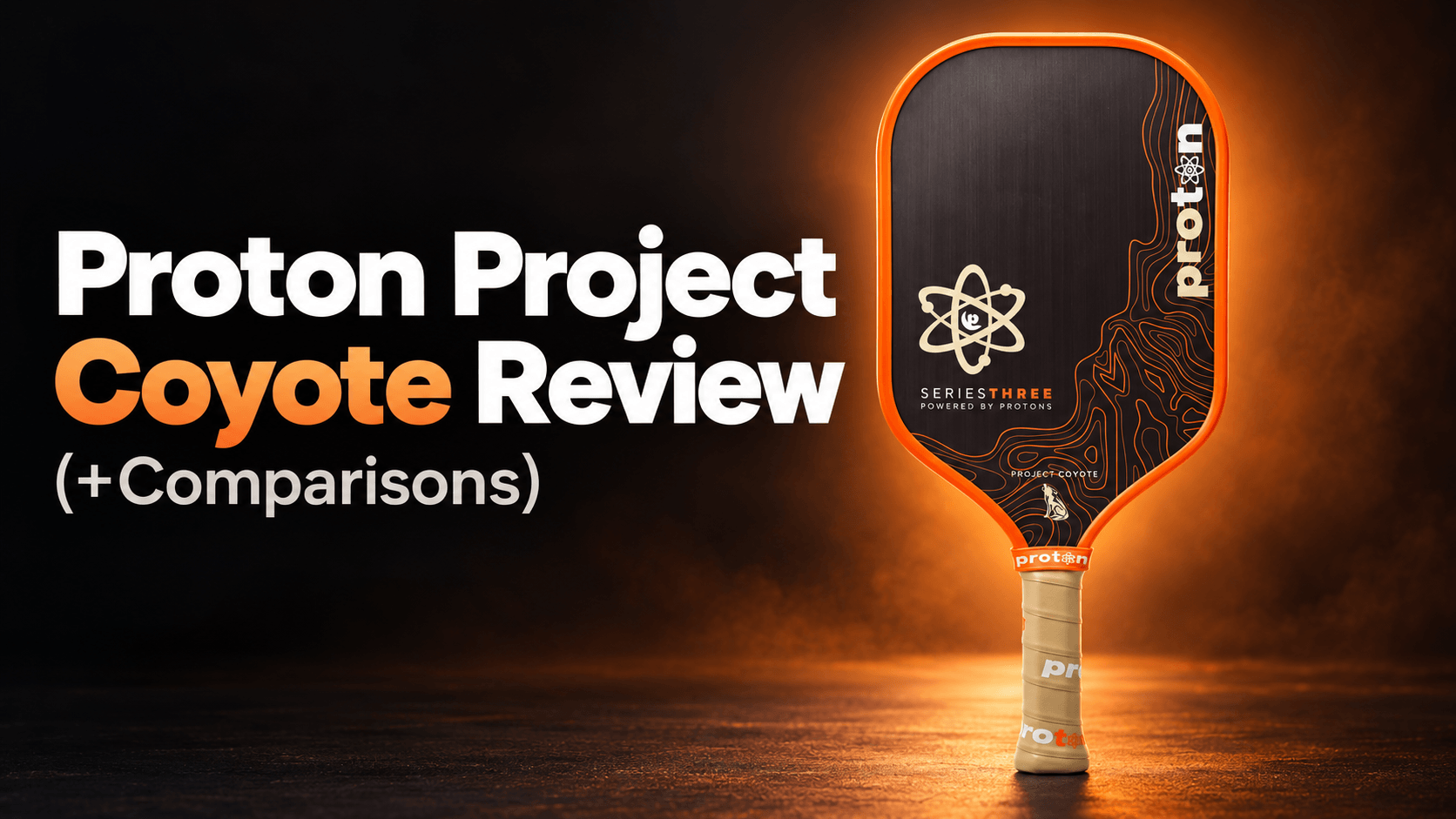
- 2. Proton Project Coyote Specs
- 3. Feel: The Closest Thing to a Pro V
- 4. Spin: Coyote vs. Honolulu J6CR vs. Proton Flamingo
- 5. Power and Pop
- 6. Sweet Spot and Tuning
- 7. Head-to-Head Results at a Glance
- 8. Proton Project Coyote vs. JOOLA Pro V Perseus
- 9. Who Should Buy the Proton Project Coyote?
- FAQs
If you're still hooked on honeycomb, the Proton Project Coyote belongs on your shortlist for your next paddle.
By Jan Dayleg | Paddle Reviews | Spinwave Pickleball

1. Quick Verdict
I put about 15 hours on the Proton Project Coyote before writing this review. I compared it against the two paddles I expect it to get measured against: the Honolulu J6CR, because of its durable grit and elite spin, and the Proton Project Flamingo, the Coyote's predecessor. But the paddle it played most like was the JOOLA Pro V Perseus 16mm.
That's the story here. The Coyote keeps most of what players love about the Pro V, then adds more maneuverability and room to customize, at a much lower price.
- Play profile: Gen-3 honeycomb elongated, middle of the power category, controllable pop
- Feel: Slightly stiff and dense, very close to the Pro V Perseus 16mm
- Best for: Gen-3 elongated players who want a dual certified power paddle with great value
- Price: $195, about $176 with code JDPB at Spinwave
2. Proton Project Coyote Specs
| Spec | Proton Project Coyote |
|---|---|
| Core | Gen-3 (full floating honeycomb with EVA perimeter) |
| Shape | Elongated |
| Thickness | 15mm |
| Stock swing weight | 113 (my unit) |
| Stock static weight | 7.8 oz (my unit) |
| Paddle length | 16.5" |
| Paddle width | 7.5" |
| Handle length | 5.5" |
| Grip circumference | 4.125" |
| Surface | Traditional carbon fiber |
| Certification | Dual certified (USA Pickleball and UPA-A) |
| Price | $195 (use code JDPB to save 10%) |
Swing weight and static weight come from my test unit, so expect a little variation from paddle to paddle. Length, width and grip circumference are the listed specs.
3. Feel: The Closest Thing to a Pro V
The Coyote feels slightly stiff and dense. Its closest feel comparisons are its predecessor, the Proton Project Flamingo, and the JOOLA Pro V Perseus 16mm. If I'm splitting hairs, the Flamingo is slightly softer than the others.
From my first impressions through the full playtest, the Pro V was the comparison I kept coming back to. It wasn't only the feel. The overall play profile lined up closely too.
That matters, because the Pro V's honeycomb feel is one of the most loved feel profiles in pickleball. Getting most of it in a cheaper, more customizable paddle is a big deal for Gen-3 players.
4. Spin: Coyote vs. Honolulu J6CR vs. Proton Flamingo
The J6CR outspins the Coyote. The J6CR has a tier-1 durable grit surface, while the Coyote uses a traditional carbon fiber face.
That said, the Proton Project Coyote has plenty of spin out of the box. Keeping drives in and shaping shots was a breeze, and nobody is going to complain about its shot-shaping ability.
5. Power and Pop
To keep things fair, I tuned all three paddles to the same swing weight of 116.
Full swings (serves, drives, overheads): The Flamingo hit the hardest in my testing, followed by the Coyote, then the J6CR.
Short swings (counters, blocks, dinks, resets): The J6CR had the most pop, followed by the Flamingo, then the Coyote.
I'd put all three in the middle of the power category. Of the three, the Coyote has the least pop, and that pop was very controllable. If you like the play profile of the Pro V, that's what you'll find here.
6. Sweet Spot and Tuning
Of the three, the J6CR has the best sweet spot. The Flamingo and Coyote were indistinguishable.
For most players, I would not recommend playing the Proton Project Coyote stock. At 113 swing weight it felt unstable to me. Because it comes in light, though, adding weight is easy. I brought mine up to 116 with 3.5g of 1g/in tungsten tape at 4 and 8 o'clock.
Weight always affects hand speed, but the trade was worth it. The Coyote became more stable, and the sweet spot opened up to well above average.
Where to Put the Weight
New to tuning? Here's the quick placement guide:
- 3 and 9 o'clock: adds stability on off-center hits (twist weight).
- 12 o'clock: adds the most swing weight and plow-through, but costs the most hand speed.
- 2 and 10 o'clock: a blend of stability and plow-through.
- 4 and 8 o'clock: where I put mine. Stability with less added swing weight than tape higher up the face.
Go in small increments and play a full session before adding more. No tungsten tape? Spinwave's adhesive lead tape strips do the job too.
7. Head-to-Head Results at a Glance
Here's my scorecard for the Coyote, J6CR and Flamingo. Power and pop were compared with all three tuned to 116 swing weight.
| Category | Result |
|---|---|
| Feel | Coyote is slightly stiff and dense; Flamingo is close but slightly softer |
| Spin | J6CR outspins the Coyote (durable grit vs. traditional carbon fiber) |
| Full-swing power | Flamingo, then Coyote, then J6CR |
| Short-swing pop | J6CR, then Flamingo, then Coyote |
| Sweet spot | J6CR is best; Coyote and Flamingo are even |
8. Proton Project Coyote vs. JOOLA Pro V Perseus
This is the comparison that matters most. The Pro V Perseus 16mm is the paddle the Coyote played most like: both have a slightly stiff, dense feel and a similar play profile with controllable pop.
Where they split is price and flexibility. The Proton Project Coyote is more maneuverable and easier to customize, and it costs $195 versus $300 for the Pro V Perseus. The catch is that the Coyote comes in light and plays best with a few grams of tape, so plan on a little tuning.
9. Who Should Buy the Proton Project Coyote?
Buy the Coyote if:
- You're a Gen-3 honeycomb elongated player.
- You love the Pro V's feel and play profile but want something more maneuverable and customizable for less money.
- You want a dual certified power paddle with controllable pop.
- You don't mind adding a little weight to get the most out of it.
Look elsewhere if:
- Durable grit and maximum spin are your top priority. The J6CR wins there.
- You want to play a paddle stock with no tuning.
The higher-profile Gen-3 elongated paddles cost a lot more. The RPM Friction Pro V2 Elongated (16mm and 14mm) retails for $250, and the JOOLA Pro V Perseus (16mm and 14mm) for $300. The Proton Project Coyote performs comparably at about $176 with code JDPB. If you're a Gen-3 elongated player shopping for a dual certified power paddle with amazing value, look no further.
Pick yours up at Spinwave Pickleball and use code JDPB at checkout to save 10%.
Still comparing? Read my RPM Friction Pro V2 review, our guide on how to choose your next pickleball paddle, or our best pickleball paddles of 2026 rankings.
Questions? Slide into the DMs at @threefiveforever. See you on the courts.
FAQs
Is the Proton Project Coyote a Gen-3 paddle?
Yes. It uses a full floating honeycomb core with an EVA perimeter, the Gen-3 construction that gives honeycomb paddles their feedback.
How does the Proton Project Coyote compare to the JOOLA Pro V Perseus?
It's the closest comparison I found. Both have a slightly stiff, dense feel and a similar play profile with controllable pop. The Coyote is more maneuverable and customizable, and it costs $195 versus $300 for the Perseus.
Is the Proton Project Coyote USAP approved?
Yes. The Coyote is dual certified, so it's legal in both USAP- and UPA-A-sanctioned play.
Does the Proton Project Coyote have durable grit?
No. It uses a traditional carbon fiber face. Spin out of the box is still plenty for keeping drives in and shaping shots.
Should I play the Proton Project Coyote stock?
For most players, I'd add weight. At 113 stock swing weight my unit felt unstable. Adding 3.5g of tungsten tape at 4 and 8 o'clock brought it to 116 and made the sweet spot well above average.
How does the Coyote compare to the Proton Project Flamingo?
The Flamingo hits harder on full swings and has a bit more pop, and it feels slightly softer. The two sweet spots felt the same to me. The Coyote is the more controllable of the two on short swings.
How much does the Proton Project Coyote cost?
$195 retail, or about $176 with code JDPB at Spinwave Pickleball.
Proton Series Three Project Coyote 15mm Elongated Pickleball Paddle
$195.00
Proton Series Three Project Coyote 15mm Elongated Pickleball Paddle Light in the Hand • Heavy on Contact • All-Court Ready Proton took the Gen 3 build and put it on a diet. The Project Coyote is a 15mm elongated that… read more