
Table of Contents
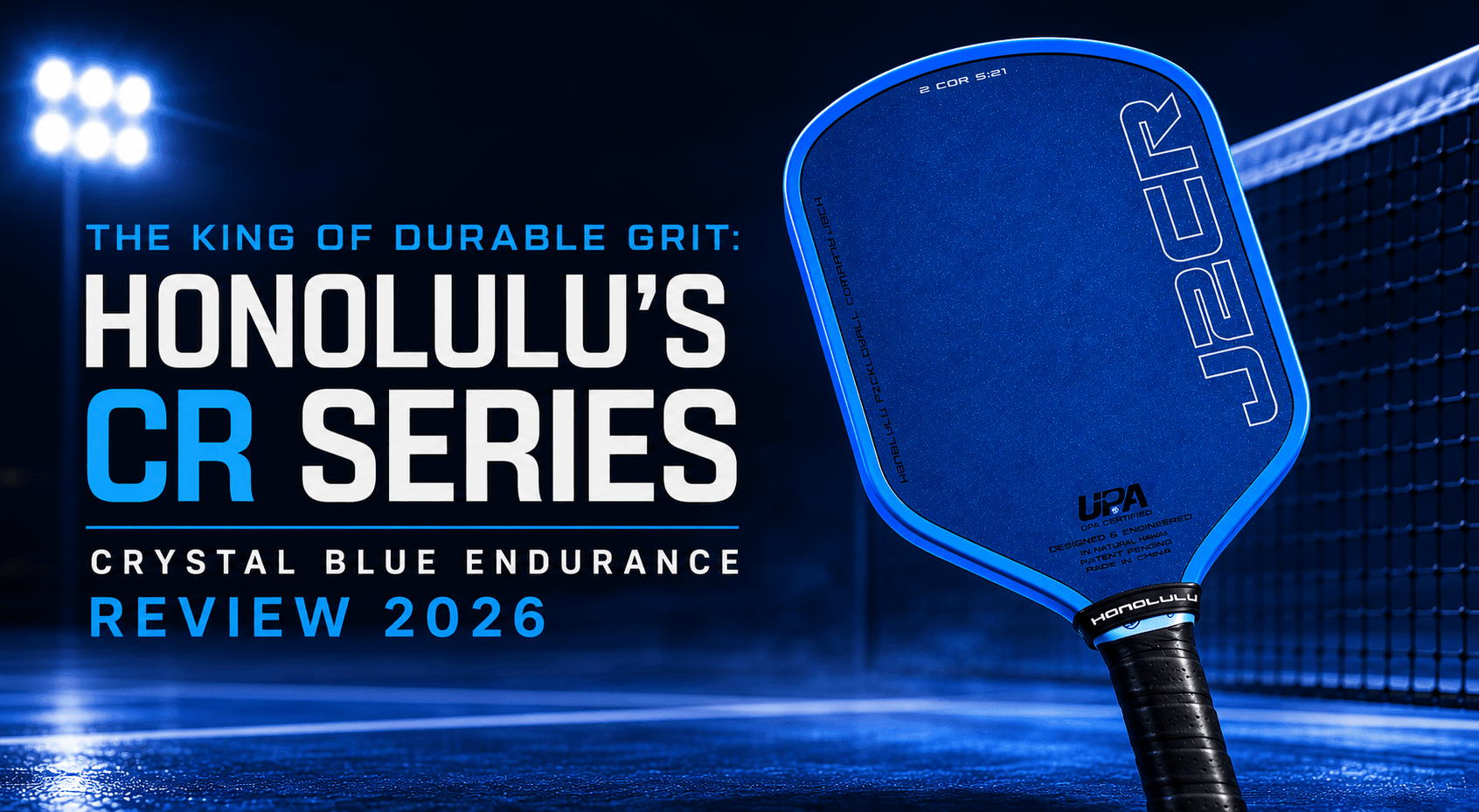
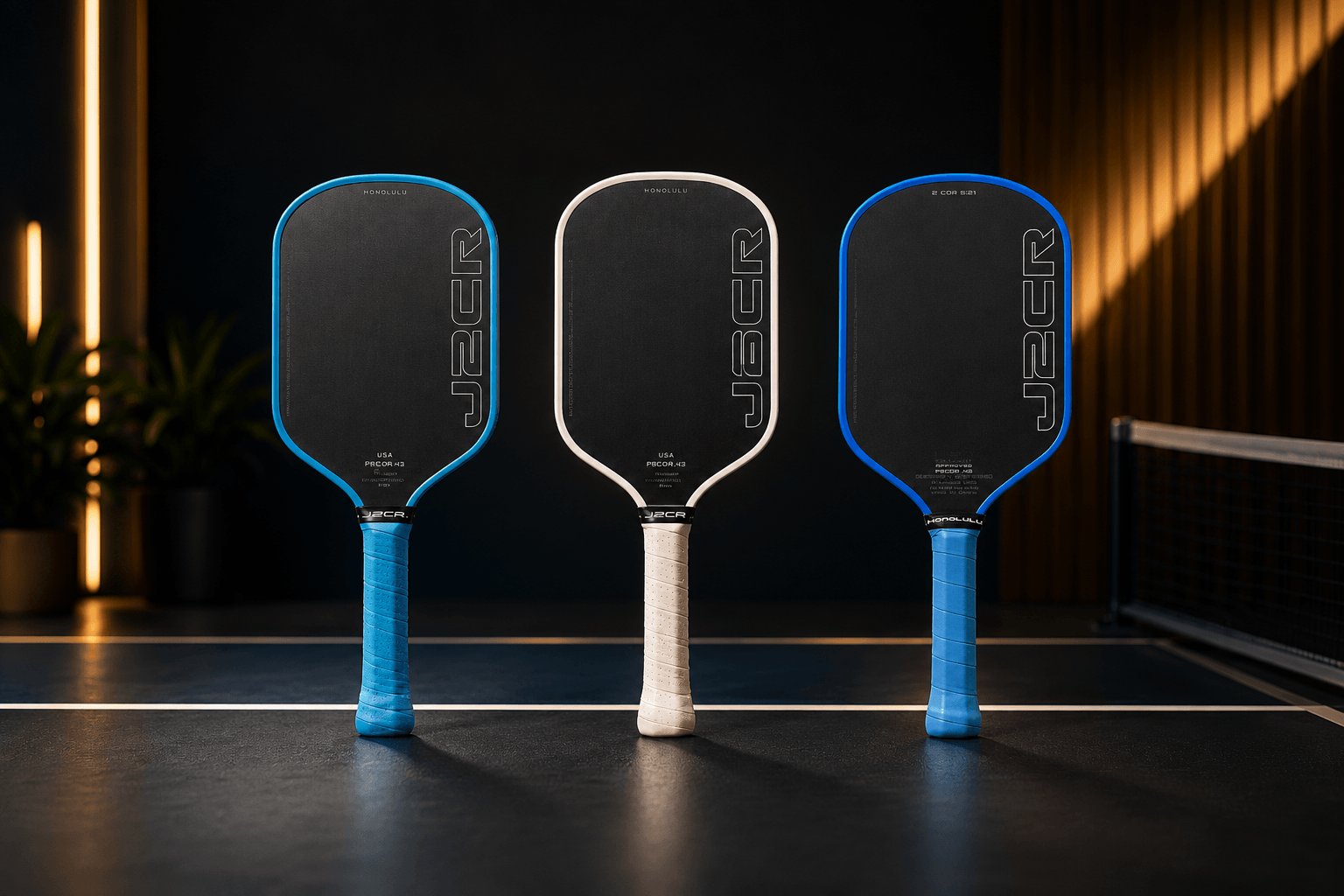
This Honolulu CR series review covers the Crystal Blue Endurance versions of the J2CR, J3CR, and J6CR — and answers the question every player is asking: did Honolulu finally fix the durable grit consistency issue?
Quick Verdict
The Crystal Blue Endurance versions of Honolulu's popular CR line all deliver the same elite performance we've come to expect from this lineup: controllable, accessible power with elite sweet spots across all shapes — rivaling the Gherkin Draco line — now with durable grit to keep spin performance consistent for longer than any raw carbon fiber surface.
I know anyone reading this Honolulu CR series review is going to wonder the same thing: did Honolulu solve the grit consistency issue that bigger reviewers like John Kew flagged? The honest answer is... maybe. Newer batches are clearly more consistent, but I personally had an original-batch J2CR standard handle that had noticeably inconsistent grit compared to my J3CR and J6CR units. More on that below — including how Honolulu handled it.
- Play Profile: Power lineup with elite sweet spots — closer to all-court than most high-firepower paddles, but still a power line at heart.
- Best For: Rec players and UPA-A tournament players who want durable grit and elite spin retention.
- The Catch: The Crystal Blue Endurance surface is UPA-A approved only — not USAP. Check with your tournament director before you compete.
What Is Crystal Blue Endurance Durable Grit?
If you've followed the durable grit conversation in 2026, you already know the appeal. Traditional raw carbon fiber surfaces generate great spin — but that grit wears down over time, and your spin performance drops with it. Durable grit surfaces like Honolulu's Crystal Blue Endurance are engineered to hold their texture far longer, keeping your spin consistent over months of heavy play.
The CR line — J3CR (Widebody), J2CR (Hybrid), and J6CR (Elongated) — is now available with this Crystal Blue Endurance surface. The play characteristics are identical to the standard raw carbon fiber versions. The only meaningful difference is the surface and, importantly, the certification. We'll get to that.
Technical Specifications
Every shape in this Honolulu CR series review shares the same Core Reactor Technology full-foam build, a ~8.1 oz average static weight, the Crystal Blue Endurance durable grit surface, and a $195 price tag.
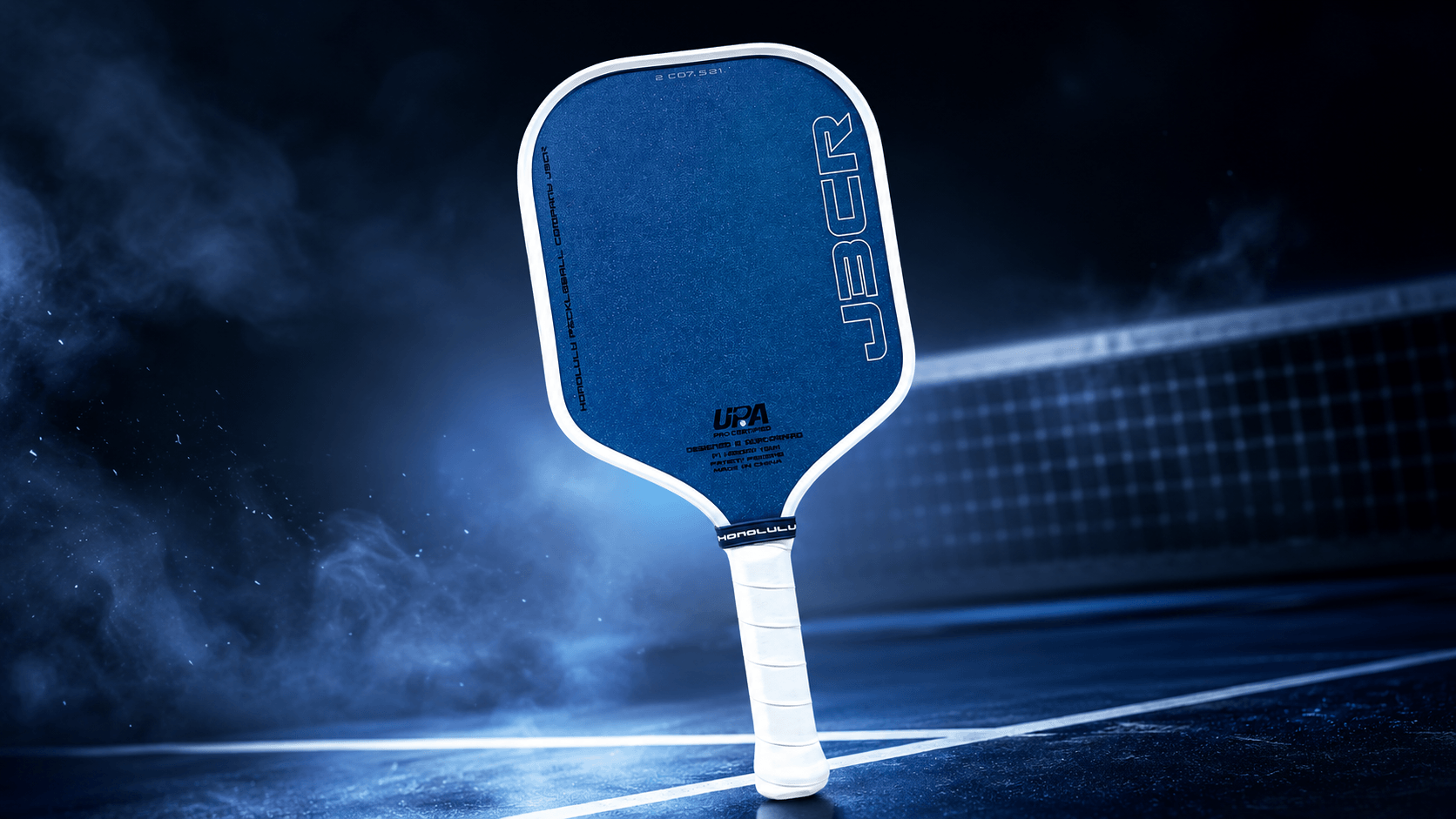
J3CR — Widebody
| Shape | Widebody |
| Length x Width | 16" x 8" |
| Static Weight | ~8.1 oz avg |
| Swing Weight | 108 avg |
| Twist Weight | 6.8–7.1 |
| Core | Core Reactor (Full Foam) |
| Surface | Crystal Blue Endurance Durable Grit |
| Certification | UPA-A |
| Price | $195 |
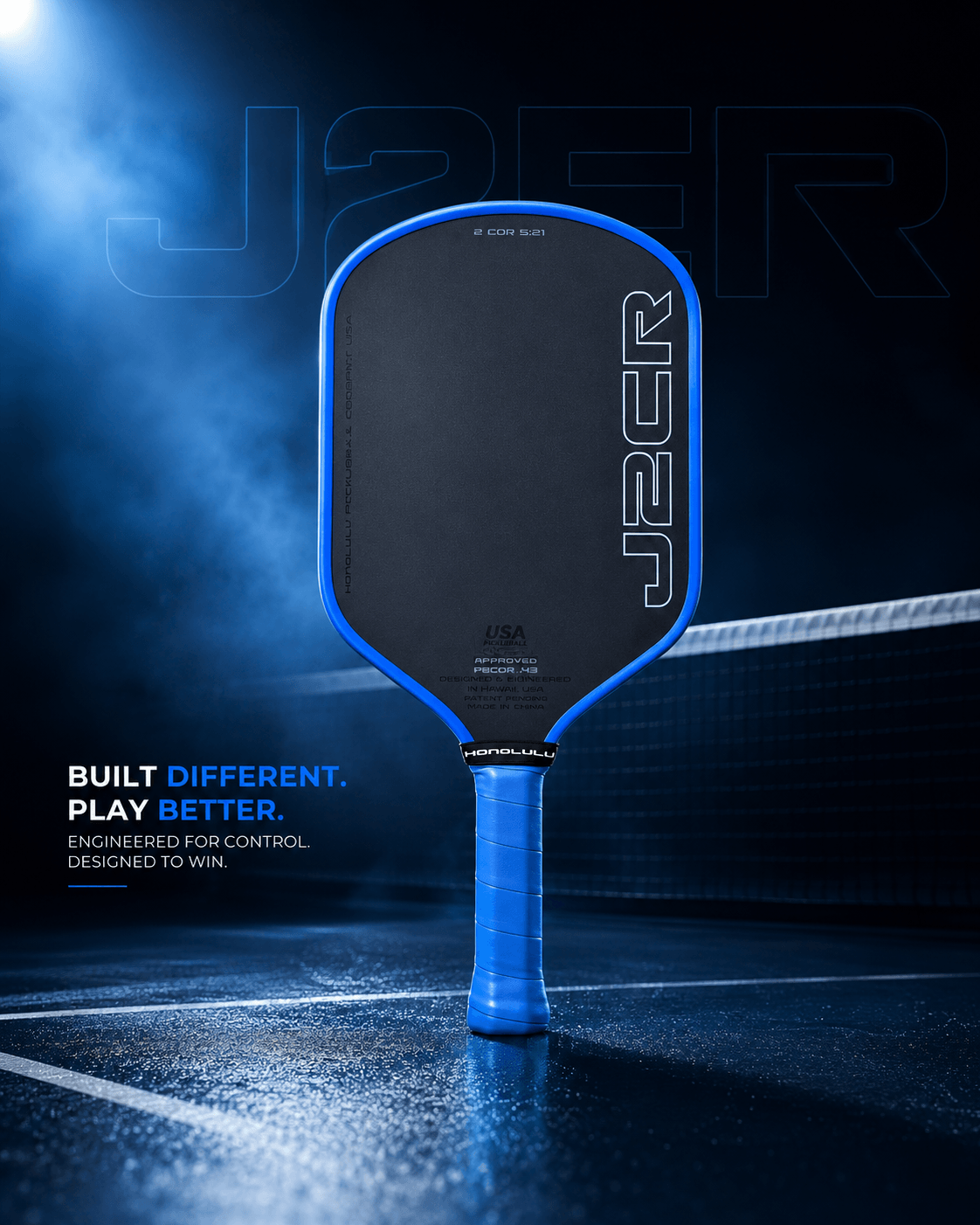
J2CR — Hybrid
| Shape | Hybrid |
| Length x Width | 16.2" x 7.8" |
| Handle Options | 5.5" standard or 6" long handle |
| Static Weight | ~8.1 oz avg |
| Swing Weight | 110 avg (both handles) |
| Twist Weight | 7.0 (5.5" handle) / 6.5 (6" handle) |
| Core | Core Reactor (Full Foam) |
| Surface | Crystal Blue Endurance Durable Grit |
| Certification | UPA-A |
| Price | $195 |
Note: The long handle version uses a sharper taper to achieve the added handle length.
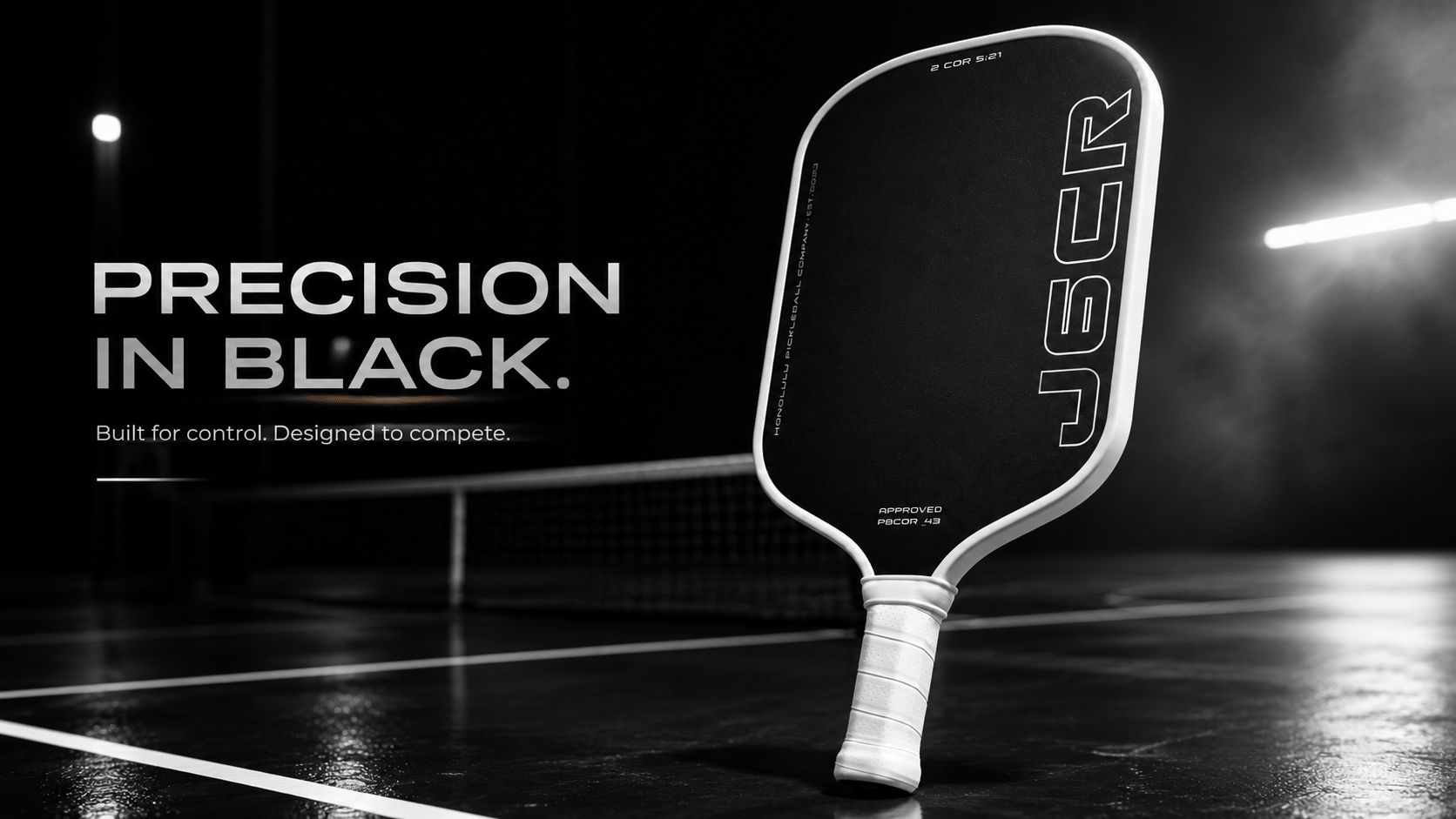
J6CR — Elongated
| Shape | Elongated |
| Length x Width | 16.48" x 7.52" |
| Handle Length | 6" |
| Static Weight | ~8.1 oz avg |
| Swing Weight | 112–118 avg |
| Twist Weight | 6.2–6.8 |
| Core | Core Reactor (Full Foam) |
| Surface | Crystal Blue Endurance Durable Grit |
| Certification | UPA-A |
| Price | $195 |
Power & Pop
The CR line follows the traditional shape pattern, exactly as you'd expect. The J6CR Elongated leads in raw power on full swings, the J3CR Widebody leads in pop and quick hands, and the J2CR Hybrid sits right in the middle.
Here's where this Honolulu CR series review gets interesting. I've been playing the Gherkin Draco line for months, and the Core Reactor full-foam build goes toe-to-toe with the Draco's NCP foam. Performance-wise, I genuinely can't say one edges the other — they're neck and neck.
But there is one difference worth calling out: the Core Reactor dwell is a touch higher than the NCP. The ball feels like it "sits" on the face for a hair longer, which let me shape shots with more confidence. It's subtle, but at a high level, that kind of thing matters.
But there is one difference worth calling out: the Core Reactor dwell is a touch higher than the NCP. The ball feels like it "sits" on the face for a hair longer, which let me shape shots with more confidence. It's subtle, but at a high level, that kind of thing matters.
The big takeaway from the power section of this Honolulu CR series review: this isn't a power lineup that hides behind specs. The pop is real, the drives have weight, and the put-aways finish points. What separates the CR line from the rest of the elite-power category is how naturally that power translates across all three shapes — the J3CR isn't just a "downgraded" J6CR, and the J2CR isn't a compromise. Each shape delivers its category leader's performance without forcing tradeoffs that show up on court.
Control & Soft Game
That extra dwell made the soft game noticeably easier to dial in for my game. Here's my proof: literally one session after receiving my J3CR, I entered and placed high in my first 4.5 tournament. Coming from my main — the Draco Widebody — that should tell you how smooth the adjustment was.
To be clear, the CR line is still a power lineup. But the massive sweet spots and the slightly stiff, hollow feel with good feedback make these easier to tame than truly elite-firepower paddles like the Draco and the Aireo Cyclone. So while the CR line is NOT an all-court line, it sits closer to that territory than most high-power options.
If you're coming from a softer or lower-pop paddle, you'll still have an adjustment period. But it's a friendlier on-ramp into power than most of the competition.
Sweet Spot & Shape Differences
This is where the CR line genuinely competes with the best on the market. At this point in my testing, I can't confidently say the sweet spots are any different from the Draco line — and that is a massive compliment to both companies. Right now, these are the two best sweet spots I've tested, period. And I'm referring to them stock, with no perimeter weight added.
The sweet spots follow the traditional shape pattern: the J3CR Widebody has the largest, the J6CR Elongated the smallest — but "smallest" here is relative. Even the elongated is impressively forgiving.
Real talk on my tournament run: I impulsively switched to the J3CR with less than two hours on it. It worked out because I'm a widebody guy and the line follows all the traditional shape patterns of power and pop. Coming from my higher-pop Draco W, the J3CR actually made tournament tightness easier to handle because I had less firepower to tame. My hands and dinking were the highlight of that day.
Feel & Construction
The CR line has a slightly stiff, hollow feel — one of the two dominant feel profiles in the market right now — and in my opinion it gives excellent feedback. You can really tell where you're hitting the ball on the face.
That's the argument for stiff/hollow over soft/dense. With muted paddles like the Six Zero Coral, the dampened feedback sometimes doesn't give you that same intuitive sense of contact. With the CR line, you always know where you caught it.
The feel is consistent across all three shapes. Sound-wise, the CR line sits at a higher pitch than the Draco lineup — I think that's a material difference more than anything. And as mentioned, the Core Reactor dwells slightly longer than the Draco's NCP foam.
Spin & The Durable Grit Truth
Let me clear up the biggest misconception about durable grit, because this matters for any Honolulu CR series review.
There's an important certification difference at play here. USAP currently uses a friction test for paddles, while UPA-A uses a pure RPM cap. What this means for you as a consumer: out of the box, and for the first month or so, a raw carbon fiber paddle should produce spin quite comparable to its durable grit counterpart.
Durable grit does NOT increase your top-end spin potential. It simply allows your spin performance to stay level for far longer than a raw carbon fiber surface, which wears down over time.
Here's my real-world data point: I've been playing the Draco's updated raw carbon surface for over two months now, and the spin generation is still comparable to the Crystal Blue Endurance surface. So the durable grit advantage isn't about more spin today — it's about the same spin six months from now.
That's the honest framing every Honolulu CR series review needs to land on, because the durable grit conversation has been oversold in 2026 marketing. The real value isn't immediate — it's longevity. If you play 4-5 times a week and put hundreds of hours on a paddle in a year, that compounding spin retention adds up to a meaningfully different paddle six months in. If you play once a week recreationally, you may not see the difference because the standard raw carbon version hasn't worn down yet. So the buying decision really comes down to: how often do you play, and how much do you value consistent spin a year from now?
The Catch: UPA-A Only Certification
Here's the thing you absolutely need to know before you buy: the Crystal Blue Endurance surface is UPA-A approved only. It is not USAP approved.
Let me break down what that means in practice.
If you play rec only, or your tournaments allow UPA-A paddles: Honestly, shopping for a paddle in 2026, I think most people will want a durable grit option. The spin retention is a real, tangible benefit and there's no reason not to take advantage of it.
If you compete in USAP-sanctioned tournaments: UPA-A paddles aren't technically legal, so I'd recommend sticking with the standard (non-durable-grit) versions of these paddles, which ARE USAP approved. Same elite performance, tournament-legal surface. For this Honolulu CR series review, though, I'm focusing specifically on the durable grit versions.
I'll add the same note I always do: I've personally seen USAP-sanctioned tournaments allow UPA-A paddles anyway. It's inconsistent. So if you plan to compete, check with your local tournament director before you buy.
On the grit consistency issue: As I mentioned, my original-batch J2CR had clearly inconsistent grit compared to my other units. Does that change my recommendation? Not at all — Honolulu's customer service was responsive and got me a replacement quickly. That said, I have not personally confirmed that newer batches have fully solved the consistency issue yet. I'm being upfront about that so you can make an informed decision.
Who Should Buy Each Shape?
Buy the J3CR (Widebody) if:
- You're a widebody player who wants the largest sweet spot in the lineup.
- You prioritize fast hands and pop at the kitchen.
- You want the most forgiving, learnable option in the CR line.
Buy the J2CR (Hybrid) if:
- You want the best of both worlds — balanced power, pop, and maneuverability.
- You want a handle choice: 5.5" standard for a more traditional feel, or 6" long handle for two-handed backhands and extra leverage.
Buy the J6CR (Elongated) if:
- You want the highest raw power on full swings and maximum reach at the baseline.
- You use a two-handed backhand and want the 6" handle.
- You're comfortable with a slightly higher swing weight for that plow-through.
Not sure which one? Go J2CR. If you're on the fence reading this Honolulu CR series review, my recommendation is the J2CR Hybrid in either handle length. The sweet spot and maneuverability sit in elite widebody territory, and you still get some of the reach you'd want from an elongated — the best of both worlds. It's also worth noting that the J2 shape as a whole has been one of the most popular shapes on the market, and arguably the best hybrid shape out there — only recently being challenged by the Kosmos flat-top hybrid shape. You're buying into a proven platform.
You might want to look elsewhere if you compete primarily in USAP-sanctioned events that don't allow UPA-A paddles — in which case grab the standard CR versions instead.
Related Spinwave Links
Want to explore more after this Honolulu CR series review?
- Shop all Honolulu paddles
- Shop Gherkin paddles (incl. Draco)
- Shop AIREO paddles
- Shop power pickleball paddles
- Shop all-court pickleball paddles
- Shop all pickleball paddles
- Get a free paddle consultation
- Read more paddle buying guides
- Read The Overgrip Bible
Final Verdict
If you're in the market for an elite-tier spin generation paddle with the massive sweet spots and controllable power that Honolulu has become famous for — pick the shape you're most comfortable with and enjoy great spin and performance for months to come.
Just make sure that if you plan to compete, you check with your local tournament directors about whether UPA-A only paddles are allowed.
The CR line with Crystal Blue Endurance is, in my testing for this Honolulu CR series review, a legitimate rival to the best power paddles on the market right now. The durable grit is the king of its category — as long as you understand the certification tradeoff going in.
Thanks for reading this Honolulu CR series review!
Pick yours up at Spinwave Pickleball. Have questions? Visit us in Great Neck or Long Beach, or book a free paddle consultation online.
FAQs
Spinwave
Spinwave